By Dr. Asnat Raziel, bariatric surgeon specializing in obesity treatment, metabolic health and healthy longevity; Director of the Multidisciplinary Center for Obesity Treatment, Assia Medical, Assuta Ramat HaChayal, Tel Aviv
Fatty liver tests: why “lose some weight” is no longer the whole answer
If an ultrasound has shown fat in your liver, you probably want to know which fatty liver tests come next and what your numbers actually mean. That is exactly what this guide covers, from the patient’s side of the desk. For years, doctors treated fatty liver as a side finding. It turned up on an ultrasound, and the visit usually ended with brief advice to lose weight.
Today the picture is completely different. We now understand that fatty liver is the local sign of a metabolic disorder that affects the whole body. In some patients it progresses to inflammation and scarring, and later to cirrhosis and other complications.
The good news is that there is now an orderly way to assess the risk. Sometimes four numbers from routine blood tests are enough. With them, we decide who needs follow-up only and who needs a test for fibrosis, meaning scarring in the liver. In the same way, we also identify who may be a candidate for drug treatment.
A new name, and a new way of looking at the disease
The accepted term today is MASLD, metabolic dysfunction-associated steatotic liver disease. The new name highlights the link between liver fat and obesity, diabetes and insulin resistance. It also highlights the link to high blood pressure and abnormal blood lipids. In addition, the new definition requires at least one cardiometabolic risk factor, rather than simply ruling out alcohol use.
According to the 2024 joint European guidelines from EASL, EASD and EASO, the disease is a continuum. It starts with fat building up in the liver and moves on to inflammation, called MASH. Later, fibrosis, cirrhosis and, in some cases, liver cancer may develop. That raises the question that really matters: what is happening to the liver underneath the fat, and has fibrosis already developed?
The first fatty liver tests: a metabolic checkup
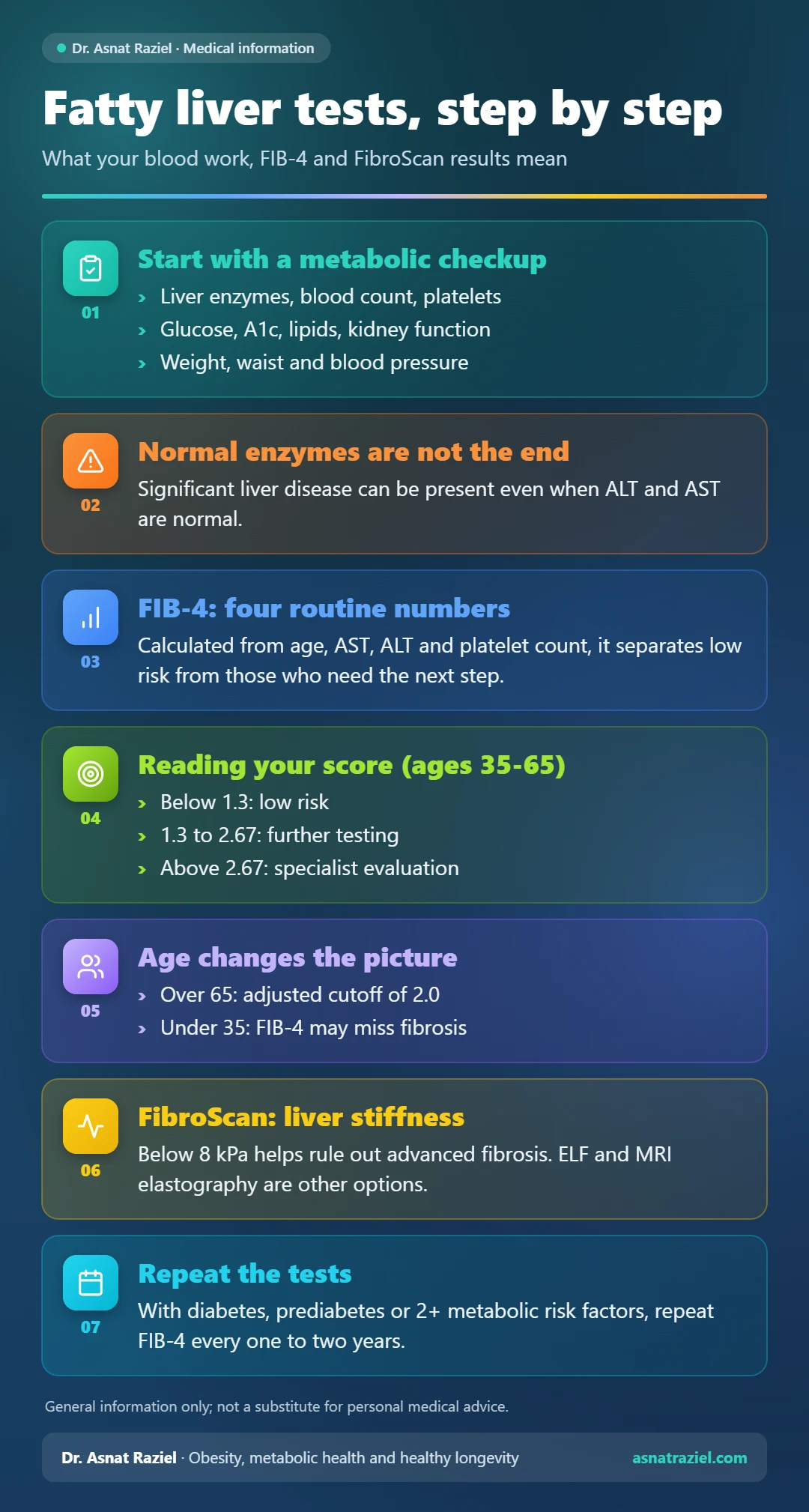
The workup starts with a wide-angle view. It is worth checking:
- Liver enzymes, a complete blood count and platelets.
- Glucose and hemoglobin A1c.
- A lipid profile and kidney function.
- Weight, waist circumference and blood pressure.
At the same time, we assess whether you have diabetes, prediabetes, abdominal obesity or abnormal blood lipids. One point is worth remembering. Even when liver enzymes are normal, significant liver disease can still be present. So the risk assessment does not end with a normal ALT or AST result.
FIB-4: the simple score behind your fatty liver tests
One of the most useful tools is the FIB-4 score. It is calculated from four values that almost always appear in your medical file: age, AST, ALT and platelet count. According to the American Association for the Study of Liver Diseases guidance (AASLD), it is the first-line score for screening for advanced fibrosis risk.
FIB-4 = (Age × AST) ÷ (Platelets × √ALT)
Age is in years, AST and ALT are in units per liter, and the platelet count is in thousands per microliter. For example, take a 55-year-old woman with an AST of 40, an ALT of 50 and a platelet count of 220,000. Her result is about 1.41. The score does not tell you how much fibrosis is in the liver. Instead, its job is to separate people at low risk from those who need the next step.
How to read your FIB-4 result
FIB-4 is usually the first number in your fatty liver tests that needs interpreting. Between the ages of 35 and 65, a value below 1.3 usually indicates a low risk of advanced fibrosis. A value of 1.3 to 2.67 is an intermediate zone and calls for further testing. By contrast, a value above 2.67 strongly raises the suspicion of advanced fibrosis. In that case, you need further evaluation, usually including a liver specialist.
Over age 65, the score tends to give false alarms. That is why many doctors use an adjusted cutoff of 2.0 instead of 1.3, as described in a review of the limitations of noninvasive tests. On the other hand, under age 35 the score is less accurate and may miss fibrosis. So when there is significant clinical suspicion, it is worth adding another test.
The next step: measuring liver stiffness
When the FIB-4 result is above the low-risk cutoff, the next step is another noninvasive test. One of the most common fatty liver tests at this stage is FibroScan. This is an elastography test, meaning a measurement of liver stiffness. The more scar tissue the liver has, the stiffer it usually is.
According to AASLD, a value below 8 kilopascals (kPa) helps rule out advanced fibrosis, especially after FIB-4. Higher values need to be interpreted in the clinical context and sometimes call for further workup. Other options include the ELF blood test and MRI elastography. When there is significant uncertainty, a liver biopsy may also be considered.
Questions to ask your doctor about fatty liver tests
Knowing the steps makes it easier to take part in the conversation about your fatty liver tests. Here are questions worth bringing to your next appointment, all based on the steps above:
- Has my FIB-4 score been calculated, and what was it?
- I am over 65. Was the adjusted cutoff of 2.0 used?
- I am under 35. Should we add another test, since FIB-4 may miss fibrosis?
- My liver enzymes are normal. Does that really rule out significant disease?
- Do I need a FibroScan, and what does my kPa reading mean?
- How often should we repeat the tests?
For a closer look at how clinicians structure this process, see my clinic protocol for fatty liver risk assessment in the new drug era.
Treatment starts with weight loss and goes well beyond it
After the fatty liver workup comes treatment. Weight loss is still one of the most powerful treatments for the disease. It helps to think of it in stages. First, losing about 5% of body weight already reduces the amount of fat in the liver. Second, 7% to 10% increases the chance of improvement in inflammation. Finally, 10% or more may also improve fibrosis in some patients. The goal is lasting weight loss while preserving muscle mass.
Physical activity is a treatment in its own right, even when your weight barely changes. The usual target is 150 to 300 minutes a week of moderate aerobic activity. In addition, two to three strength training sessions a week are recommended. This kind of activity improves insulin sensitivity and reduces visceral fat and liver fat. What is more, it protects muscle during rapid weight loss with medication.
When it comes to diet, the right choice is a Mediterranean eating pattern: vegetables, legumes, fish, olive oil, nuts, whole grains and high-quality protein. At the same time, it is worth cutting back on sugary drinks, added sugar, ultra-processed foods and refined carbohydrates. The goal is a way of eating you can stick with for years, not a short-term “liver diet.”
Treatment also targets blood sugar, lipids and blood pressure
Fatty liver is, to a large extent, a window into metabolic health. That is why a good fatty liver workup also checks the heart. Treatment also includes managing diabetes and prediabetes, treating high blood pressure and balancing blood lipids. Treating cardiovascular risk is especially important, because patients with fatty liver often have a high risk of heart disease. I wrote about this in my article on the cardiometabolic danger of fatty liver. In other words, treating the liver and treating the heart go hand in hand.
A new era: drugs that also treat the liver disease
In March 2024, the US Food and Drug Administration approved (FDA) resmetirom, marketed as Rezdiffra. The drug was approved for adults with MASH without cirrhosis and with moderate to advanced fibrosis (F2-F3), alongside diet and exercise. It works on the thyroid hormone receptor beta. In August 2025, resmetirom also received conditional approval in the European Union.
In August 2025, another important development followed. The FDA approved Wegovy, that is, semaglutide at a dose of 2.4 mg, for the same group of patients. Both approvals were granted under an accelerated pathway, and their continuation depends on confirming the benefit in follow-up studies. In the European Union, semaglutide for MASH was approved in March 2026 under a separate brand name, Kayshild, rather than as part of the Wegovy label. I cover this in more detail in my article on Wegovy and fatty liver.
What the ESSENCE trial showed
The approval was based on the first part of the ESSENCE trial, published in NEJM. The trial enrolled 1,197 patients with biopsy-confirmed MASH and stage 2 or 3 fibrosis. The interim analysis at week 72 included the first 800 patients. These were the findings:
- Resolution of liver inflammation without worsening of fibrosis: 62.9% with semaglutide versus 34.3% with placebo.
- Improvement in fibrosis without worsening of inflammation: 36.8% versus 22.4%.
- Average weight loss: 10.5% versus 2.0%.
- Digestive side effects were common in the semaglutide group.
The implications are especially broad for obesity medicine. A drug we came to know for its effects on weight, blood sugar and the heart has also become an approved treatment for advanced liver disease. Tirzepatide, the active ingredient in Mounjaro, has also been studied in this setting, and I wrote about it in my article on Mounjaro and MASH.
Alcohol and follow-up fatty liver tests
Alcohol intake is an important part of the conversation with every patient. The more advanced the liver disease, the more important it is to cut back substantially. For patients with advanced fibrosis, avoiding alcohol completely is recommended.
Even a patient with a low FIB-4 score needs repeat fatty liver tests, as long as the risk factors remain. According to AASLD, people with diabetes, prediabetes or at least two metabolic risk factors should repeat FIB-4 every one to two years. During follow-up, we check weight, waist circumference, blood pressure, blood sugar, lipids and liver enzymes.
The bottom line: the right tests turn a chance finding into a manageable disease
Fatty liver should no longer end with the sentence “you should lose some weight.” First, we assess metabolic risk. Second, we calculate FIB-4. Then, if needed, we move on to FibroScan or another test. Finally, we build a personal treatment plan that includes diet, physical activity, muscle preservation and treatment of risk factors, and in suitable cases, medication.
The great advantage of doing fatty liver tests in this order is early detection, at a stage when the course of the disease can still be changed. For a broader view, read the complete guide to diagnosing and treating fatty liver.
The information in this article is general and does not replace personal medical advice.
References
Potential Drawbacks of Noninvasive Diagnostic Methods for Nonalcoholic Fatty Liver Disease
FDA Approves First Treatment for Patients with Liver Scarring Due to Fatty Liver Disease
Rezdiffra – European Medicines Agency
Wegovy® approved in the US for the treatment of MASH
Phase 3 Trial of Semaglutide in Metabolic Dysfunction-Associated Steatohepatitis
The ESSENCE trial was funded by Novo Nordisk.