By Dr. Asnat Raziel, bariatric surgeon specializing in obesity treatment, metabolic health and healthy longevity; Director of the Multidisciplinary Center for Obesity Treatment, Assia Medical, Assuta Ramat HaChayal, Tel Aviv
Healthy aging: what do people really want?
Healthy aging matters to people far more than the dream of living to 120. That is the finding of a new survey of 1,000 Americans. Most respondents are not looking for extreme biohacking protocols, meaning efforts to upgrade the body with technology and self-experimentation. Instead, they want to stay healthy, clear-headed, strong and independent. They also want to truly enjoy the years that have been added to their lives.
The new goal: living well, not just living long
For years, the longevity world focused mainly on extending life. It talked about slowing the biological clock and about futuristic anti-aging technologies. However, the Longevity Insights Report survey by HEALTH shows a different set of priorities.
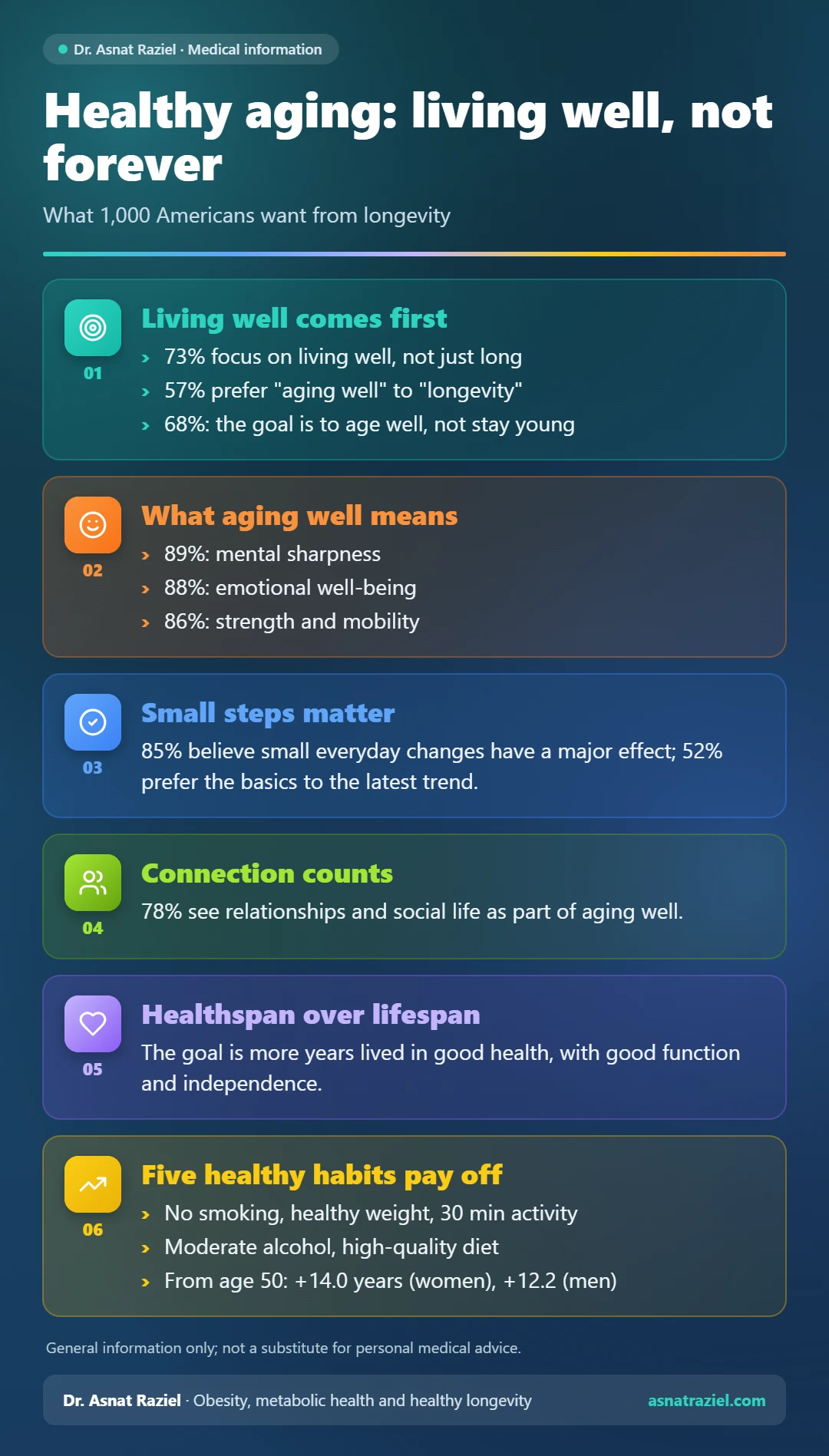
According to the survey, 73% of respondents prefer to focus on living well, not just on living long. Moreover, 57% preferred the phrase “aging well” to the word “longevity.” In addition, 68% said the goal of longevity is to age well, not to stay young. In other words, the question is no longer just “How many years will I live?” The new question is “How will I feel and function during those years?”
What does healthy aging mean?
The respondents described human, practical goals. According to a report on the survey, 89% said aging well means mental sharpness. Similarly, 88% mentioned emotional well-being, and 86% mentioned strength and mobility. Likewise, 86% want enough energy for the things they love.
In other words, lifespan, the number of years we live, is only part of the picture. The concept that really matters is healthspan: the number of years we live in good health, with good function and independence. Mayo Clinic also presented this concept this year in an article on rethinking aging. The article puts function, cognition and independence at the center.
The gap between the two is real. As Ynetnews reported, based on the Global Burden of Disease 2023 study in The Lancet Public Health, Israelis now spend 11.7 years of life in poor health, up from 9.8 years in 1990.
85% believe in small steps
The most surprising finding in the survey concerns lifestyle. In fact, 85% of respondents believe that small everyday changes have a major effect on healthy aging. In addition, 52% prefer to focus on the basics rather than chase the latest trend.
This is almost the opposite of the picture on social media. There, longevity looks like sophisticated tests, endless tracking, ice baths and piles of supplements. That said, the message is not that innovation doesn’t matter. On the contrary, the science in this field is moving very fast. But for most people, technology should serve life. It should not turn life into an endless optimization project. I wrote about the scientific side of this trend in my article on biohacking, NAD and peptides.
Health is much more than the absence of disease
Of the respondents, 89% said that avoiding serious illness is essential to aging well. Yet the survey revealed a much broader picture. Mental sharpness, emotional health, strength, mobility and independence received similar weight.
In addition, 78% saw relationships and social life as part of aging well. This is an important finding, because longevity is not just biology. Relationships, belonging, meaning and social engagement shape how we will live those extra years. I expanded on this in my article on social connections and longevity.
Appearance is still part of the picture, too. Overall, 61% said it is important to them to look good for their age. What’s more, 69% rejected the stereotype that older adults stop caring about grooming and fashion.
And what about the brain?
One of the strongest messages in the survey is the importance of brain health. For many people, memory, judgment and clarity matter no less than simply living longer. Sometimes they matter even more.
That is why longevity medicine is moving in a broader direction today. It is not only about preventing a heart attack or diabetes. Rather, it aims to preserve overall function: the brain, muscles, bones, mobility and metabolic health. Practical steps for protecting the brain appear in my article on dementia prevention.
Healthy aging instead of a war on age
For years, the term “anti-aging” grew into an entire industry. However, the survey suggests that the public is moving away from the idea of “defeating” age. The preference for the phrase “aging well” reflects a mature outlook. Aging is not a medical failure. The question is which changes we can delay, prevent or reduce. The World Health Organization, too, in its World report on ageing and health, defines healthy aging by the preservation of functional ability, and not merely by the absence of disease.
So it is worth asking a few simple questions. Are we strong? And do we walk briskly, climb stairs and keep our balance? It is also important to check whether our blood pressure, blood sugar and blood lipids are under control. In addition, we should ask whether we sleep well and maintain our muscle mass. Finally, are we socially active, and do we challenge our brain? A simple and interesting measure of body strength is described in my article on grip strength and life expectancy.
These are not modest goals. To a large extent, they are exactly the goals of modern longevity medicine.
The future: combining science and lifestyle
Science keeps moving forward. Researchers are studying drugs that act on the mechanisms of aging, senescent cells and epigenetic clocks. They are also developing personalized medicine and tools for measuring biological function. Even so, no breakthrough replaces the basics.
Aerobic exercise, strength training, high-quality nutrition and good sleep are the foundation. So are not smoking, treating risk factors, preventive screening and social connections. The data support this. A large Harvard study looked at five habits: not smoking, a healthy weight, 30 minutes of activity a day, moderate alcohol intake and a high-quality diet. Women who adopted all five could expect to live an average of 14.0 more years from age 50. For men, the difference was 12.2 years. You can read more about the role of exercise in my article on aerobic versus strength training.
You can think of these habits as compound interest. A single workout or a single meal will not change anything. But thousands of small decisions over the years will shape the person we become at 70, 80 and 90.
Bottom line on healthy aging
The survey shows that the pursuit of longevity is not a pursuit of eternal life. Most people want something tangible: more years of clear thinking, walking, exercising, working, traveling and family. They also want to keep making their own decisions. This is exactly the difference between lifespan and healthspan. Ultimately, the goal of healthy aging medicine is not just to add years to life. The goal is to add life to years. A broad look at the field appears in my article on longevity medicine and healthspan.
Governments are joining this race, too. I look at one example in my article on Russia’s national program against aging.
The information in this article is general and does not replace personal medical advice.
Questions and answers
What is the difference between lifespan and healthspan?
Lifespan is the total number of years we live. Healthspan, by contrast, is the number of years we live in good health, with good function and independence.
Do you need biohacking to extend your healthspan?
No. Physical activity, good nutrition, sleep and preserving muscle are still the most important tools. The same goes for controlling risk factors and maintaining social connections.
Is the goal to reach age 100?
Not necessarily. The important goal is to shorten, as much as possible, the years of illness, disability and loss of independence.
When should you start thinking about longevity?
Long before old age. Muscle mass, metabolic health, cardiorespiratory fitness and bone health are built over decades.
References
New survey reveals what Americans really want from longevity
New HEALTH Survey Finds Americans Don’t Just Want to Live Longer – They Want to Age Well
Rethinking aging: Why ‘healthspan’ matters as much as lifespan
World report on ageing and health
Impact of Healthy Lifestyle Factors on Life Expectancies in the US Population