By Dr. Asnat Raziel, bariatric surgeon specializing in obesity treatment, metabolic health and healthy longevity; Director of the Multidisciplinary Center for Obesity Treatment, Assia Medical, Assuta Ramat HaChayal, Tel Aviv
Anti-aging gene: what the researchers uncovered
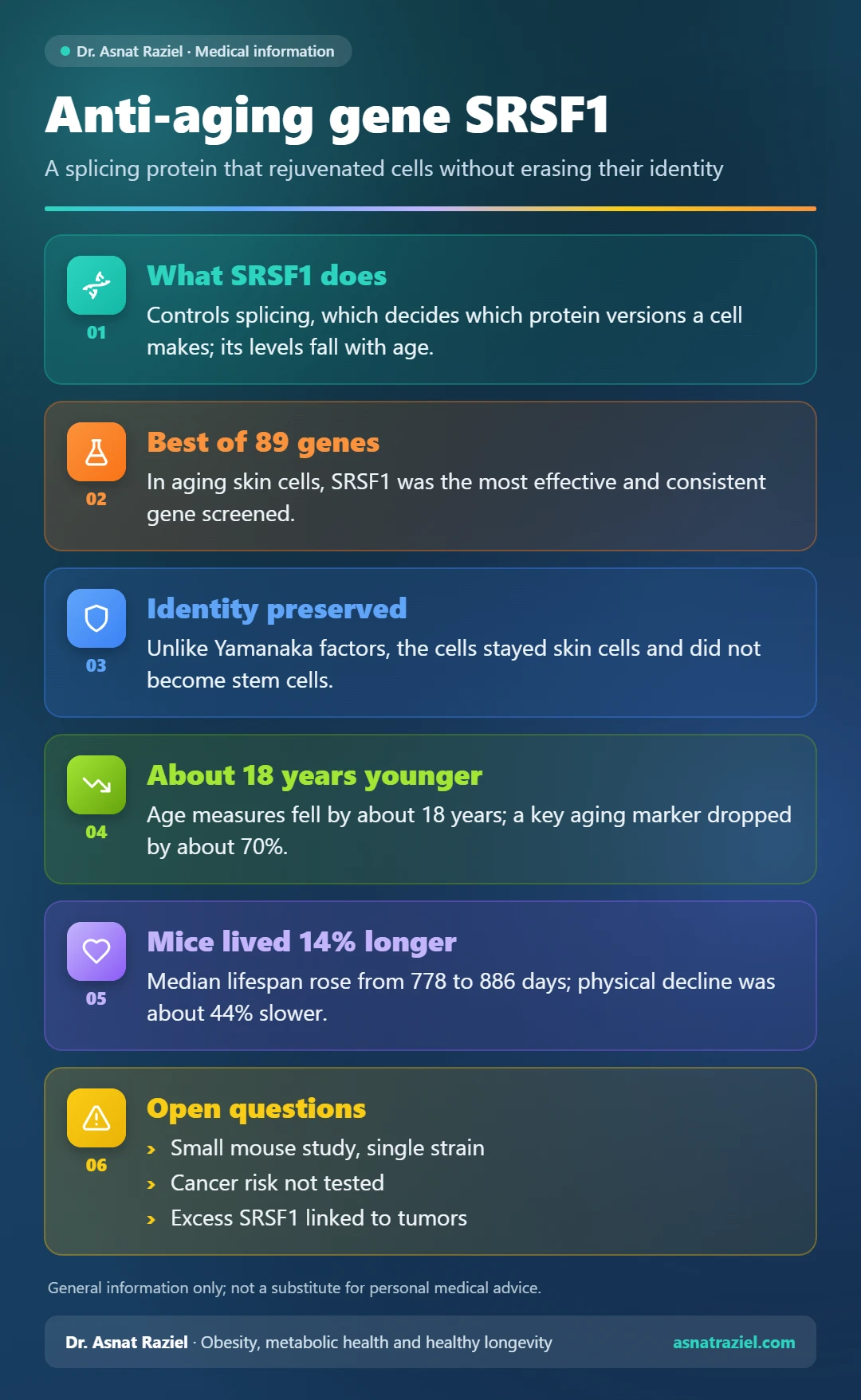
A new study has identified an anti-aging gene that can rejuvenate human cells. The gene, called SRSF1, was described in the journal Nature Aging. First, the researchers showed that switching it on turns back signs of age in skin cells. In addition, the cells kept their original identity and did not become stem cells. What’s more, in mice the treatment even extended lifespan. So this is a promising direction, but it is still far from use in people.
What is special about the SRSF1 protein?
SRSF1 is a protein that “edits” genetic information through a process called splicing, in which a gene’s instructions are cut and reassembled. In other words, it determines which versions of proteins the cell makes. With age, its levels in cells gradually decline. The researchers, led by a team at Harvard University, hypothesized that restoring its activity would rejuvenate the cell. They measured this with epigenetic clocks, tools that estimate biological age from changes in DNA.
How this anti-aging gene works
The team screened 89 different genes in aging skin cells. Of all of them, SRSF1 was the most effective and the most consistent. Unlike the well-known Yamanaka factors approach, this protein does not erase the cell’s identity. Yamanaka factors can turn mature cells into stem cells and may even raise the risk of tumors. Here, by contrast, the cells remained skin cells in every respect. In fact, this is the key difference that makes the approach so interesting. I describe another way to turn back the cellular clock in my article on reversing cellular aging.
Surprising results in cells and in mice
In the skin cells, age measures dropped by about 18 years, according to a computational model. In addition, a key marker of cellular aging fell by about 70%. For example, the cells also closed a lab “wound” faster than control cells. On the other hand, it is important to remember that these were cells in a lab dish, not living skin.
The mouse experiment was small but intriguing. Nineteen female mice received the gene therapy at an older age. As a result, median lifespan rose from 778 to 886 days, an increase of 14%. Moreover, physical decline progressed about 44% more slowly than in the control group.
An anti-aging gene, but with question marks
Despite the excitement, caution is needed. First, the mouse experiment included only a small number of animals, all from a single strain. In addition, the study did not look at cancer risk at all. In fact, earlier work has linked an excess of this protein to tumor development. That is why we need further studies that confirm both effectiveness and long-term safety.
On the broader question of genes and lifespan, a Weizmann Institute study reported by Ynetnews estimated that genetics accounts for about half of the variation in human lifespan. Still, lifestyle factors remain important.
The bottom line
An anti-aging gene like SRSF1 joins a series of fascinating discoveries in longevity medicine. Even so, the road to use in humans is still long. Meanwhile, I review other candidate compounds in my article on geroprotectors. Ultimately, this is another step toward understanding the mechanisms of aging and the link between genetics and longevity. Please note: the information in this article is general only and is not a substitute for personal medical advice.
Sources
Transcriptomic reprogramming screen identifies SRSF1 as a regulator of aging
Reversing age by reprogramming gene expression networks
Novel gene rejuvenation therapy preserves cell identity while reversing age