By Dr. Asnat Raziel, bariatric surgeon specializing in obesity treatment, metabolic health and healthy longevity; Director of the Multidisciplinary Center for Obesity Treatment, Assia Medical, Assuta Ramat HaChayal, Tel Aviv
Reversing cellular aging: a lab breakthrough
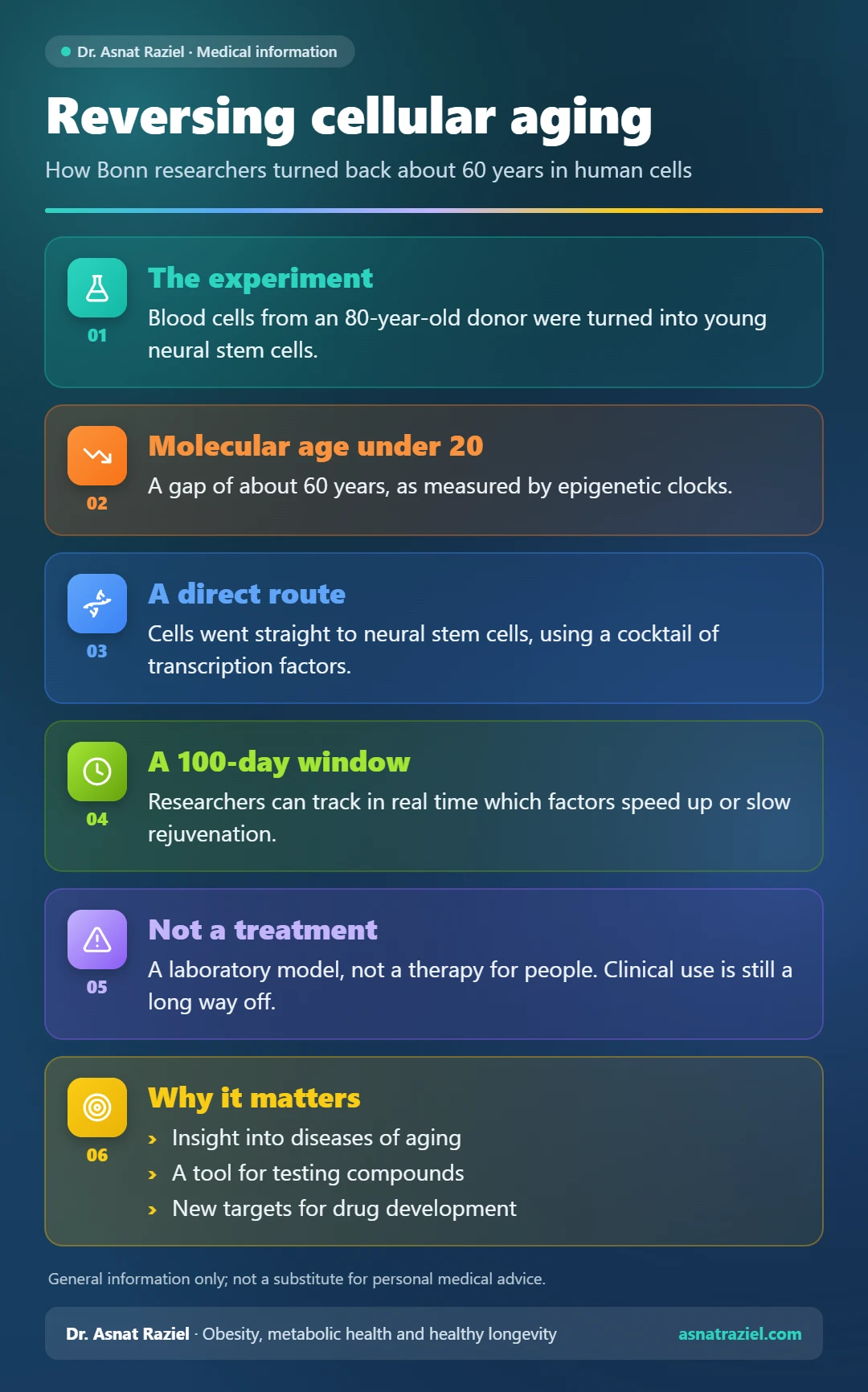
Reversing cellular aging sounds like science fiction, but researchers at the University of Bonn in Germany have demonstrated it in human cells. They took blood cells from an 80-year-old donor and turned them into young neural stem cells. The molecular age of the cells dropped to under 20. That is a huge gap of about 60 years. For a related study, see my article on epigenetic rejuvenation of very old blood cells.
How reversing cellular aging works in the lab
The team, led by Prof. Oliver Brüstle, used a direct and clever method. Instead of taking the cells all the way back to an embryonic-like state, they converted them directly into neural stem cells. To do this, they used a “cocktail” of transcription factors. The process reset the epigenetic clocks, the measures that track a cell’s biological age.
Why is this so exciting?
First, it clearly shows that the age of human cells can be reset. In addition, the direct method opens a window of about 100 days for tracking the rejuvenation. This means researchers can watch in real time which factors speed up rejuvenation and which slow it down. That makes the method a valuable research tool. For another angle on cell renewal, see my article on the anti-aging gene SRSF1.
Keeping it in perspective
Still, this is not a treatment. The researchers stress that it is a laboratory model, not a therapy for people. On the other hand, understanding how to reset cellular age may one day advance treatments for diseases of aging. Degenerative brain diseases are one example. The model also makes it possible to test different compounds and factors and see which ones speed up rejuvenation. This could help identify new targets for drug development. Even so, the road to clinical use is still long.
An NIA overview of the epigenetics of aging makes a similar point: most reprogramming work has been tested only in cells or animals and is not approved for people.
Israeli labs are working on related questions. For example, Ynetnews reported on a Bar-Ilan University study in which boosting the protein SIRT6 in old mice shifted DNA packaging in liver cells back toward a youthful pattern. However, that work has not yet been tested in humans.
The bottom line
In short, the study reinforces a central idea in the science of aging: biological age is not destiny. You can read more about this idea in my articles on healthspan and longevity medicine, on biological aging clocks, and on biohacking and the fountain of youth. Ultimately, the deeper we understand the mechanisms of renewal, the closer we will get to medicine that treats the root causes of aging.
The information in this article is general and does not constitute personal medical advice.
References
Rejuvenation breakthrough: Scientists reverse 60 years of aging in human cells