By Dr. Asnat Raziel, bariatric surgeon specializing in obesity treatment, metabolic health and healthy longevity; Director of the Multidisciplinary Center for Obesity Treatment, Assia Medical, Assuta Ramat HaChayal, Tel Aviv
Senolytic cream: what’s new in the research
A new experimental senolytic cream has shown an intriguing result: a drop of about two years in “skin age.” The American company Rubedo presented the data on its product, RLS-1496. First, the cream targets aging cells known as senescent cells. In addition, researchers tested it in people with eczema. However, this is a very early trial, and no peer-reviewed journal has published the results yet.
What are senescent cells, and why do they matter?
Senescent cells are old cells that have stopped dividing but do not die. In other words, they stay in the tissue and keep releasing substances that promote inflammation. In fact, their buildup plays a part in many aging processes. That is why scientists are looking for ways to clear them out or neutralize them. One approach is senolytic drugs, which researchers are already testing in other settings such as fatty liver.
Back in 2011, a National Institute on Aging report described how removing these cells in mice delayed age-related changes in fat, muscle and eye tissue.
Since then, the research has moved forward. In aged mice, Mayo Clinic’s recent studies of senescent zombie cells found that senolytic drugs reduced inflammation and improved frailty. However, that work is still preclinical.
How a senolytic cream works
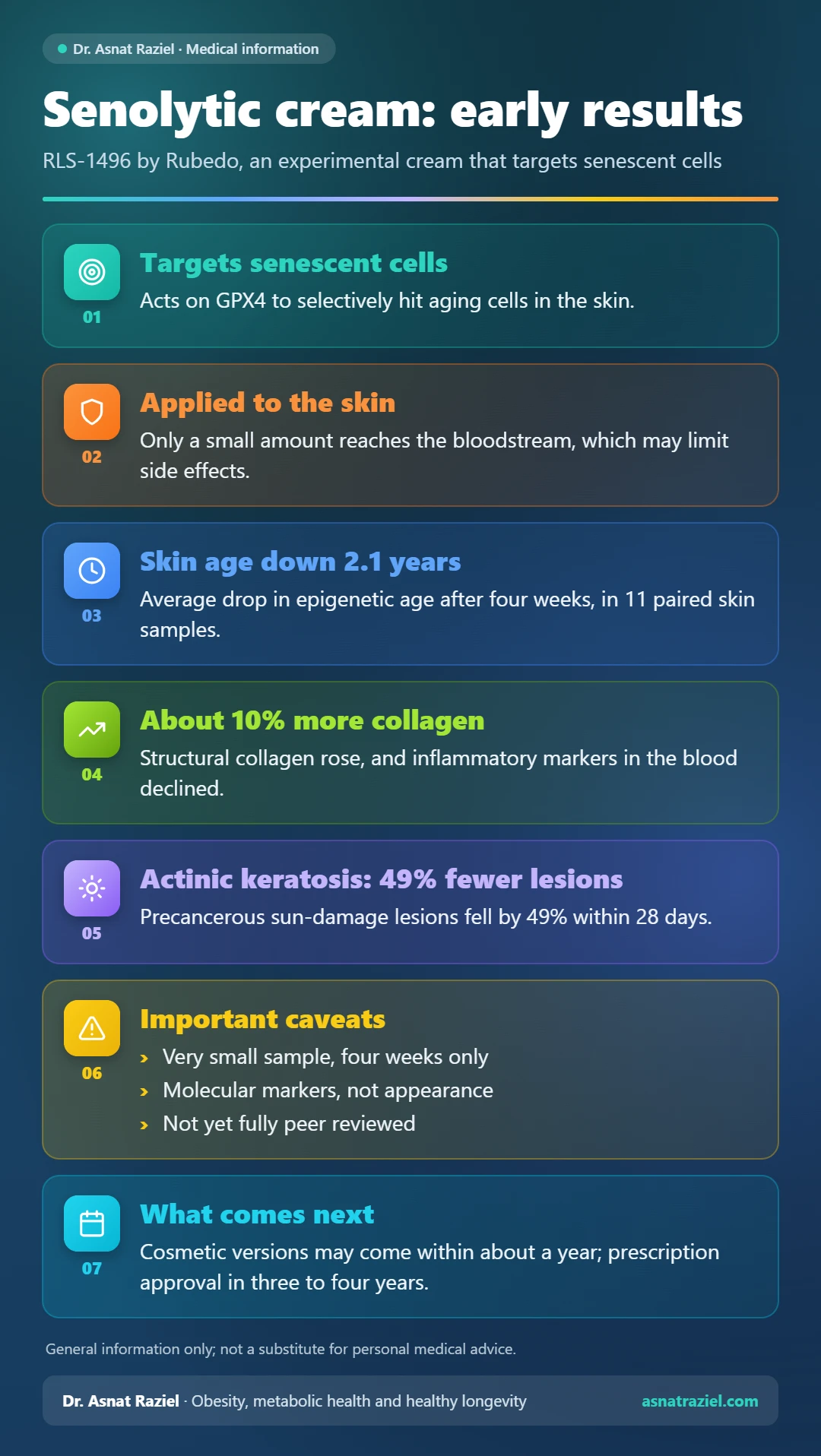
RLS-1496 targets a protein called GPX4. Through it, the product selectively hits the senescent cells in the skin. Moreover, because patients apply it to the skin, only a small amount reaches the bloodstream. In this way, the researchers hope to limit side effects. Overall, this is one of the first senolytic creams that researchers have tested in humans.
What the trial found
The trial included patients with eczema, also known as atopic dermatitis. In 11 paired skin samples, the skin’s epigenetic age dropped by an average of 2.1 years after four weeks. In addition, the researchers measured an increase of about 10% in a structural collagen. Inflammatory markers in the blood also declined. In a separate study in patients with actinic keratosis, precancerous lesions caused by sun damage to the skin, lesions decreased by 49% within 28 days.
Senolytic cream: important caveats
Despite the promise, it is important to keep things in proportion. First, a sample of 11 skin samples is very small. In addition, follow-up lasted only four weeks. The study also measured molecular markers, not how the skin actually looks or functions. Finally, the company presented the data at a conference, and the findings have not yet gone through full peer review.
The bottom line
A senolytic cream is an intriguing direction in skin aging and longevity medicine. According to the company, cosmetic versions may reach the market within about a year. By contrast, the company expects approval as a prescription product only in three to four years. In the meantime, it makes sense to view these results with both caution and curiosity. Please note: the information in this article is general only and is not a substitute for personal medical advice.
Sources
Experimental skin cream linked to 2-year drop in biological age in early study