By Dr. Asnat Raziel, bariatric surgeon specializing in obesity treatment, metabolic health and healthy longevity; Director of the Multidisciplinary Center for Obesity Treatment, Assia Medical, Assuta Ramat HaChayal, Tel Aviv
Epigenetic rejuvenation: what the researchers found
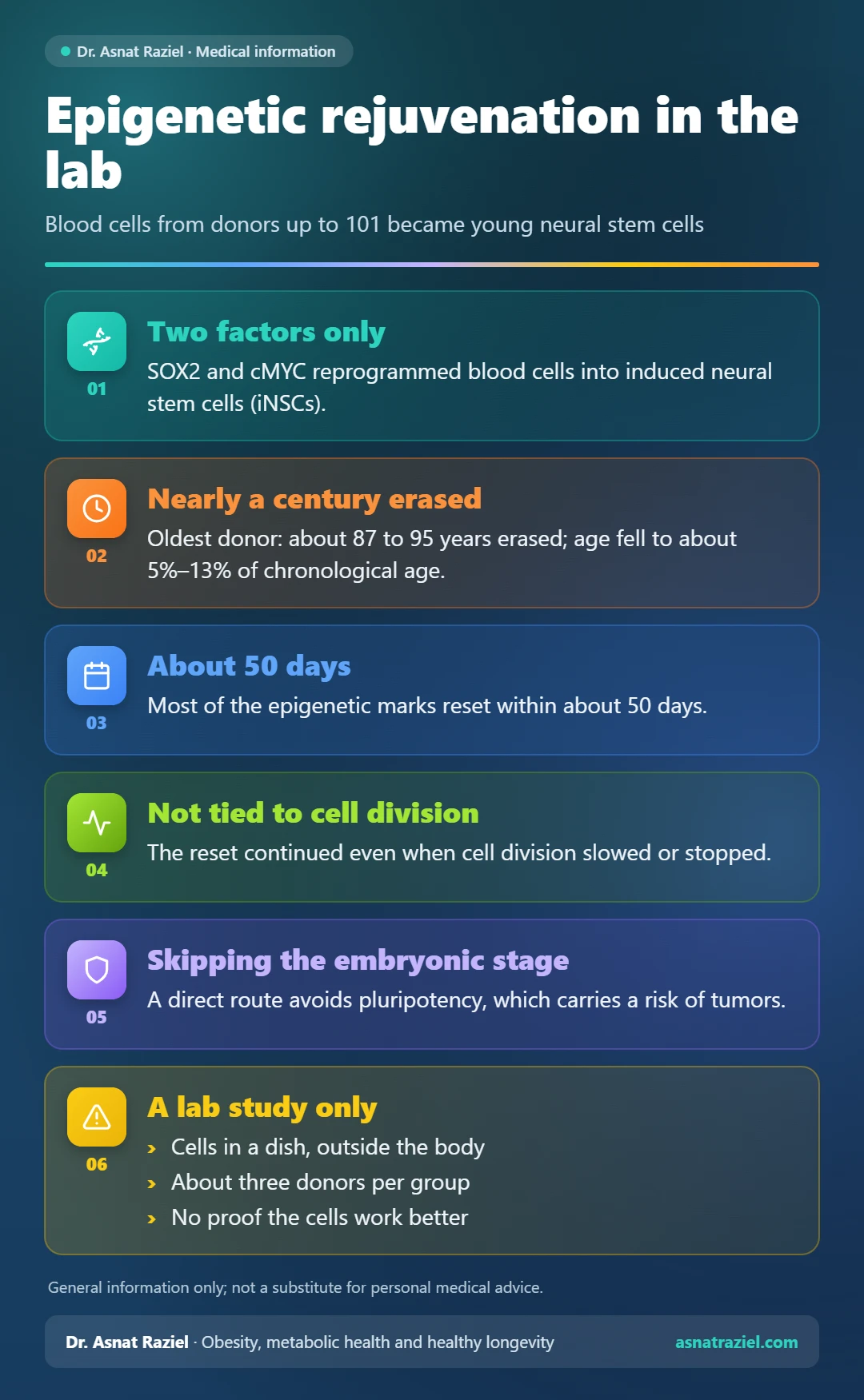
Researchers recently achieved a dramatic epigenetic rejuvenation in the lab. Blood cells from donors as old as 101 “went back in time” by almost a century. A team at the University of Bonn in Germany turned these blood cells into neural stem cells. First, the cells’ biological age dropped sharply. In addition, most of the change happened within about 50 days. However, this is a lab study only, and it is still far from any use in people.
How do you turn blood cells into brain cells?
The researchers used just two regulatory factors, SOX2 and cMYC. With them, they “reprogrammed” the blood cells into induced neural stem cells (iNSCs). In other words, a mature cell took on an entirely new identity. This approach recalls the principle behind the Yamanaka factors, but with fewer ingredients. For a different approach to rejuvenating cells, see my article on the SRSF1 gene.
What makes this epigenetic rejuvenation special
The team measured cellular age with epigenetic clocks, which read chemical marks on DNA. In the oldest donor, roughly 87 to 95 years simply “disappeared.” In fact, the cells’ age fell to only about 5% to 13% of the donor’s chronological age. Moreover, most of the marks reset within about 50 days, which is relatively fast compared with other methods. For more on this research field, see my article on reversing cellular aging.
Epigenetic clocks are also moving toward the clinic. Ynetnews described a blood test that estimates biological age from DNA methylation, published in Nature Aging.
The surprise: it does not depend on cell division
Until now, many scientists believed that rejuvenation comes from “diluting” these marks as cells divide. Here, however, the process continued even when cell division slowed down or stopped. Therefore, the finding challenges the accepted explanation. In other words, an independent reset mechanism, one that does not rely on division, may be at work.
Epigenetic rejuvenation, but only in the lab
It is very important to keep things in proportion. First, the researchers ran the experiment on cells outside the body, in a lab dish. In addition, the sample was small, with about three donors in each group. The team also engineered the cells genetically, using viruses. Finally, the study did not show that the “young” cells actually work better.
Why skip the embryonic stage?
Until now, most experiments have taken cells all the way back to an embryonic-like state. This stage is called pluripotency, and it carries a risk of tumor formation. By contrast, the Bonn team chose a direct route. The researchers took red blood cell precursors and converted them straight into neural stem cells. Because they skipped the embryonic stage, they hope the process will prove safer. The team worked together with RWTH Aachen University, and the study appeared in the journal Aging Cell.
Epigenetic rejuvenation: what does it mean for research?
First, young neural stem cells are a valuable research tool. With them, scientists can study how cells age and renew themselves. In addition, they may help researchers study neurodegenerative diseases such as Alzheimer’s. Moreover, they open the door to new studies in regenerative medicine. Meanwhile, the proven ways to slow aging remain a healthy lifestyle and longevity medicine.
The bottom line
This kind of epigenetic rejuvenation is a fascinating proof of concept for the science of aging and for longevity medicine. It hints that the biological clock may be more flexible than we thought. Still, the road to use in humans remains very long. Ultimately, every step like this deepens our understanding of how we age. Please note: the information in this article is general only and is not a substitute for personal medical advice.
Sources
Bonn researchers successfully rejuvenate human cells in a test tube
Researchers transform old blood cells into young brain cells
Rejuvenation breakthrough: Scientists reverse 60 years of aging in human cells