By Dr. Asnat Raziel, bariatric surgeon specializing in obesity treatment, metabolic health and healthy longevity; Director of the Multidisciplinary Center for Obesity Treatment, Assia Medical, Assuta Ramat HaChayal, Tel Aviv
Airlines discover the power of weight-loss drugs
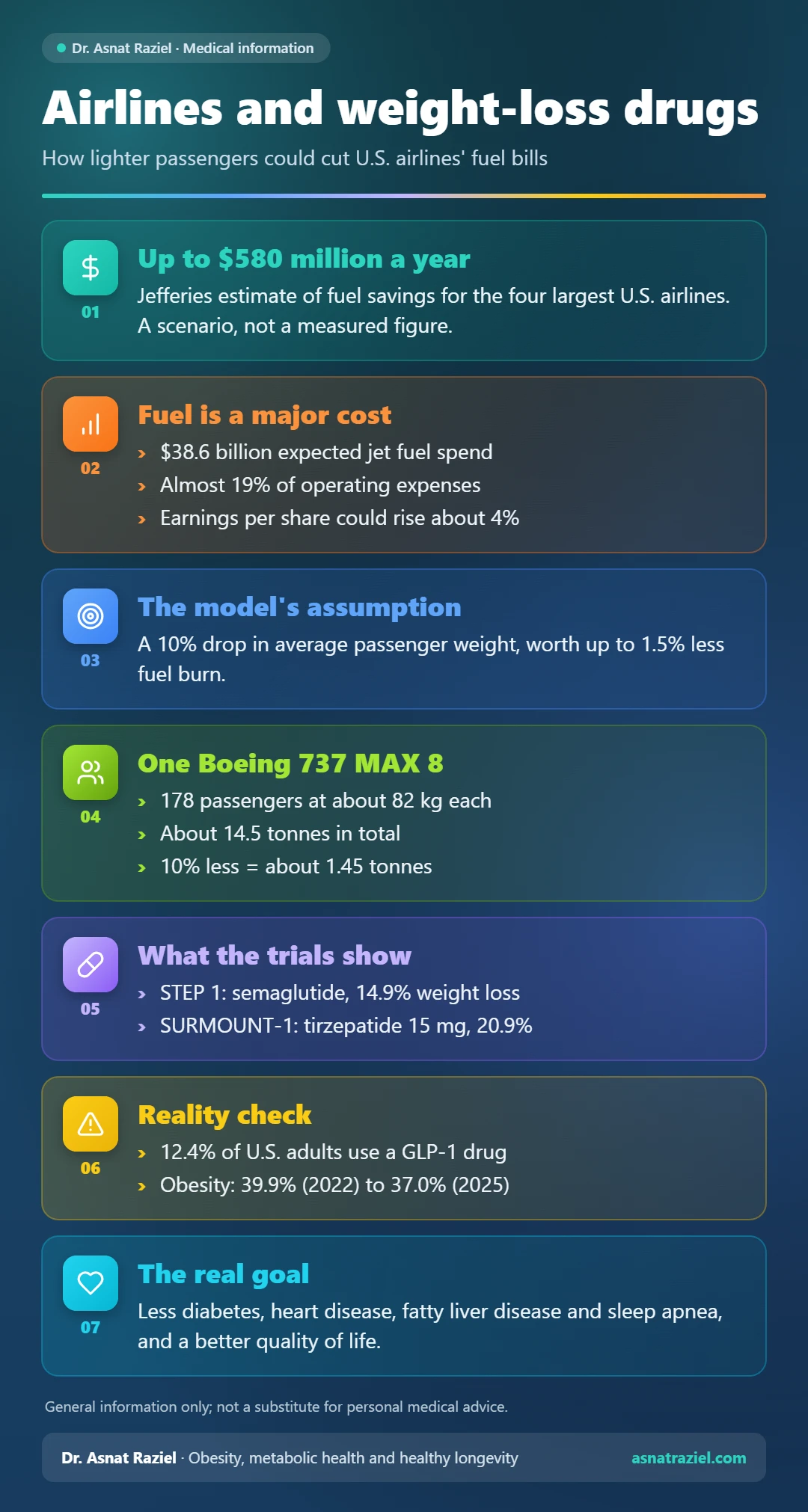
The link between airlines and weight-loss drugs may sound surprising. Yet the largest U.S. carriers could save hundreds of millions of dollars thanks to these medications. Satiety-hormone drugs, known as GLP-1 agonists from the incretin family, are already a key tool for weight loss. They also lower the risk of metabolic disease. Now it turns out that their impact goes well beyond personal health. According to an analysis by the investment bank Jefferies, lighter passengers could save the four biggest U.S. airlines up to $580 million a year in fuel. However, let me be precise from the start: this is an economic estimate based on a scenario. It is not a savings figure that anyone has actually measured.
What the analysis actually claims
Jefferies analysts published the analysis in January 2026, and Fox Business covered it in detail. One of the authors, analyst Sheila Kahyaoglu, told The New York Times that it makes sense for passenger weight to affect costs as well. The airlines in the analysis were American Airlines, Delta, United and Southwest.
According to Business Traveller, the four carriers are expected to spend a combined $38.6 billion on jet fuel. Fuel makes up almost 19% of their total operating expenses. As a result, even a small drop in fuel use is worth a lot of money. In addition, Business Today, citing Bloomberg, reported that the savings could lift earnings per share by about 4%.
The math: from passenger kilograms to jet fuel
The model assumes a 10% drop in the average passenger’s weight. For example, a Boeing 737 MAX 8 in a standard configuration carries 178 passengers. At an average of about 82 kg per passenger, they weigh roughly 14.5 tonnes together. A 10% reduction saves about 1.45 tonnes. That is about 2% of the plane’s maximum takeoff weight.
According to the analysts, a reduction like this translates into up to 1.5% less fuel burn. The number sounds small. But when you multiply it across thousands of flights a day, the savings add up to hundreds of millions of dollars. Indeed, 1.5% of $38.6 billion is about $580 million. That is why analysts started looking at airlines and weight-loss drugs together. The analysts also noted that the calculation does not include lost revenue from in-flight snack and food sales.
Before weight-loss drugs: airlines and their long history of cutting weight
Airlines have always counted every gram. The Jefferies report noted with some humor that they have cut weight everywhere, from pitted olives to thinner paper. Until now, however, the weight of the passengers themselves was beyond their control.
To work out how much fuel to load, airlines use a standard average weight per passenger. In the Federal Aviation Administration (FAA) guidance, these values are based on U.S. national health surveys, plus an allowance for clothing. The guidance also lets an airline run its own survey if the standard average does not represent its passengers. In other words, a real change in population weight would gradually filter into these tables too.
Is a 10% drop in passenger weight realistic?
Here we need to separate the individual patient from the population as a whole. For someone on treatment, losing 10% or more is entirely possible. In the STEP 1 trial, people taking semaglutide lost 14.9% of their body weight on average. In the SURMOUNT-1 trial, tirzepatide at 15 mg led to a 20.9% reduction.
On the other hand, most passengers do not take these drugs. According to a Gallup survey published in October 2025, 12.4% of U.S. adults take a GLP-1 drug for weight loss. In the same survey, the obesity rate fell from 39.9% in 2022 to 37.0% in 2025. In other words, for airlines, weight-loss drugs would make a real difference only with far wider use. Therefore, a 10% drop in the average weight of all passengers is an optimistic future scenario, not today’s reality.
How satiety-hormone drugs work
These medications act on the satiety pathways in the brain and the digestive system. They slow stomach emptying, increase the feeling of fullness and reduce appetite. The result is sustained weight loss, better metabolic markers and a lower risk of chronic disease. A full explanation appears in my article on how obesity medication works. In addition, the arrival of the Wegovy pill on the market in early 2026 is expected to widen the circle of patients.
Airlines and weight-loss drugs: just one example of the ripple effect
The airline story shows how public health connects fields that seem far apart. Here, obesity medicine, energy and aviation meet at a single point. Other industries are already feeling the change as well. For example, the food industry is adapting its products to consumers who eat less. Likewise, the obesity drug market itself has become one of the biggest economic engines in the world.
What this story teaches us about obesity as a disease
Beyond the business headlines, the analysis is a reminder of an important medical fact. Obesity is a disease that affects millions of people, so treating it has a broad impact too. When a large part of the population is on treatment, the effect is felt in the health system, the labor market and even in the sky. Still, the goal of treatment is not to save fuel. The goal is to reduce diabetes, heart disease, fatty liver disease and sleep apnea, and to improve quality of life.
It is also important to remember that people respond to these drugs differently. Some patients lose a lot of weight, while others lose only a little. That is why treatment should be personalized, with medical follow-up, good nutrition and physical activity. For a broader look at global trends, see my article on obesity around the world.
Airlines, weight-loss drugs and the bottom line
Satiety-hormone drugs are no longer just a personal treatment for people with obesity or diabetes. They show how a physiological change across a population could affect complex economic systems. That said, the $580 million figure is an analyst estimate, not a measured number. In the end, the true value of weight-loss drugs is measured in patients’ health, not on airlines’ balance sheets.
The information in this article is general and does not replace personal medical advice.
References
Airlines have 580 million reasons to like GLP-1 weight-loss drugs, analysis finds
Could Weight Loss Drugs Change Airline Economics?
Lighter flyers, lower fuel burn: Weight-loss drugs may cut US airline fuel bills by $580 million
Obesity Rate Declining in U.S.
Aircraft Weight and Balance Control (AC 120-27F)
Once-Weekly Semaglutide in Adults with Overweight or Obesity