By Dr. Asnat Raziel, bariatric surgeon specializing in obesity treatment, metabolic health and healthy longevity; Director of the Multidisciplinary Center for Obesity Treatment, Assia Medical, Assuta Ramat HaChayal, Tel Aviv
GLP-1 and the food industry: not just a medical revolution
The link between GLP-1 and the food industry has become one of the hottest topics in the business world over the past year. Drugs such as Ozempic and Wegovy (semaglutide), and Mounjaro (tirzepatide), which acts on two hormones, change how hungry we feel. They also change taste preferences and how much we eat. When millions of people eat less, and especially fewer sweet and fatty snacks, food companies feel it at the register. That is why they are adapting their products, portion sizes and marketing.
Fewer snacks, a shift toward protein and smaller portions, and “GLP-1 friendly” labels are no longer a passing trend. They are a strategy. So what do the data on GLP-1 and the food industry show, and what will supermarket shelves look like in the coming years?
What happens to the shopping cart of GLP-1 users
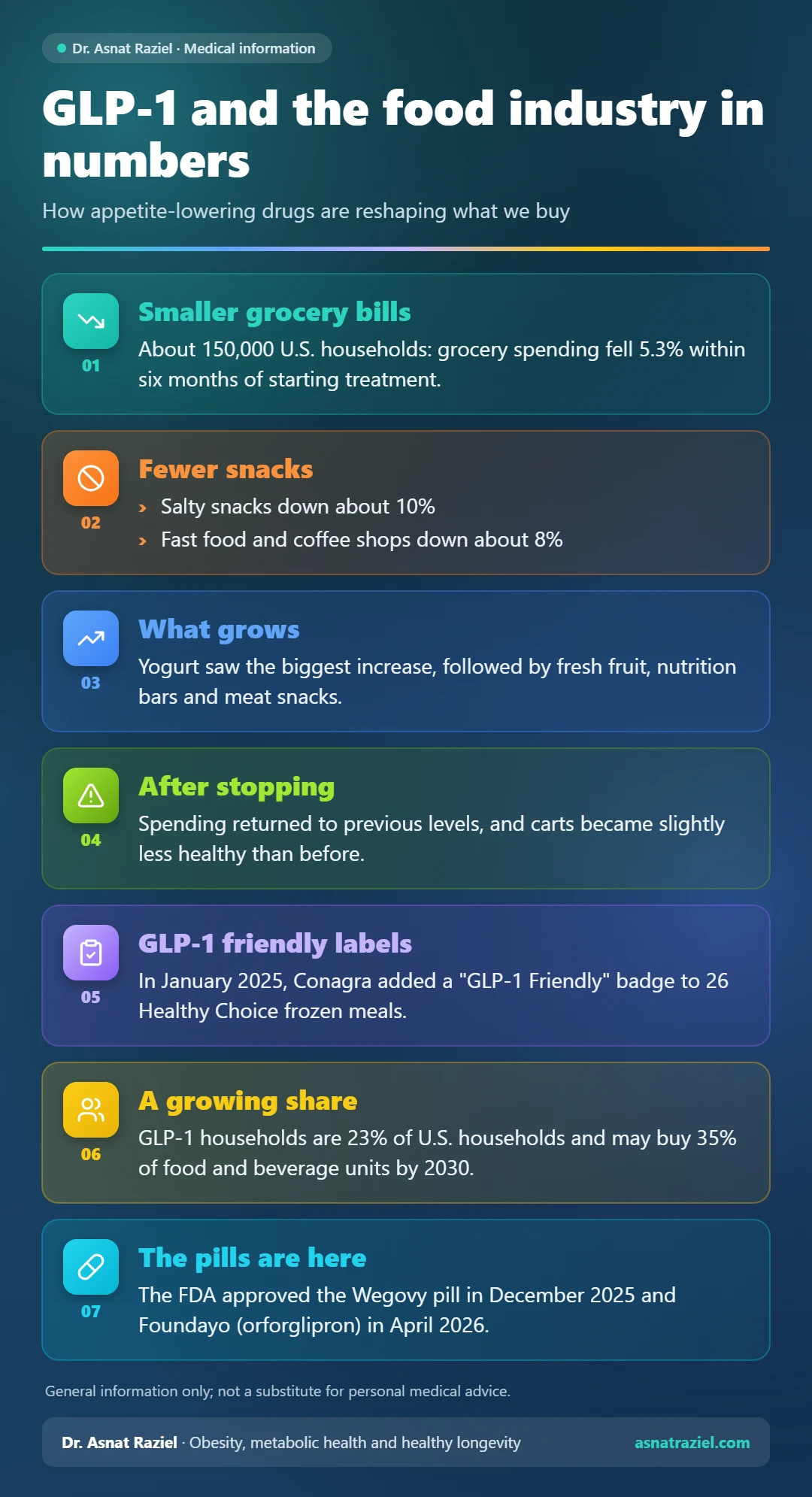
The key data came from Cornell University. The researchers combined purchase data from about 150,000 U.S. households with repeated surveys on medication use. The study, published in the Journal of Marketing Research, found an average 5.3% drop in grocery spending. The drop appeared within six months of starting treatment. In high-income households, it exceeded 8%.
The decline is especially striking for snacks. Purchases of salty snacks fell by about 10%, and sweets, baked goods and cookies also declined. On the other hand, yogurt showed the biggest increase, followed by fresh fruit, nutrition bars and meat snacks. Spending at fast-food chains and coffee shops also fell by about 8%.
Another finding has medical significance. People who stopped the medication went back to their previous level of spending. What’s more, their shopping cart became slightly less healthy than before, partly because of candy and chocolate. In other words, the drug changes habits only as long as it is working, unless real change is built alongside it. You can read more about this in my article on food noise.
GLP-1 and the food industry: five moves companies are making
1. “GLP-1 friendly” labels
Food companies are already branding products as suitable for people taking these drugs. The most prominent example is Conagra. In January 2025, it added a “GLP-1 Friendly” badge to 26 Healthy Choice frozen meals. The badge marks meals that are high in protein, low in calories and a good source of fiber. The company noted that the meals themselves had not changed.
2. Smaller, more precise portions
The logic is simple: when you feel full quickly, a large product becomes a burden. The same applies when eating out, as I explain in my guide to ordering fast food on GLP-1. As a result, we’ll see more single-serve versions, small portions and pre-divided packages on the shelves. In addition, the new pills are expected to increase the number of patients, and with it the demand for portions like these.
3. Protein is the new currency
The industry’s focus is shifting to protein: high-protein meals, protein bars, protein yogurts and products that promise satiety. For patients, this is also a medical need, because protein helps preserve muscle during weight loss. You’ll find a practical guide in my article on protein intake during weight loss.
4. Simple, easy-to-digest food
Many patients report that they now prefer simple food. Fatty and fried foods also make their nausea worse. So we can expect new products with less fried fat, less sugar and less volume. Examples include soups, yogurts, fruit and ready-made bowls. I wrote about the link between processed food and the brain in my article on ultra-processed food.
5. Sharing data with retail chains
Large chains are tracking the shift in shopping habits. They use loyalty-club data to adjust shelves, promotions and their product mix. According to the market research firm Circana, households with GLP-1 users already make up 23% of U.S. households. By 2030, they are expected to buy 35% of all food and beverage units sold.
GLP-1 and the food industry: what to expect in the coming years
Supermarket shelves: a satiety diet instead of a calorie diet. Products with protein, fiber, small volume and high satiety will gain ground. In contrast, sales of sweet snacks, baked goods and candy may fall, especially if use of these drugs keeps expanding.
Price and packaging: quality instead of jumbo packs. When people eat less, they are willing to pay for quality and nutritional value. Meanwhile, the need for jumbo packs is shrinking. Likewise, “buy one, get one free” deals may make way for small packages that cost more per unit.
Restaurants and fast food: the half portion. Falling demand for large portions will push restaurants toward half portions, light combos and an emphasis on protein and vegetables. As mentioned, spending on fast food has already dropped among users.
Regulation: who gets to write “GLP-1 friendly”? As marketing claims multiply, pressure on regulators will grow. The goal is to prevent unfounded promises. So the authorities will need to set clear standards for labels and messaging.
The pills are already here. What was once a forecast has become reality. The FDA approved the Wegovy pill in December 2025, and in April 2026 it also approved the Foundayo (orforglipron) pill. A daily pill removes the barrier of the injection, so it may increase the number of users.
GLP-1 and the food industry in numbers: how many users worldwide
It is hard to measure a single global rate. There are gaps between countries and between use for diabetes and use for obesity, and there is also a private market that is not fully reported. Still, there are several reliable anchors:
- United States: according to a KFF poll from November 2025, 12% of adults currently take a GLP-1 drug, and 18% have ever taken one. A RAND survey from spring 2025 found that 11.8% had ever used one.
- United Kingdom: according to an estimate by Nesta, about 1.5 million people are receiving treatment, about 95% of them privately.
- Market size: according to IQVIA, global spending on obesity drugs passed the $30 billion mark for the first time in 2024.
- Global access: the World Health Organization estimates that by 2030, these drugs will reach fewer than 10% of the people who could benefit from them.
GLP-1 and the food industry: what it means for you
The change in the market is an opportunity. Protein-rich products and small portions help you eat well during treatment. However, it is worth reading the nutrition label and not just the marketing badge. A personalized nutrition plan matters far more than any sticker on a package. That is why I recommend using my nutrition guide for weight loss injections and working with a dietitian.
Bottom line: companies that don’t adapt will lose their place at the table
The link between GLP-1 and the food industry is already a structural shift in consumption, not just another health trend. Companies that move to small portions, protein, transparency and smart labeling will ride the wave. In the end, those that stick with a menu, packaging and language of “more, bigger, sweeter” may find that their customers simply aren’t hungry.
This article provides general information and is not a substitute for personal medical advice.
References
The No-Hunger Games: How GLP-1 Medication Adoption is Changing Consumer Food Demand
Ozempic is changing the foods Americans buy
Silver bullet or sticking plaster? Weight-loss drugs and the UK’s obesity crisis
Outlook for obesity in 2025: more than a transition year
WHO issues global guideline on the use of GLP-1 medicines in treating obesity
Weight-loss pill approval set to accelerate food industry product overhauls




