By Dr. Asnat Raziel, bariatric surgeon specializing in obesity treatment, metabolic health and healthy longevity; Director of the Multidisciplinary Center for Obesity Treatment, Assia Medical, Assuta Ramat HaChayal, Tel Aviv
A microbiome test: not just who lives inside us, but what they are doing
A microbiome test, such as the Viome microbiome test, is one of the most intriguing tools in longevity medicine. The microbiome is the trillions of microorganisms that live in our bodies, mainly in the gut and the mouth. In recent years, we have come to understand that it is an active biological system. It produces substances, communicates with the immune system and affects metabolism and the level of inflammation in the body.
This is where Viome comes in. It is an American company trying to turn microbiome science into a tool for personalized medicine. The idea is tempting: get a “molecular snapshot” of what your microbes and cells are doing, and tailor your diet and habits to it. Still, it is important to be precise from the start. Some of the company’s scores and recommendations are not a proven diagnostic tool for extending life. We need to distinguish between microbiome science, which keeps getting stronger, and clinical proof for a specific consumer product.
What the Viome microbiome test measures
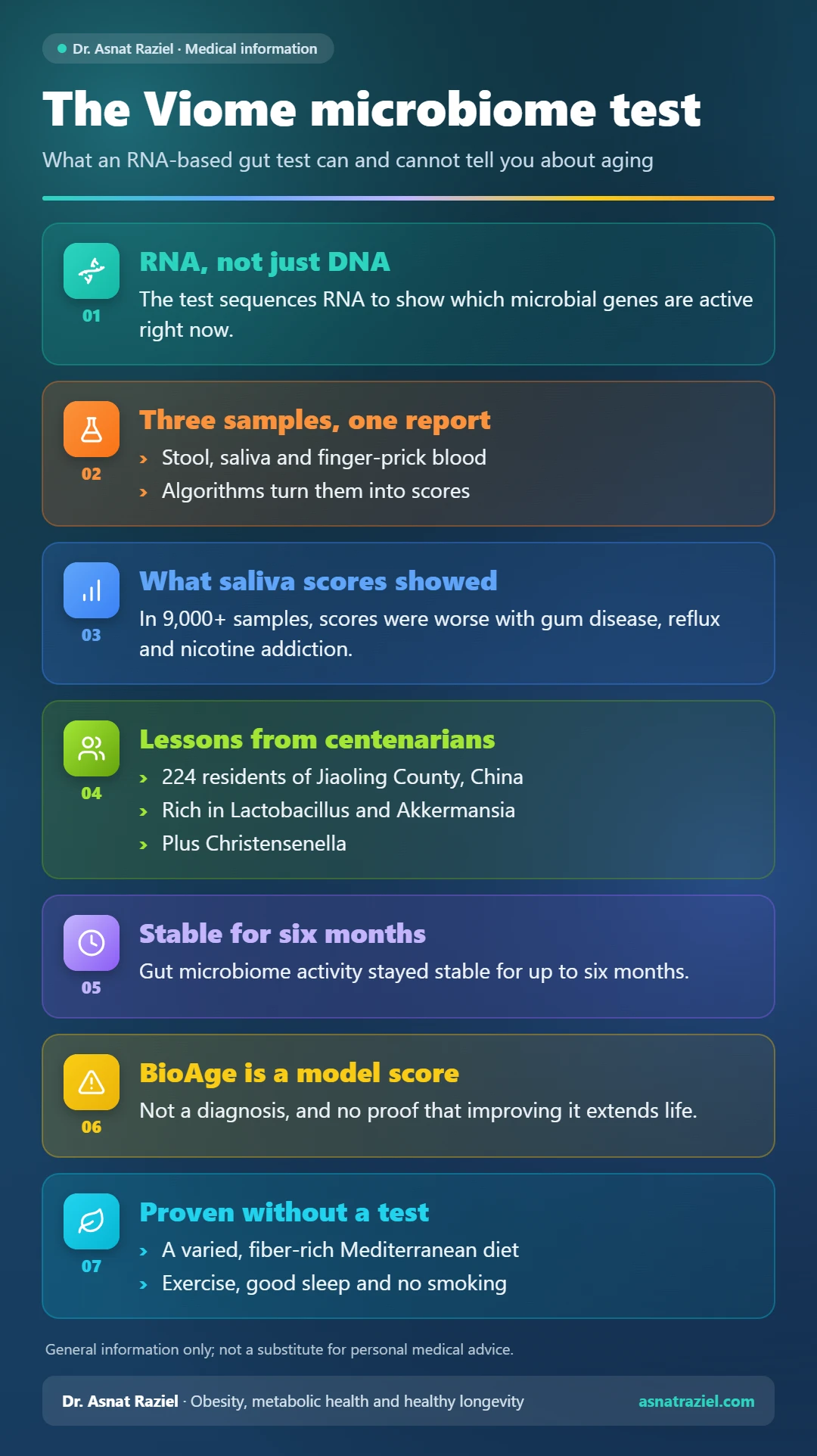
Most tests rely on DNA and ask, “Which bacteria are there?” Viome, by contrast, uses metatranscriptomics, which means sequencing the RNA of all the microorganisms in a sample. The difference matters. DNA tells us which genes and bacteria are present. RNA, on the other hand, shows which genes are active at the moment the sample was taken. In simple terms: not just who is there, but what they are doing right now.
The company offers at-home tests. Depending on the package, they include a stool sample, a saliva sample and a finger-prick blood sample. The samples go to a lab, where machine learning algorithms turn them into health scores and diet recommendations. In other words, the comprehensive test combines information from the gut microbiome, the oral microbiome and the person’s own cells.
What you get from the Viome microbiome test
Users receive scores for gut health, metabolic activity, inflammatory pathways and microbial activity. Next, they get a list of foods to favor and foods to limit. This is an attempt to build a dynamic, personal diet. Instead of telling everyone “eat broccoli, legumes and avocado,” the model asks what suits this particular person, based on the biological activity measured in their samples.
The company also sells supplements, prebiotics and probiotics based on the results. Here we need to be critical. The fact that we can measure a biological pathway does not prove that an algorithm-selected supplement will improve health over the years. A study by the company’s researchers of more than 9,000 saliva samples showed that its scores were worse in people with gum disease, acid reflux and nicotine addiction. This is a statistical association, not proof that the recommendations prevent disease.
The microbiome and aging
Aging research shows that the microbiome changes over the course of life. Moreover, the links between the gut, the immune system, metabolism and tissue aging run in both directions. A review in Nature Reviews Endocrinology from March 2026 describes the microbiome as a possible player in shaping the course of aging. However, the authors stress that its causal role is still uncertain. In addition, there is no single “normal” microbiome, because it depends heavily on the environment and the individual.
These changes are linked to inflammaging, the chronic low-grade inflammation that accompanies aging. I wrote more about this in my article on gut bacteria and inflammation. In addition, gut bacteria produce short-chain fatty acids (SCFAs), such as butyrate, by fermenting dietary fiber. These substances are important for the gut barrier, the immune system and metabolism. It is also worth reading about the gut barrier and aging.
What centenarians teach us
One of the most beautiful findings in the field comes from people who have passed the age of 100. There is no single “longevity bacterium.” Nor is the centenarian microbiome a young microbiome preserved for a century. Instead, it is an ecosystem that has adapted to aging.
A 2025 study examined 224 residents of Jiaoling County in China, an area known for the longevity of its people. In the centenarians, the researchers found a wide diversity of bacteria and an abundance of Lactobacillus, Akkermansia and Christensenella. But we need to be careful about cause and effect. We do not know whether the microbiome helped them reach 100, or whether their lifestyle and genetics shaped it. Most likely, both directions are true to some extent.
The Viome microbiome test and biological age
The direct link to longevity is the company’s BioAge model. In its latest version, V5, the model combines signals from the gut microbiome, the oral microbiome and the blood sample. According to the company, it reflects inflammation, metabolism, mitochondrial activity, cell repair and microbial function. The company itself notes that the information is not intended for diagnosis and does not replace medical advice.
It is important to understand what “biological age” means here. It is a score calculated by a model, not a measure of how many years we have left. Today, there is no basis for saying that improving a commercial score extends life. In responsible longevity medicine, the score is just one more layer of information. It does not replace blood pressure, lipids, blood sugar, body composition, fitness, muscle mass, sleep and cognitive function. It is also worth comparing it with epigenetic clocks, which measure biological age in a different way.
The microbiome is not destiny
One of the exciting things about the microbiome is that it responds to the environment. Diet, the amount and type of fiber, medications and especially antibiotics all change it. Exercise, illness and age affect it too. Hence the idea of repeat testing: if we change our lifestyle, perhaps after a few months we will see a change in microbial activity. In April 2026, the company published a large study of stool samples. According to the study, gut microbiome activity remained stable for up to six months. This finding helps clarify how often a repeat test adds useful information.
Should you eat according to a Viome microbiome test?
Here the science still lags behind the marketing. Different people respond differently to the same food, and the microbiome explains part of that difference. A review in Nature Reviews Gastroenterology & Hepatology describes the microbiome as a link between diet and health. Even so, it points to knowledge gaps that must be closed before precise advice can be given to each person. So it is too early to say that a commercial test can determine which foods are “good” or “bad” for you.
Any advice to avoid a food should be weighed in a broad context. First, is the food nourishing? Second, is there a real sensitivity? Also, could avoiding it lead to deficiencies? And finally, what happens to clinical measures after the change?
What we already know without any test
You do not need to wait for an RNA test to do what has already been proven. That means a varied Mediterranean diet with vegetables, fruit, legumes, nuts and whole grains, as tolerated. In addition, it means regular exercise, preserving muscle, good sleep and not smoking. Fiber is the raw material that bacteria use to make SCFAs. Therefore, a rich and varied plant-based menu is one of the simplest ways to nurture a healthy microbiome. I covered this in more depth in my article on nutrition and supplements for longevity.
The future: test, intervene, test again
In my view, the interesting part of this model is not the list of “good and bad foods.” Rather, it is the chance to think of health as a feedback system: measure, intervene, live differently, measure again, adjust. This fits longevity medicine very well. Instead of seeing a doctor only when disease appears, we could track metabolic, inflammatory and microbial pathways over many years. But for this to become real medicine, we need long-term studies. They will have to show that the recommendations do more than change a score in an app. They must reduce disease and extend healthspan, the years of healthy life.
The bottom line on the Viome microbiome test
The microbiome is probably an important piece of the aging puzzle. Viome offers a fascinating technological way to peek into this world, using RNA, artificial intelligence and repeat measurements. I see a microbiome test like this as a possible addition to the toolbox, mainly alongside blood tests, body composition, VO₂max, sleep and metabolic health. Perhaps one day, alongside “What is your cholesterol?”, we will also ask: what is your microbiome doing today, and is it working in favor of your healthy aging? Until then, you may also want to read about the microbiome and biological age.
The information in this article is general and does not replace personal medical advice.
References
The gut microbiome and ageing trajectories: mechanisms and clinical implications
Viome – Biological Age and Health Insights
The gut microbiome connects nutrition and human health
Gut microbiota-derived short-chain fatty acids and their role in human health and disease
Viome – Scientific Publications
The saliva study and the stability study were conducted by Viome researchers.




