By Dr. Asnat Raziel, bariatric surgeon specializing in obesity treatment, metabolic health and healthy longevity; Director of the Multidisciplinary Center for Obesity Treatment, Assia Medical, Assuta Ramat HaChayal, Tel Aviv
The future of obesity medicine: a revolution that has already begun
The future of obesity medicine will look completely different from what we have known. In the past, treatment relied mainly on diets, personal discipline and sometimes surgery. Today it is an advanced medical field built on science, technology and deep biology. So the question is no longer whether obesity can be treated. The question is how to treat it precisely, safely and over the long term.
We can already see the direction. Over the past year, two new obesity pills were approved in the United States, and advanced combination drugs are on the way. Here, I want to look further ahead: where is all of this going? I also outline three key directions for obesity care in a separate article.
From one-size-fits-all to personalized treatment
One of the key changes is the shift from a uniform approach to a personalized one. Obesity is not a single disease but a spectrum of biological conditions. That is why we choose treatment according to personal characteristics: eating patterns, body composition, metabolic profile, hormonal response, mental health and social context.
In practice, this starts with new questions in the clinic. Does the patient mainly struggle with constant hunger or with emotional eating? Perhaps they have fatty liver disease, diabetes or sleep apnea? And what is happening to their muscle mass? The answers determine the type of drug, the dose and the kind of support. As a result, two people with the same weight may receive completely different treatment.
Diagnosis itself is changing too. In January 2025, an international commission of The Lancet Diabetes & Endocrinology published a new definition of clinical obesity. According to the commission, BMI (body mass index) alone is not enough for an individual diagnosis. In addition, waist circumference or body fat should be measured, along with a check of whether the fat is already harming organ function. I explain this approach in my article on the definition of clinical obesity.
The future of obesity medicine and multi-hormone drugs
The next generation of drugs does not target just one hormone. The new medications combine effects on GLP-1, GIP, amylin and other pathways. In this way, they closely mimic the body’s natural system of fullness and hunger.
The data are impressive. In the SURMOUNT-5 trial, tirzepatide led to an average weight loss of 20.2% after 72 weeks. By comparison, semaglutide led to a 13.7% loss. In the REDEFINE 1 trial, the combination CagriSema, amylin plus semaglutide, reduced weight by 20.4%, compared with 3.0% on placebo.
In addition, in December 2025 Lilly reported results from the TRIUMPH-4 trial. Retatrutide, a drug that acts on three hormones, led to an average weight loss of 28.7% at the 12 mg dose after 68 weeks, among those who stayed on treatment. The drug has not yet been approved. You can read more in my article on retatrutide research.
However, the goal is not just large weight loss. The goal is also persistence, less emotional eating and keeping the results over time. Powerful drugs like these set a new bar, but they require careful, professional management.
Beyond injections: the pills are already here
Obesity pills have become a reality. On December 22, 2025, the FDA approved the Wegovy pill, oral semaglutide at 25 mg once a day. In April 2026, the FDA also approved Foundayo, also known as orforglipron. This pill can be taken at any time of day, without food or water restrictions. In Israel, Foundayo has been available since September 2026.
For many people, injections are an emotional or practical barrier. That is why a pill may improve adherence and make treatment more accessible, especially in the early stages of the disease. Still, here too the challenge is not only effectiveness, but also personal fit and follow-up. I covered this in detail in my Foundayo treatment guide.
Obesity as a target for preventive medicine
An important shift in thinking is recognizing obesity as a key target for prevention. Treating obesity early may prevent diabetes, heart disease, sleep apnea and even some types of cancer. For example, the SELECT trial included 17,604 patients with heart disease and overweight, without diabetes. A major cardiac event occurred in 6.5% of patients on semaglutide, compared with 8.0% on placebo. That is a 20% reduction in risk.
In the future of obesity medicine, we will see early interventions, long before complications appear. In other words, treatment will begin when excess fat has not yet damaged the organs. A change like this requires both new health policy and a new public mindset. Longevity medicine faces a similar gap between science and policy, as I describe in my article on the future of longevity.
The future of obesity medicine: data and artificial intelligence
Digital technologies, remote monitoring and artificial intelligence will change how we follow patients. Collecting data on nutrition, activity, sleep and treatment response will allow adjustments in real time. In addition, this information will help detect treatment failure or side effects early. I wrote more about this in my article on artificial intelligence in obesity treatment.
Even so, technology will not replace the human connection. It will serve as a supporting tool for professional, compassionate medicine. I expand on this in my article on human skills in medicine.
Medicine stays human
Despite all this progress, the future does not lie only in molecules and algorithms. It lies in combining advanced science with deep human understanding. This means recognizing the stigma around obesity, offering emotional support and understanding the complexity of each patient’s life. Ultimately, successful treatment respects the biology, but also the person behind it.
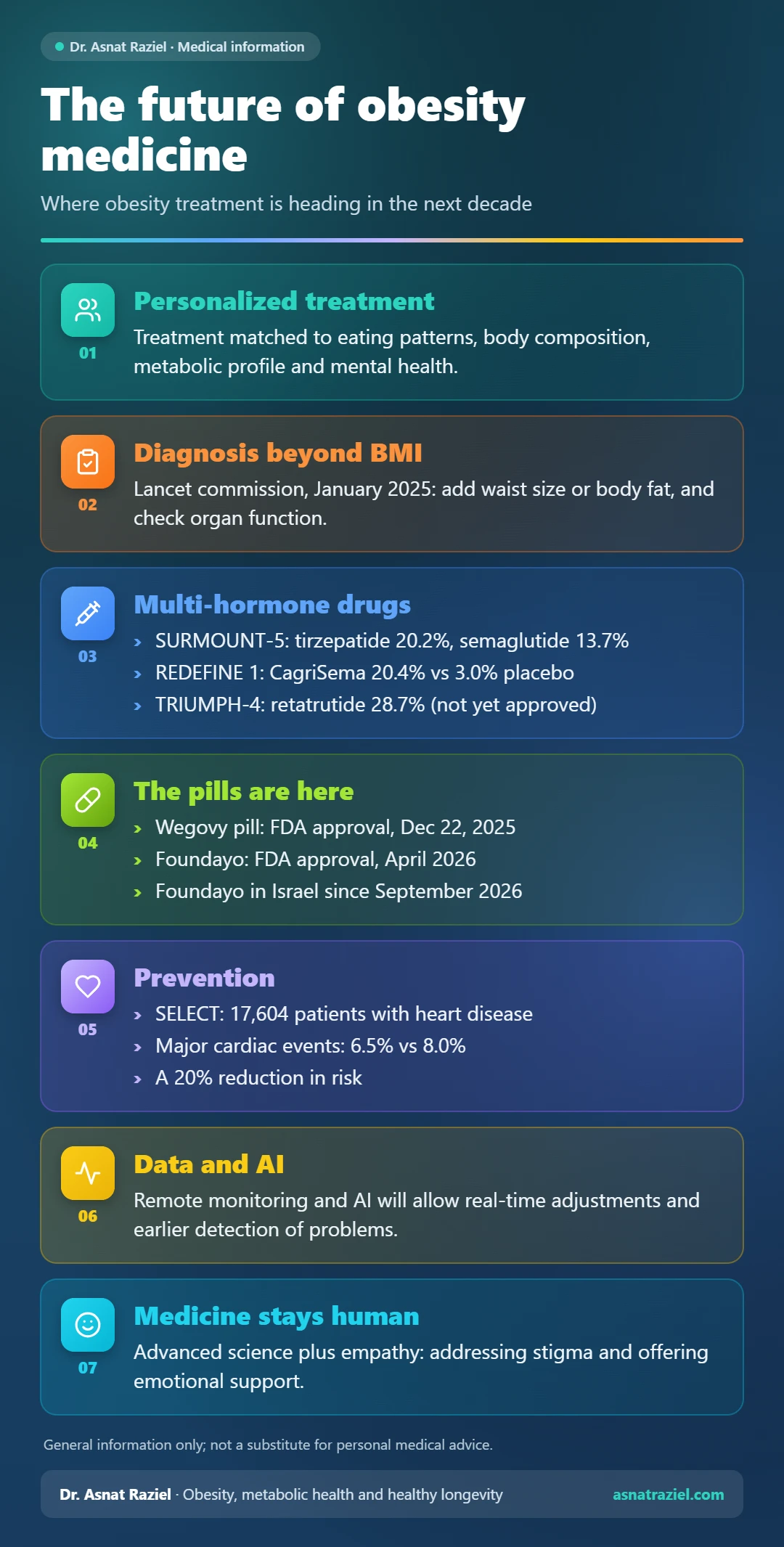
The bottom line: where the future of obesity medicine is heading
Over the next decade, obesity medicine will be more precise, effective and accessible than ever. At the same time, it will demand a high level of professional responsibility. This is a field going through a quiet but profound revolution, with the potential to change the face of public health. So the question is not only where it is going. The question is how we lead this change wisely, in a balanced and humane way.
The information in this article is general and does not replace personal medical advice.
References
Definition and diagnostic criteria of clinical obesity
Tirzepatide as Compared with Semaglutide for the Treatment of Obesity
Coadministered Cagrilintide and Semaglutide in Adults with Overweight or Obesity
Wegovy pill approved in the US as first oral GLP-1 for weight management
Semaglutide and Cardiovascular Outcomes in Obesity without Diabetes




