By Dr. Asnat Raziel, bariatric surgeon specializing in obesity treatment, metabolic health and healthy longevity; Director of the Multidisciplinary Center for Obesity Treatment, Assia Medical, Assuta Ramat HaChayal, Tel Aviv
What is the femtech revolution, and why does it matter?
Femtech is quietly, yet with growing force, changing the way we understand, diagnose and treat women’s health. Femtech, short for female technology, covers apps, medical devices and digital solutions across a woman’s entire life cycle. In the past, women’s medicine focused mainly on fertility, pregnancy and gynecology. Today, it has become a complete technological ecosystem that brings together artificial intelligence, wearable sensors and personalized medicine.
The term was coined in 2016 by Ida Tin, founder of the Clue app. Beyond the technology, however, it reflects a deep change in thinking. A woman’s body is not a “scaled-down version of a man’s body.” Rather, it is a unique biological system, with rich hormonal dynamics that affect every system in the body.
The gap femtech aims to close
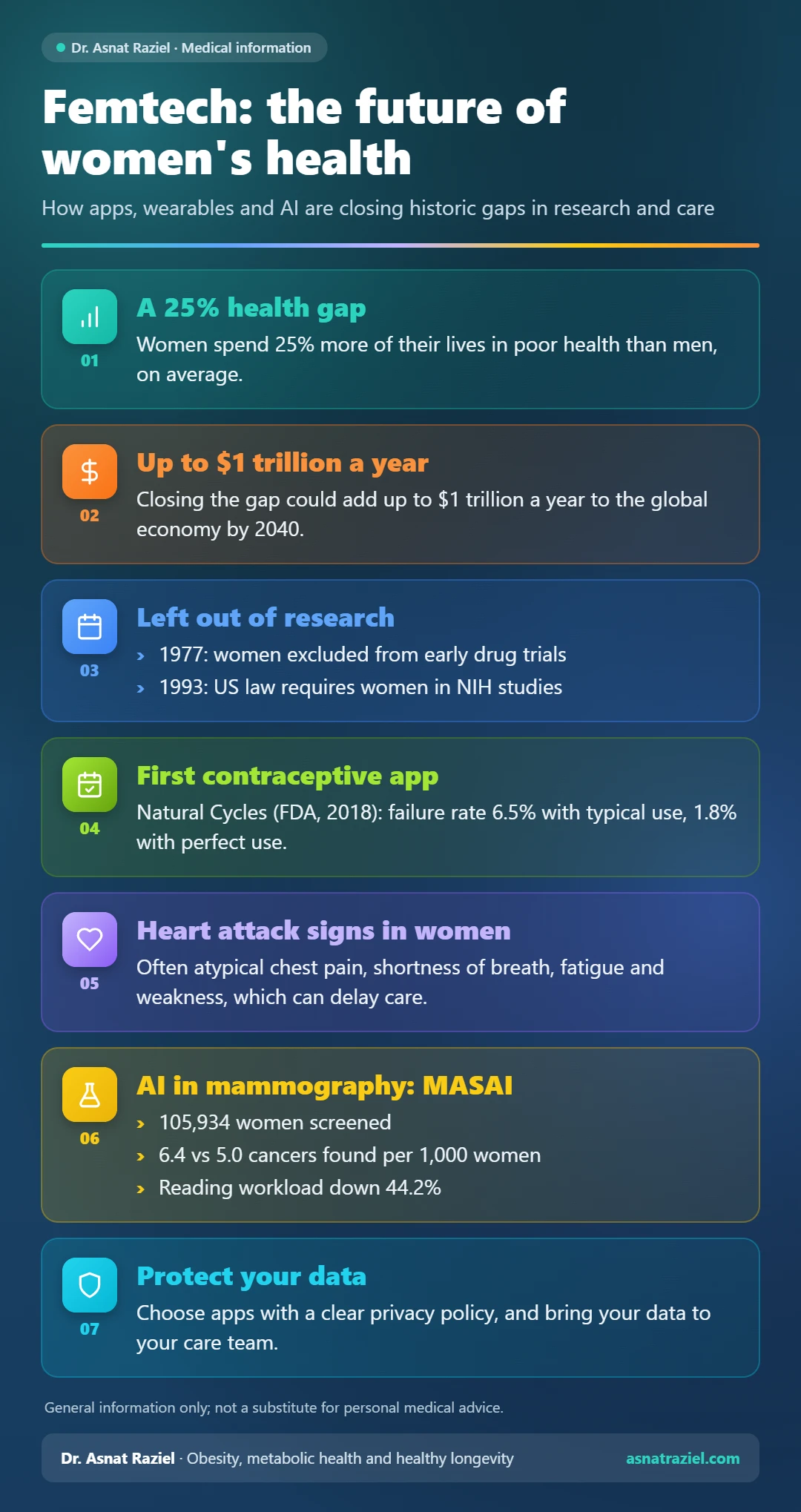
According to a report by the McKinsey Health Institute and the World Economic Forum, women spend 25% more of their lives in poor health than men, on average. The report estimates that closing this gap could add up to $1 trillion a year to the global economy by 2040. In other words, women’s health is both a medical challenge and an economic opportunity.
Closer to home, I wrote about Israeli women leading the way and the gaps that remain.
The gap has historical roots. In 1977, the US Food and Drug Administration (FDA) recommended excluding women of childbearing age from early-phase drug trials. Only in 1993 did a US federal law require the National Institutes of Health to include women in clinical research. As a result, our knowledge of how women respond to drugs, of their side effects and of their unique risks remained incomplete for many years.
From reactive medicine to preventive medicine
One of the central themes of the femtech revolution is the shift from medicine that reacts to disease to medicine that gets ahead of it. Period and ovulation tracking apps are no longer just tools for planning a pregnancy. Instead, they collect physiological data over time. Combined with algorithms, they may detect unusual patterns and flag hormonal changes. For example, tracking irregular cycles may raise suspicion of polycystic ovary syndrome, thyroid disorders or metabolic problems, and lead to a medical workup.
Apps such as Clue and Flo Health have gathered millions of users worldwide. At the same time, smart rings like the Oura Ring track sleep, temperature and heart rate. These data are especially relevant to changes around ovulation, pregnancy and perimenopause. Moreover, in 2018 the FDA allowed marketing of Natural Cycles, the first app for contraception. Its failure rate was 6.5% with typical use and 1.8% with perfect use.
Femtech beyond fertility: the heart, the brain and metabolism
The new generation of femtech is not limited to reproduction. It is moving into areas that research neglected in the past: heart disease in women, mental health around hormonal fluctuations, chronic pain and endometriosis. In addition, it addresses obesity and metabolic syndrome during menopause. I wrote about the link between obesity and women’s health across the lifespan in my article on obesity in women.
The heart is a striking example. According to a scientific statement from the American Heart Association, women often report atypical chest pain, shortness of breath, fatigue and weakness during a heart attack. This can delay treatment. Therefore, wearable sensors and sex-specific algorithms may help identify cardiac and metabolic risk at an early stage. You can read more in my article on heart disease in women.
In mental health, too, digital platforms are exploring the link between fluctuations in estrogen and progesterone and anxiety, depression and sleep problems. The implications are broad: instead of one-size-fits-all care, we get models that take a woman’s hormonal life cycle into account.
Artificial intelligence as a growth engine
The real leap happens when big data from women meets artificial intelligence. Analyzing millions of cycles may improve the prediction of ovulation, the risk of gestational diabetes and patterns of weight gain. Still, most of these applications are at the research stage.
One example that has already been tested in a controlled trial is the Swedish MASAI study of mammography. The study included 105,934 women. AI-supported screening detected 6.4 cancers per 1,000 women, compared with 5.0 with standard reading. In addition, the radiologists’ reading workload dropped by 44.2%, with no increase in false positives. You can find more about how these tools are used in my own field in my article on artificial intelligence in obesity treatment.
On the other hand, the challenge is clear: privacy, data security and ethics in the use of intimate data. Information about women’s health is especially sensitive, and public trust is a condition for continued growth.
A cultural revolution as much as a technological one
Beyond the science, femtech represents a cultural shift. Topics that used to be taboo, such as periods, menopause, low libido or severe menstrual pain, are becoming an open, data-driven conversation. For patients, this is empowering. For the medical team, it is an opportunity for a precise conversation based on measurement rather than guesswork. Women in menopause, for example, can track their sleep, symptoms and weight, and come to the clinic with a clear picture. You will find more about this stage of life in my article on weight gain in menopause.
The future of femtech
The future of femtech is not just about shiny apps or smart gadgets. Rather, it lies in the connection between technology, clinical research and evidence-based medicine. When digital data, biomarkers and hormonal understanding come together, the result is precise, personalized and sex-specific medicine.
Over the next decade, the field is likely to expand to more groups: women in menopause, women with chronic diseases and adolescent girls. So the question is not whether femtech will change the rules of the game. The question is how we integrate it properly into practice, while holding on to rigorous science and professional ethics.
For patients, my advice is simple. Choose apps that publish a clear privacy policy, and bring your data to the conversation with your care team. Technology does not replace a medical examination, but it can greatly improve it.
The bottom line
The femtech revolution puts the female body back at the center of research and care. It offers continuous monitoring, precise diagnosis and tailored treatment, but it also demands strict protection of privacy. In the end, the future really is female. What’s more, it is data-driven and precise, and it challenges us to rethink women’s medicine in the 21st century.
The information in this article is general and does not replace personal medical advice.
References
New report highlights one trillion potential of closing women’s health gap
Women’s Health Research: Progress, Pitfalls, and Promise – Introduction
FDA allows marketing of first direct-to-consumer app for contraceptive use to prevent pregnancy
Acute Myocardial Infarction in Women: A Scientific Statement From the American Heart Association