By Dr. Asnat Raziel, bariatric surgeon specializing in obesity treatment, metabolic health and healthy longevity; Director of the Multidisciplinary Center for Obesity Treatment, Assia Medical, Assuta Ramat HaChayal, Tel Aviv
Employers and weight-loss drugs: why this is a hot topic
Employers and weight-loss drugs are a pairing that keeps making headlines. In recent years, obesity treatment has changed dramatically. Medications such as semaglutide and tirzepatide allow significant weight loss and improve many diseases. However, for many people, treatment is still out of reach. The main reason is the high price. In addition, many insurance plans do not cover obesity medications.
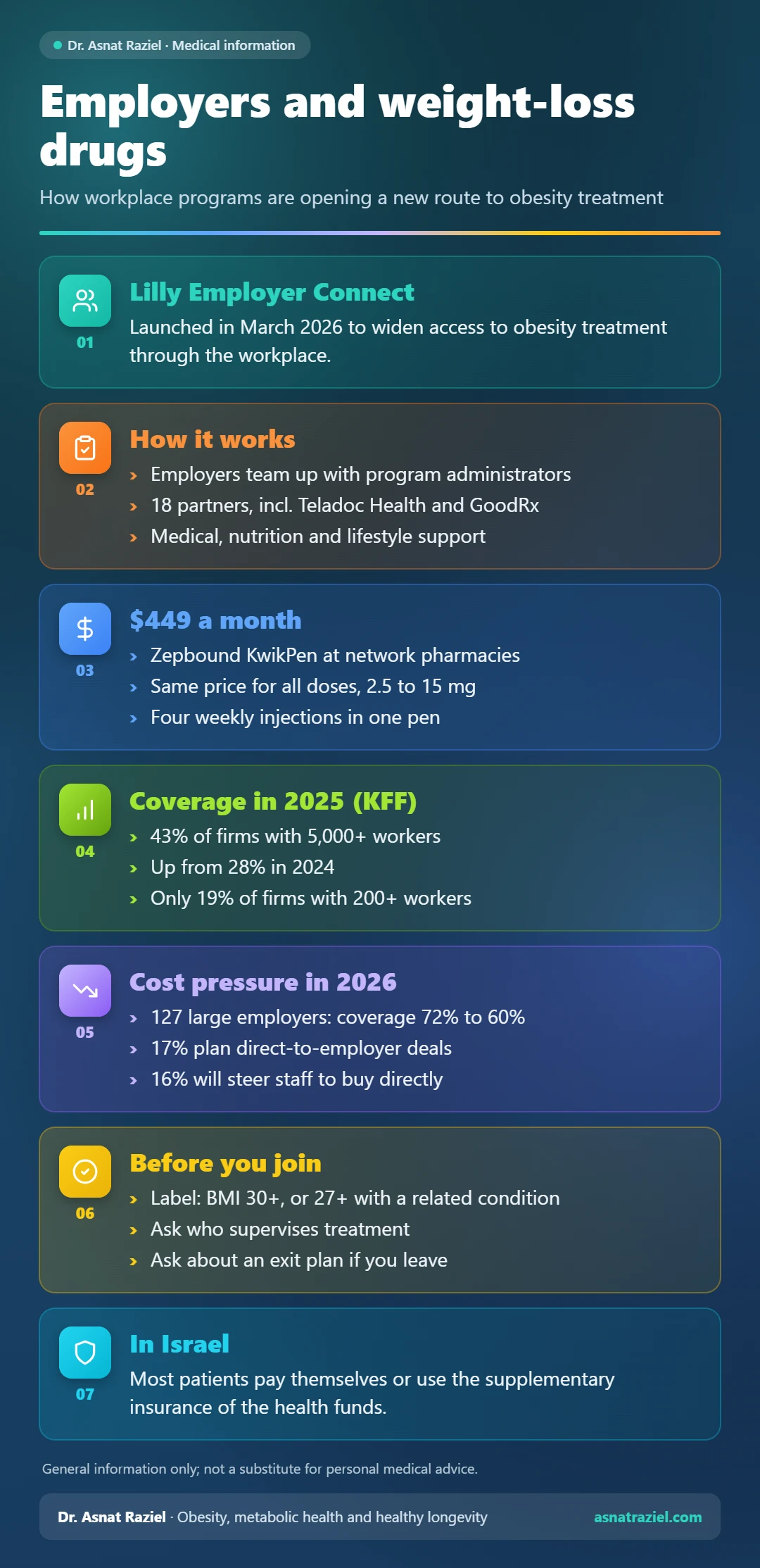
In March 2026, the drug company Eli Lilly introduced an initiative that tries to change this. The company launched a platform called Lilly Employer Connect. Its aim is to widen access to obesity treatment through the workplace.
Obesity treatment through the workplace
The idea is simple. Patients do not have to chase complicated insurance coverage on their own. Instead, the employer offers workers a health program that also includes obesity treatment.
The platform connects employers with organizations that run health programs. These organizations give employees medical advice, nutrition coaching, support for a healthy lifestyle and access to medication. More than fifteen independent program administrators took part in the launch. In fact, the official announcement listed 18 partners, including Teladoc Health, GoodRx and Mark Cuban Cost Plus Drugs. This way, each employer can choose the model that suits its workforce.
The price: $449 a month for every dose
The cost of these drugs is one of the main barriers. That is why Lilly offers a discounted price for Zepbound through the program. Zepbound is the U.S. brand name of tirzepatide for obesity. In Israel, the company markets the same active ingredient as Mounjaro. The drug comes in a new KwikPen, which delivers four weekly injections from a single device.
According to coverage of the launch, the price for network pharmacies is $449 a month for all doses. The doses range from 2.5 to 15 mg. The final cost to the employee depends on the employer’s share and the program administrator’s fees. The goal is for more people to get effective treatment instead of giving it up because of the price.
Not just Lilly: employers and weight-loss drugs in a changing market
Lilly is not alone. Back in November 2025, Lilly and Novo Nordisk announced a collaboration with Waltz Health. This program sells obesity drugs directly to employers at a fixed price. In other words, the direct-sales model, without a middleman, keeps growing. As a result, employers and weight-loss drugs now meet outside the usual insurance route as well.
Combining medication, digital medicine and lifestyle
The platform does not focus on medication alone. Rather, it offers a broad approach to obesity care. Participants can get remote medical consultations, professional nutrition coaching and ongoing medical follow-up. They also receive exercise programs and digital tools for tracking their weight.
This combination matters. It treats obesity as a chronic disease that needs multidisciplinary care. Not as a cosmetic problem, and not as a matter of willpower alone. We see this every day in our clinic: a multidisciplinary team improves results over time.
Why are employers interested in weight-loss drugs?
Obesity is linked to many diseases, such as diabetes, heart disease, sleep apnea and joint problems. These conditions lead to missed workdays, lower productivity and high medical costs. I covered these risks in more detail in my article on the health risks of excess weight.
That is why many companies understand that investing in employee health can save money in the long run. In addition, it improves the quality of life of the employees themselves.
Employers and weight-loss drugs: what the coverage data show
The picture in the United States is mixed. On the one hand, the 2025 KFF survey found that 43% of companies with 5,000 or more workers cover GLP-1 drugs for weight loss. In 2024, the figure was 28%. By contrast, among companies with 200 or more workers, only 19% cover them.
On the other hand, the cost is heavy. A Business Group on Health survey reported in August 2026 included 127 large employers. The share of employers covering GLP-1 drugs for obesity fell from 72% in 2025 to 60% in 2026. At the same time, 17% plan to move to direct-to-employer arrangements that bypass the pharmacy benefit manager, and 16% will steer employees to buy directly. In other words, Lilly’s model responds to exactly this pressure.
What to check before joining a program
A workplace program is an opportunity, but it does not replace a medical assessment. First, according to its label, the drug is meant for adults with a BMI of 30 or higher, or 27 or higher with a related medical condition. So we first check personal suitability, other medications and medical history. For example, Waltz Health verifies eligibility against the criteria of the FDA, the U.S. Food and Drug Administration.
Second, it is important to ask who supervises the treatment. Digestive side effects are common early on, so close follow-up is needed. Also, find out what happens if you leave your job. Stopping treatment suddenly usually leads to weight regain, as I explained in my article on what happens after stopping GLP-1 drugs. That is, a good program also includes an exit plan.
Finally, ask about nutrition coaching and physical activity. The medication works on appetite, but keeping muscle mass and good habits takes teamwork.
What about Israel?
In Israel, the situation is different. Most patients pay for treatment themselves or use the supplementary insurance plans of Israel’s health funds (HMOs). American-style employer programs are still uncommon here. I wrote about the options that do exist in my article on insurance coverage for obesity medications.
A shift in thinking: the future of employer health programs
This initiative reflects a broader shift in medicine. In the past, obesity was seen as a lifestyle problem. Today it is clear that it is a chronic disease with biological and hormonal mechanisms. The new medications make effective treatment possible. But for treatment to last, it needs to combine medicine, behavioral support and a supportive environment.
The bottom line
In the near future, we will probably see more workplace health programs with access to advanced obesity treatment. If the model succeeds, it could change how millions of people get care. Ultimately, the question is not only who pays. The question is how to ensure continuous, safe and supervised treatment for everyone who needs it.
The information in this article is general and does not replace personal medical advice.
References
Eli Lilly launches its direct-to-employer platform for obesity drugs
Eli Lilly, Novo Nordisk and Waltz Health collaborate on obesity drugs
Employers cut GLP-1 coverage as pharmacy costs hit 25% of health spend




