By Dr. Asnat Raziel, bariatric surgeon specializing in obesity treatment, metabolic health and healthy longevity; Director of the Multidisciplinary Center for Obesity Treatment, Assia Medical, Assuta Ramat HaChayal, Tel Aviv
Diet and exercise: why you need both
Combining diet and exercise is one of the most effective ways to lose weight and keep it off over time. Diet is responsible for most of the weight loss in the first months. Physical activity, on the other hand, protects your muscles, improves your fitness and helps you avoid regaining the weight. In this article, I’ll explain what the research shows and how to build a practical plan that fits real life.
What the research shows
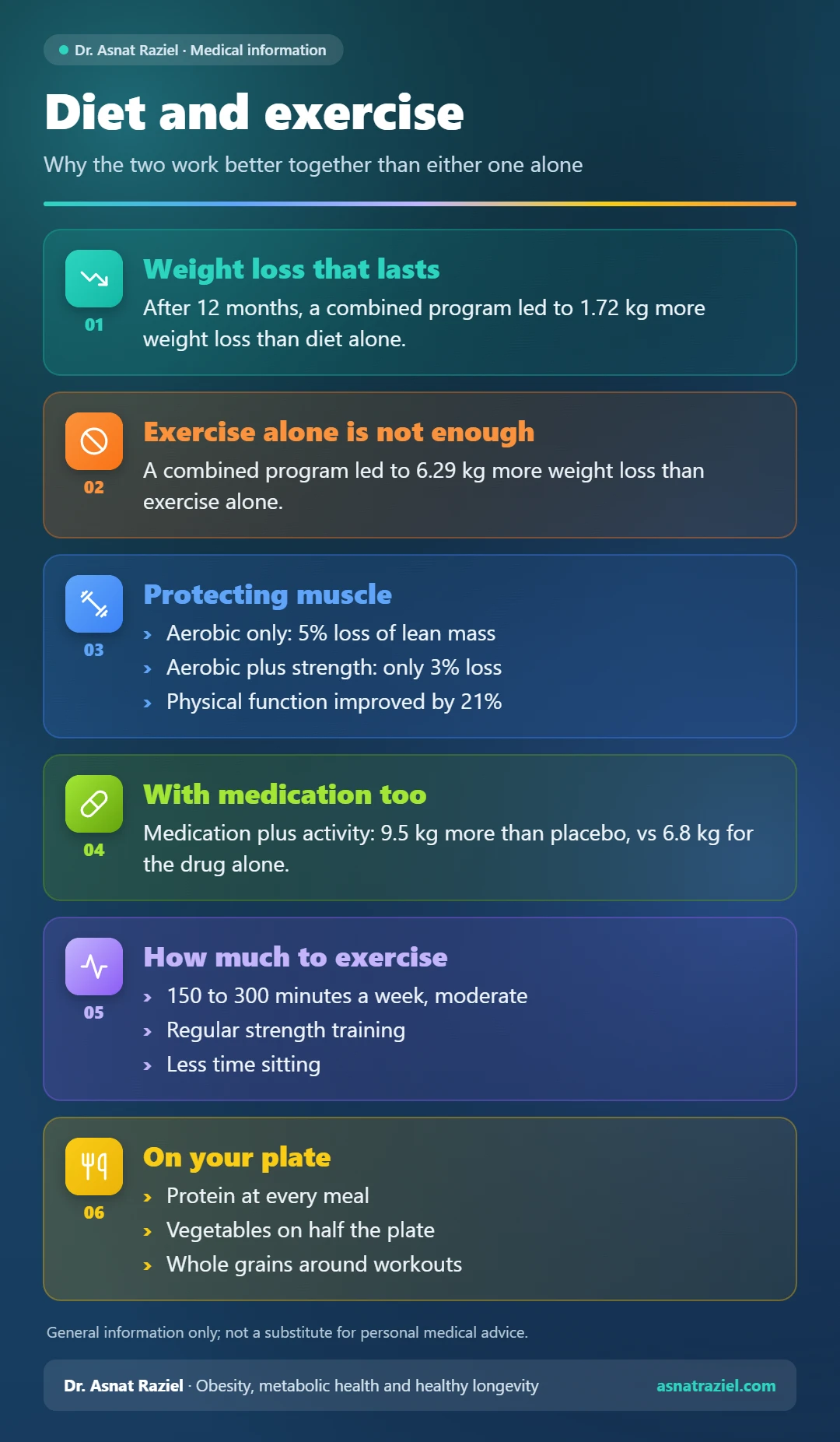
A systematic review and meta-analysis compared diet-only programs, exercise-only programs and programs that combined the two. All of the studies in it lasted at least a year. In the short term, at 3 to 6 months, the researchers found no significant difference between diet alone and a combined program. However, after 12 months, the combined program led to an average of 1.72 kg more weight loss.
By contrast, programs based on exercise alone were much weaker. Compared with exercise alone, the combined program led to 6.29 kg more weight loss after 12 to 18 months. In other words, exercise by itself takes off only a little weight. But when you add it to a healthy diet, the result lasts a long time.
Diet and exercise protect your muscles
Whenever you lose weight, your body also loses muscle mass, not just fat. A study published in NEJM followed 160 older adults with obesity who took part in a weight-loss program. The researchers assigned them to aerobic training, strength training, a combination of both, or a control group. In all of the exercise groups, participants lost about 9% of their body weight.
The difference was in what they lost. In the aerobic group, lean body mass fell by 5%, whereas in the combined group it fell by only 3%. In addition, physical function improved by 21% in the combined group, compared with 14% in each of the other two groups. I wrote about ways to protect your muscles in detail in my article on preserving muscle mass during weight loss.
Diet and exercise alongside medication
Even in the era of obesity medications, exercise remains part of treatment. A controlled Danish study included 195 people with obesity who lost an average of 13.1 kg on an 8-week low-calorie diet. The researchers then divided them into four groups for a year: exercise, liraglutide, a combination of the two, or placebo.
After a year, compared with placebo, exercise added 4.1 kg of weight loss, the medication 6.8 kg and the combination 9.5 kg. What’s more, only the combination group also improved blood sugar, insulin sensitivity and physical fitness. The same is true of other treatments, from the Epitomee capsule and Razin (phentermine) to Wegovy and Rybelsus: they are meant to be used alongside healthy eating and physical activity, not instead of them.
How much exercise do you need?
The World Health Organization guidelines recommend that adults get 150 to 300 minutes a week of moderate-intensity activity. Alternatively, 75 to 150 minutes of vigorous activity is enough. The guidelines also recommend regular strength training and less time sitting. In other words, every bit of movement counts, and some activity is better than none. I also looked at the other end of the scale in my article on extreme exercise and memory.
For general background on the components of fitness, see the Wikipedia entry on physical fitness. I wrote about the differences between types of training in my article on aerobic vs. strength training.
A sample active week
What does this look like in practice? Here is a sample week for beginners that you can adapt to any schedule:
- Sunday, Tuesday and Thursday: a brisk 30- to 40-minute walk.
- Monday and Thursday: a 30-minute strength workout, using your body weight, resistance bands or machines.
- Friday or Saturday: an outdoor activity with the family, such as a hike or a bike ride.
Altogether, that adds up to about 150 minutes of aerobic activity and two strength sessions. After a few weeks, gradually add time or intensity. It is important to choose an activity you enjoy, because enjoyment is what keeps you going.
Diet and exercise on your plate
Good nutrition supports your workouts, and good workouts improve your appetite and your sleep. A few simple principles help connect the two:
- Protein at every meal: chicken, fish, eggs, legumes and dairy. You’ll find guidance on how much in my protein intake guide.
- Vegetables on half your plate: they add volume and fiber with few calories.
- Whole-grain carbohydrates around your workout: for example, a slice of whole-grain bread or a piece of fruit before a long session.
- Drinking throughout the day: especially when you exercise in the heat.
A simple post-workout meal could be, for example, a healthy chicken thigh dish with a large salad. That way, you get protein, vegetables and a feeling of fullness without much effort.
How to start without getting injured
First, start gradually. A 20-minute walk every day and two light strength sessions a week are a good beginning. Second, wear comfortable shoes with proper foot support, and insoles if needed. Finally, if you have pain that doesn’t go away, see a physiotherapist. As the NHS explains, physiotherapists treat bone, joint and muscle problems, including sports injuries.
When the scale stops moving
Almost everyone who loses weight reaches a point where the scale stops moving. This is natural, because a smaller body uses less energy. So it is worth taking another look at how much food is on your plate, adding another strength workout and improving your sleep. I wrote about this in my article on the weight-loss plateau. Also remember that a moderate pace is better, as I explained in my article on slow, safe weight loss.
The bottom line
Combining diet and exercise gives better results than either one alone. Diet drives the weight loss, while physical activity protects your muscles and helps you keep the results. Even people taking medication will benefit from regular workouts. Ultimately, the best plan is the one you can stick with for years.
The information in this article is general and does not replace personal medical advice.
Questions and answers
Can I lose weight with exercise alone?
It’s hard. In studies, exercise-only programs led to much less weight loss than combined programs.
Which workout is better, aerobic or strength?
A combination of both. In the study of older adults with obesity, the combination improved physical function and preserved muscle.
Do diet and exercise still matter with weight-loss injections?
Yes. In the Danish study, combining medication with physical activity led to better results than either one alone.
How many minutes a week should I exercise?
According to the World Health Organization, 150 to 300 minutes at moderate intensity, together with regular strength training.
Sources
Aerobic or Resistance Exercise, or Both, in Dieting Obese Older Adults
Healthy Weight Loss Maintenance with Exercise, Liraglutide, or Both Combined
World Health Organization 2020 guidelines on physical activity and sedentary behaviour




