By Dr. Asnat Raziel, bariatric surgeon specializing in obesity treatment, metabolic health and healthy longevity; Director of the Multidisciplinary Center for Obesity Treatment, Assia Medical, Assuta Ramat HaChayal, Tel Aviv
Lifespan heritability: is longevity passed down in families?
A study from Israel’s Weizmann Institute of Science suggests that lifespan heritability is greater than the commonly accepted estimates. In other words, genetics may play a bigger role in the differences in how long people live. The researchers arrived at an estimate of about 55% for the heritability of lifespan linked to intrinsic mortality. What does this mean for us, and what is still in our hands?
A related question is how long humans can live at all, which I explore in the limit of human lifespan.
When someone turns 100, people almost always ask them for the secret. Is it the diet? The daily walk? Optimism? Family? The story of Maria Branyas, who lived more than 117 years, shows how much curiosity people who reach a very old age arouse.
But alongside habits and circumstances, there is one factor we cannot choose: the genetic makeup we received from our parents. The study from Rehovot came out on January 29, 2026, and it suggests that genetics plays a larger role than previously thought. Even so, this figure describes differences between people in a population. It does not mean that genes decide half of a person’s life in advance. And it certainly does not mean there is no point in taking care of your health. I have also written about the broader link between genes and long life in my article on genetics and longevity. Here, we will focus on the study itself: how the researchers designed it, what it found and what its critics say.
Why did we think genes mattered less?
For years, many studies estimated the heritability of lifespan at about 20% to 25%. For example, a Danish study from 1996 included 2,872 twin pairs born between 1870 and 1900. It estimated heritability at 26% in men and 23% in women.
A 2018 study in the journal Genetics reached an even lower estimate, well below 10%. The researchers found similarities in lifespan even between in-laws, who share a family only through marriage. Therefore, they concluded that part of the family resemblance comes from people choosing partners with similar traits, and not only from shared genes.
This distinction matters. Family members often share living conditions, income, education and habits as well. So the fact that a grandmother and her daughter both lived long lives does not, on its own, reveal how much of that advantage came from genes.
The accident that can hide the picture
Imagine two identical twins. One dies in an accident at age 30, and the other lives to 90. The huge difference between them does not necessarily reflect a difference in their biological capacity to age.
However, in a study based on age at death, cases like this are also part of the calculation. When we add them to many other data points, the link between genes and lifespan may look weaker.
The researchers call factors such as accidents, infections and environmental hazards “extrinsic mortality.” They wanted to separate their effect from that of internal processes, such as declining body function and age-related diseases. This separation is especially important in historical data, from periods when infectious diseases claimed many lives. Still, as we will see below, the line between an external cause and an internal one is not always sharp.
What did the lifespan heritability study examine?
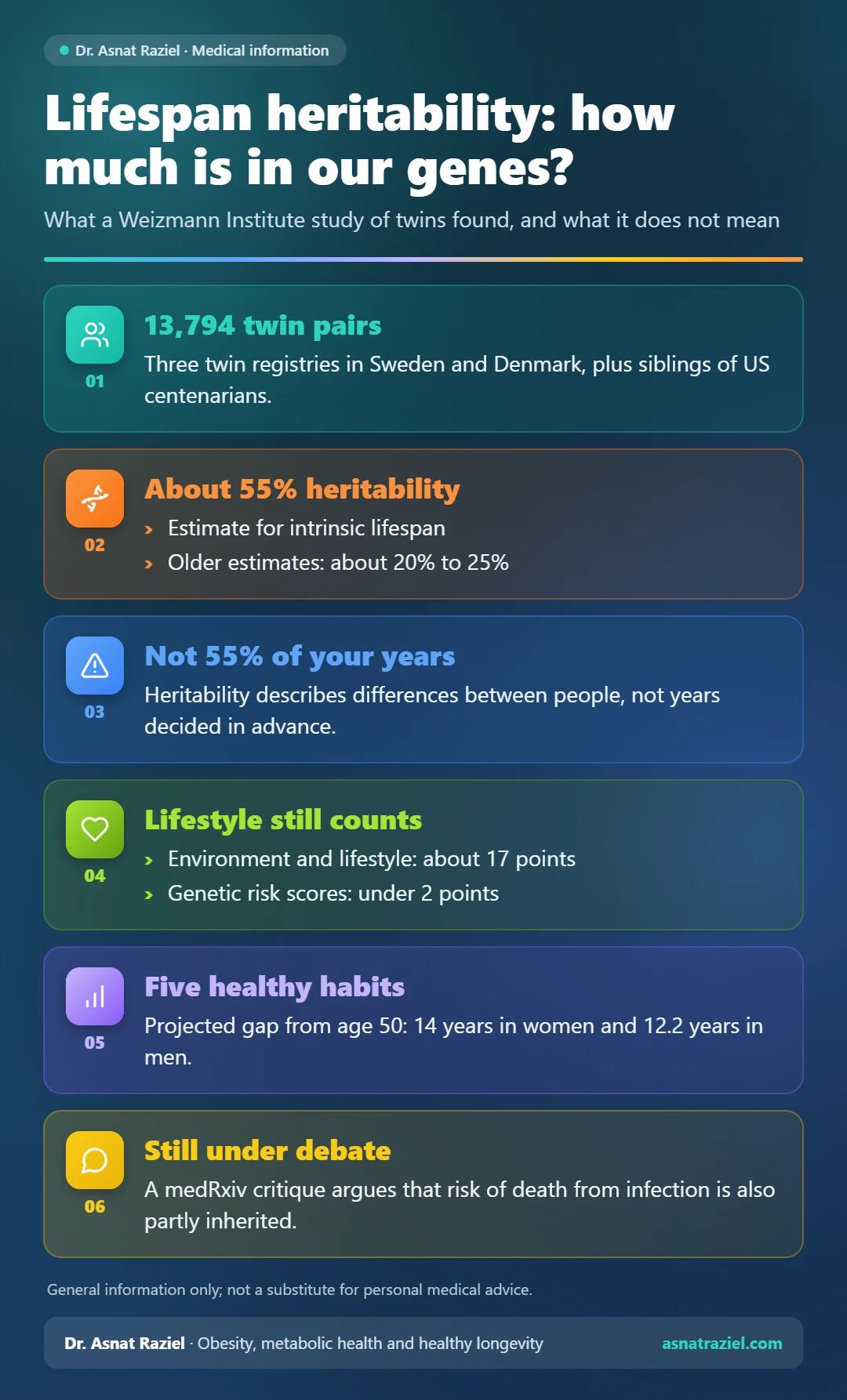
The study appeared in the journal Science. Ben Shenhar from Prof. Uri Alon’s group led the work. The Weizmann team combined data from three twin registries in Sweden and Denmark, with a total of 13,794 twin pairs. In addition, a further analysis relied on data from siblings of centenarians in the United States.
One of the registries is SATSA, the Swedish Adoption/Twin Study of Aging, which also includes twins who grew up apart. A comparison like this helps test the contribution of heredity when the childhood environment differs. The researchers compared identical twins with non-identical twins, who share on average about half of the inherited genetic variation.
Using two mathematical frameworks, they estimated what heritability would be in a scenario without extrinsic mortality, among people who reached age 15. This is a research calculation of “intrinsic lifespan.” That is, no real population lives without accidents, infections or other risks.
The combined estimate was 55%, with a standard error of one percentage point. By contrast, in the SATSA registry the uncorrected estimate was 33%, with a standard error of six percentage points. You should not compare these two numbers directly. The first combines registries and models under standardized conditions. Meanwhile, the second refers to a single registry and to participants who survived to age 61.
What does the 55% figure actually mean?
“Heritability” is a statistical term. According to the US National Library of Medicine, it describes how much of the variation in a trait among people in a given population is linked to genetic differences.
It does not divide a person’s life into years from genes and years from habits. Someone who lives to 100 did not get 55 years from their parents and another 45 from diet and exercise. Moreover, we cannot conclude that the non-genetic part is entirely under our control. Life circumstances, exposure to risks and random biological processes are not personal choices.
Furthermore, heritability depends on the environment where researchers measure it. When people’s living conditions are more similar, genetic differences may explain a larger share of the differences that remain. And within the same population, a shared improvement in living conditions can still benefit many people. So a high genetic share is no reason to give up on prevention.
Lifestyle is still a central part of the story
A study led by the University of Oxford appeared in 2025 in Nature Medicine. It examined data on 492,567 participants in the UK Biobank, a large British health and genetic database.
After accounting for age and sex, information on environment and lifestyle explained about 17 more percentage points of the variation in mortality. In contrast, genetic risk scores for 22 diseases explained less than two additional percentage points. Among the leading factors were smoking, socioeconomic status, physical activity and living conditions.
In addition, a US study in Circulation drew on 123,219 participants. It found a link between lifestyle and longer life expectancy. The researchers looked at not smoking, physical activity, healthy weight, a high-quality diet and moderate alcohol intake. In projections of life expectancy from age 50, the gap between people who met all five criteria and those who met none was 14 years in women and 12.2 years in men.
These are estimates from an observational study, not a promise that adopting these habits will add that many years for everyone. Also, including alcohol in the study’s score is not a recommendation to start drinking.
Lifespan heritability versus lifestyle research: a contradiction?
At first glance, this picture looks very different from the Weizmann study. But the studies do not measure the same thing. The British study examined how well environmental factors and risk scores based on known genetic variants predict outcomes. The twin study, on the other hand, tried to estimate the inherited contribution to intrinsic lifespan. So you cannot directly compare 2% with 55%.
The new estimate is still under debate
In February 2026, a researcher posted a scientific critique on medRxiv, a server for medical preprints that have not yet gone through peer review. One of its arguments is that susceptibility to severe infections can also run in families. If so, death from infection is not necessarily an external factor unrelated to genes.
The preprint also raises questions about the effect of selecting participants who survived to a certain age, and about interactions between genes and environment. This does not settle the matter against the study. Nevertheless, it is an important reminder: the estimate rests on model assumptions. Even a small standard error does not necessarily capture all the uncertainty in those assumptions.
Therefore, the accurate way to put it is that the study proposes a higher estimate of heritability. It did not prove how much of each person’s life is predetermined.
Can we find the genes that protect us?
Here lies one of the most intriguing possibilities. If heredity plays a larger role, the search for genetic differences linked to longevity may reveal important protective mechanisms.
For example, variants in the FOXO3 gene showed a link to longevity in a study of American men of Japanese descent in Hawaii. Similarly, a preliminary study from Leiden identified a rare variant in the CGAS gene in long-lived families. The researchers examined its effect on cellular mechanisms related to inflammation and aging.
Some protective variants seem to work by calming inflammation. I describe one example in my article on inflammaging in long-lived families.
These are biological clues, not ready-made treatments. Many stages of research lie between finding a genetic link and developing a safe, effective drug. The Max Planck Institute for Biology of Ageing notes that changes in certain genes greatly extend life in worms and flies. However, they may also carry biological costs. What extends life in the lab is not necessarily right for humans.
What can we take from this into everyday life?
The study offers no basis for recommending a commercial test that predicts how many years we will live. Nor does it examine NAD+ infusions (NAD+ is a molecule involved in producing energy in cells), peptides or supplements. To evaluate a specific treatment, you need to look directly at the evidence for it.
On the other hand, family history can add information to the conversation with your doctor. Which diseases have appeared in your family, and at what age? How well did relatives who lived long lives function? This information becomes meaningful alongside your personal health status and lifestyle.
Ultimately, the goal is not just to reach old age. What matters is how many of those years we spend functioning well, independently and able to do what is important to us. The Weizmann study does not directly answer questions about years of independence and function. For that, it is worth looking at actual abilities, using the intrinsic capacity approach.
Bottom line: what the lifespan heritability study teaches us
Genes may explain more of the differences in lifespan than we thought. The practical question is how to learn from these protective mechanisms while we keep reducing risks and preserving function. The future of longevity medicine may grow out of the connection between the two.
The information in this article is general and is not a substitute for personal medical advice.
References
Heritability of intrinsic human life span is about 50% when confounding factors are addressed
Rethinking Longevity: Genes Matter More Than We Thought
Integrating the environmental and genetic architectures of aging and mortality
Impact of Healthy Lifestyle Factors on Life Expectancies in the US Population
Misclassification of heritable mortality undermines estimates of intrinsic life span heritability
FOXO3A genotype is strongly associated with human longevity