By Dr. Asnat Raziel, bariatric surgeon specializing in obesity treatment, metabolic health and healthy longevity; Director of the Multidisciplinary Center for Obesity Treatment, Assia Medical, Assuta Ramat HaChayal, Tel Aviv
Fatty liver and the heart: a link many people miss
Fatty liver and the heart are connected far more closely than most people imagine. For years, fatty liver was seen as a local liver problem. It was often discovered by chance, and nobody rushed to treat it. Over the past decade, however, our understanding has changed profoundly. Today it is clear that fatty liver is a central feature of a metabolic disease that affects the whole body, and especially the heart and blood vessels.
The disease’s new name, MASLD (metabolic dysfunction-associated steatotic liver disease), reflects its true nature. The joint European guidelines define it as liver fat together with at least one cardiometabolic risk factor, without harmful alcohol intake. In other words, this is not a problem caused by something the patient “did wrong.” Rather, it results from insulin resistance, chronic inflammation and disrupted regulation of fats and sugars.
A silent epidemic on a global scale
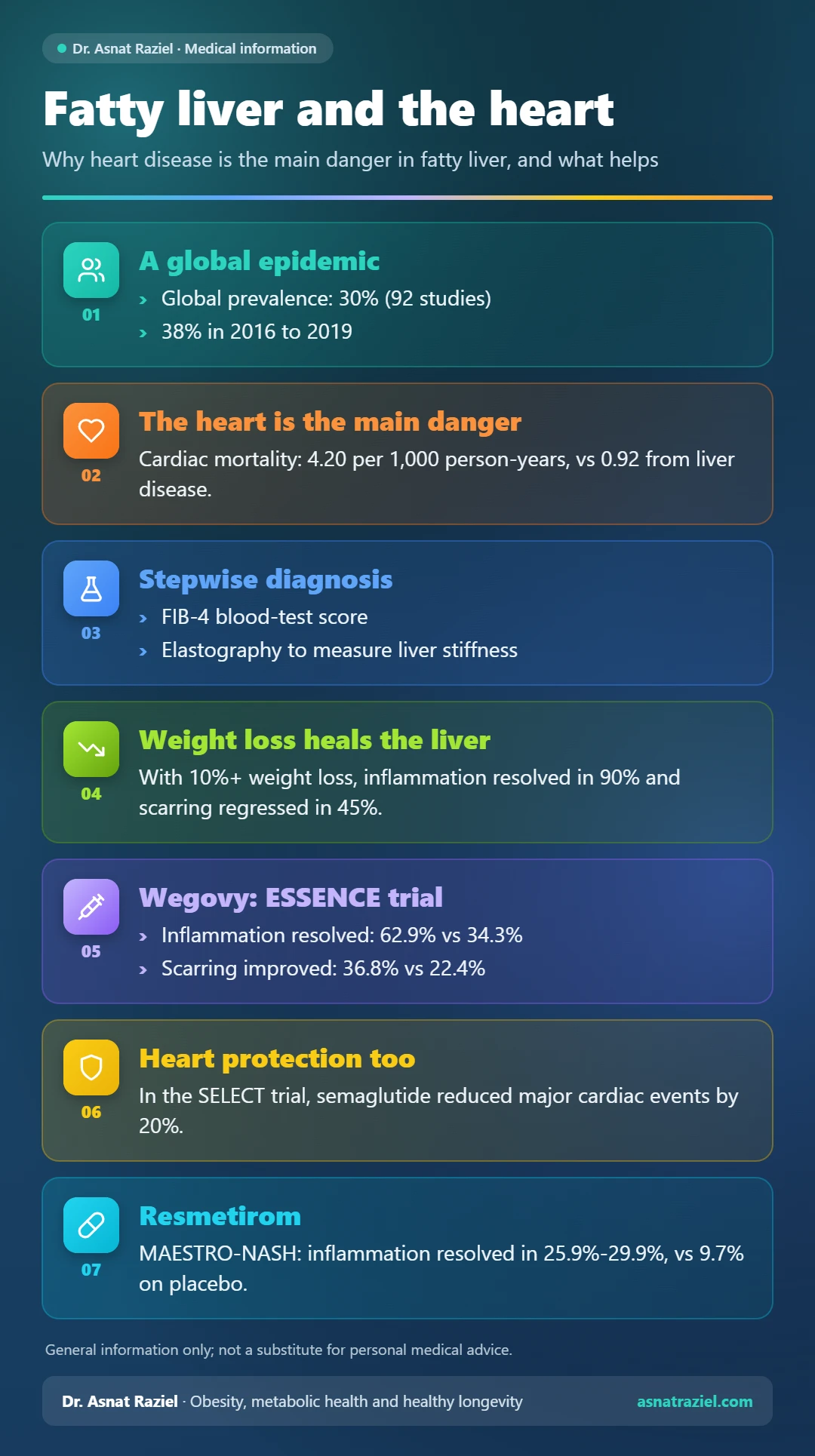
MASLD is one of the most common diseases in the world. A meta-analysis of 92 studies with more than 9 million participants estimated its global prevalence at 30%. Moreover, in 2016 to 2019 the rate reached 38%. Among people with obesity or type 2 diabetes, the prevalence is much higher. Even so, most patients have no idea they have the disease.
The reason is simple: in most cases there are no symptoms. The liver does not “hurt,” blood tests may be normal, and the disease progresses silently. In some patients, only fat builds up. In others, chronic inflammation, scarring, cirrhosis and even liver cancer develop. And yet, most people with fatty liver do not die of liver complications, but of cardiovascular disease.
Fatty liver and the heart: where the real risk hides
Research from recent years is sharp and clear. A scientific statement from the American Heart Association concluded that atherosclerotic heart disease is the leading cause of death in people with fatty liver. The numbers tell the same story. In the meta-analysis I mentioned, cardiac mortality was 4.20 per 1,000 person-years of follow-up. By contrast, mortality from liver disease was only 0.92.
People with MASLD face a high risk of heart attack, stroke, heart failure and arrhythmias. As the liver disease advances, the cardiac risk rises too. This link is no coincidence. Fatty liver is part of a broader picture of insulin resistance, systemic inflammation and deep abdominal (visceral) fat. These are exactly the mechanisms that lead to atherosclerosis and heart disease. Put another way, the liver acts as an early warning light for the whole system. I describe the broader picture in my article on cardiovascular-kidney-metabolic syndrome.
Why the disease gets missed
One of the main problems is underdiagnosis. Because there are no symptoms, and blood tests do not always reflect how severe the disease is, diagnosis often comes late. Quite often, fatty liver turns up by chance on an ultrasound done for a completely different reason.
That is why the guidelines recommend actively looking for the disease in people at risk. This means people with obesity, diabetes, high blood pressure, abnormal blood lipids or abdominal obesity. The guidelines suggest a stepwise approach. First, doctors calculate a simple blood-test score called FIB-4, which estimates the degree of scarring. If needed, the next step is elastography, a noninvasive test that measures liver stiffness. This way, advanced disease can be found before complications appear. You will find a detailed diagnostic guide in my article on diagnosing and treating fatty liver.
Treatment that starts with lifestyle, but does not end there
The foundation of treatment is lifestyle change. A study with repeat liver biopsies showed that the amount of weight lost determines the degree of improvement. In those who lost 10% or more of their weight, liver inflammation resolved in 90% of cases, and scarring regressed in 45%. A loss of 7%-10% also improved the liver, mainly in patients with few risk factors. A balanced diet, less ultra-processed food, regular physical activity and better body composition are the cornerstones.
Fatty liver and the heart in the era of new drugs
In recent years, drug treatment has also advanced dramatically. In the ESSENCE trial, patients with MASH (an inflammatory form of fatty liver) and moderate to advanced scarring received semaglutide 2.4 mg. After 72 weeks, the inflammation resolved in 62.9% of patients, compared with 34.3% on placebo. Scarring improved in 36.8%, compared with 22.4%. Following these results, the FDA approved Wegovy in August 2025 for MASH without cirrhosis. I wrote about the trial in detail in my article on Wegovy for fatty liver.
Semaglutide has a double advantage, because it also protects the heart. In the SELECT trial, it reduced major cardiac events by 20% in people with obesity and heart disease but without diabetes. Tirzepatide, the active ingredient in Mounjaro, showed liver improvement in a phase 2 trial. However, as of November 2026 it is still not approved for this indication, and the large phase 3 SYNERGY-OUTCOMES trial is still recruiting. You can find the details in my article on Mounjaro and fatty liver.
A liver-specific drug has also come into use. Resmetirom, which acts directly on liver cells, led to resolution of inflammation in 25.9%-29.9% of patients in the MAESTRO-NASH trial, compared with 9.7% on placebo. In cases of severe obesity, bariatric surgery is another effective tool. It improves weight, the liver, diabetes and other related conditions.
The bottom line on fatty liver and the heart
Fatty liver is not an isolated problem, but a sign of a broader metabolic disease. Modern care for MASLD therefore requires a multidisciplinary view. It treats not only the liver, but also the heart, the blood vessels, body composition and lifestyle. Anyone who understands the link between fatty liver and the heart knows that timely diagnosis and combined treatment save lives. Ultimately, it pays to act long before the liver itself “cries for help.”
The information in this article is general and does not replace personal medical advice.
References
Phase 3 Trial of Semaglutide in Metabolic Dysfunction-Associated Steatohepatitis
FDA Approves Semaglutide (Wegovy) Injection 2.4 mg for Noncirrhotic MASH
Semaglutide and Cardiovascular Outcomes in Obesity without Diabetes
A Phase 3, Randomized, Controlled Trial of Resmetirom in NASH with Liver Fibrosis
The ESSENCE and SELECT trials were funded by Novo Nordisk, and the MAESTRO-NASH trial by Madrigal.