By Dr. Asnat Raziel, bariatric surgeon specializing in obesity treatment, metabolic health and healthy longevity; Director of the Multidisciplinary Center for Obesity Treatment, Assia Medical, Assuta Ramat HaChayal, Tel Aviv
Obesity treatment success: beyond the number on the scale
Obesity treatment success is not just about the number on the scale. Weight loss is almost always seen as an achievement. The needle moves left, clothes get looser and the people around you cheer you on. However, modern medicine pauses for a moment to ask a deeper question: is every weight loss really a health success? The answer is not always.
Weight loss is a means, not the goal
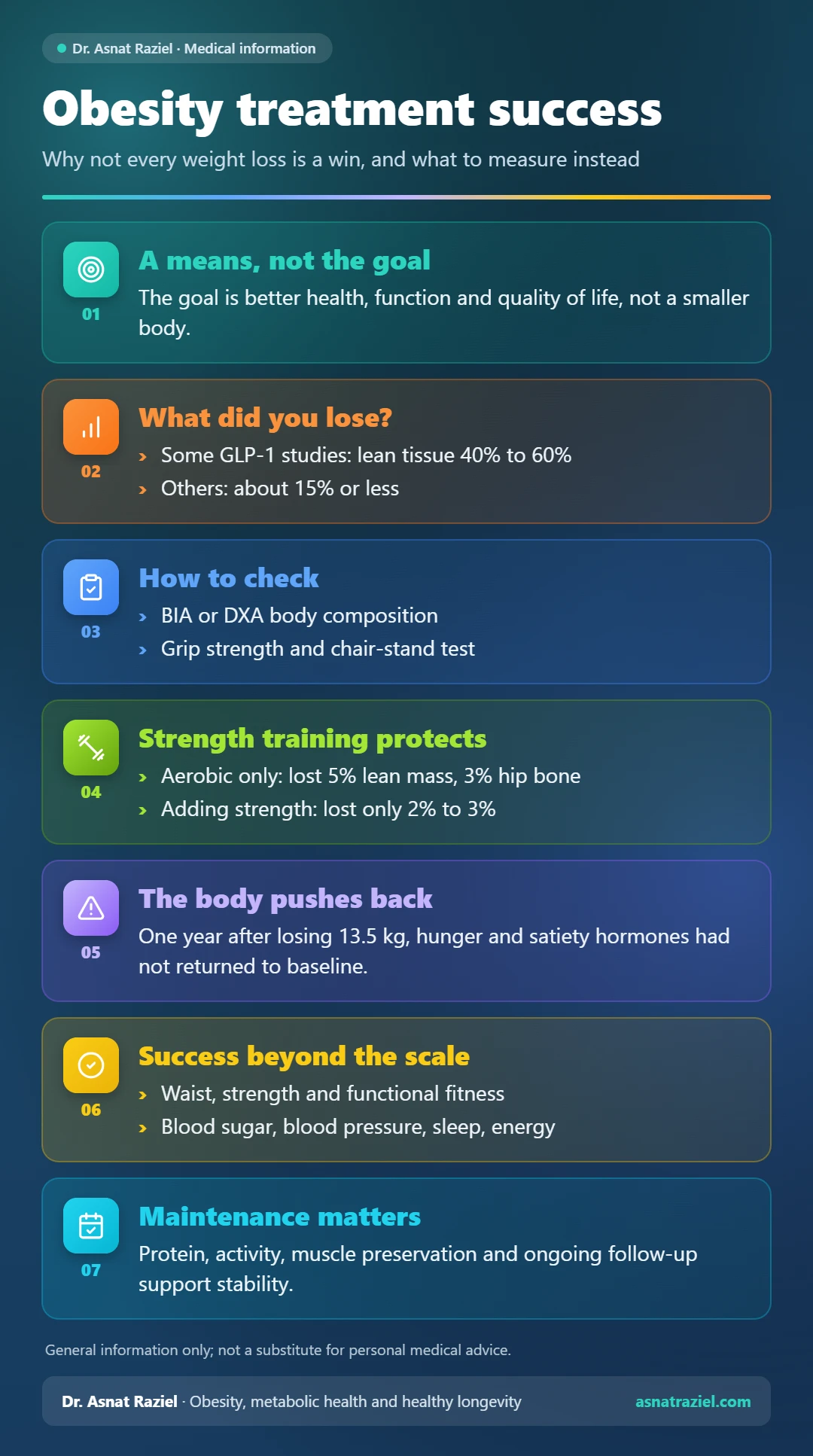
The goal of obesity treatment is not to make the body smaller. Rather, the goal is to improve health, function and quality of life. Weight loss is a tool along the way, not the goal itself. Therefore, when weight loss comes at the expense of muscle, bone, energy or mental health, the achievement is only an illusion.
The medical definition of the disease also reflects this approach. In 2025, the Lancet commission on the diagnosis of clinical obesity defined clinical obesity as a disease in which excess fat impairs organ function or daily activities. In other words, success should also be measured by function, not just by kilograms. When the body becomes weaker, the number goes down, but health does not improve.
What did the weight actually come from?
The important question is not “how much did I lose?” but “what did I lose?” Weight loss that comes mainly from fat improves metabolic markers and lowers the risk of disease. In contrast, weight loss that comes with a large loss of muscle can slow your metabolism, reduce your fitness and raise the risk of regaining weight.
The data here are not uniform. A review of GLP-1 drugs found large differences between studies. In some, lean tissue made up 40% to 60% of the weight lost, while in others it was only about 15% or less. The researchers note that older age and more severe disease raise the risk of muscle loss. I wrote about this in my article on why body composition matters more than weight.
So how do you know what the weight came from? A body composition test with a BIA device, which measures using a weak electrical current, shows the ratio of fat to muscle. A DXA scan, which uses low-dose radiation, is especially accurate. In addition, measuring grip strength and doing a chair-stand test add information about muscle function. This way, unwanted muscle loss can be detected in time and the course can be corrected.
Muscle is a vital tissue for health. It is responsible for stability, strength, blood sugar control and energy expenditure. As a result, damage to muscle makes the achievement fragile and short-lived.
When losing weight too fast harms the body
Sharp, rapid weight loss, especially without professional support, can cause a range of problems. For example, it can lead to weakness, dizziness, fluid imbalances, muscle loss and reduced bone density. In older adults, the consequences are especially serious, because the risk of falls and loss of independence goes up.
A study published in NEJM included 160 older adults with obesity, who lost about 9% of their body weight. Those who did only aerobic training lost 5% of their lean body mass and 3% of their hip bone density. In contrast, those who added strength training lost only 2% to 3% of their lean body mass. In other words, the same weight loss can leave behind either a strong body or a weak one.
Furthermore, the body responds to weight loss with compensatory mechanisms. A study of appetite hormones followed patients who lost an average of 13.5 kg. Even one year after the diet, levels of hunger and satiety hormones had not returned to baseline, and hunger remained high. These mechanisms set the stage for weight regain.
Obesity treatment success measures you can’t see on the scale
Weight does not tell the whole story. Equally important measures include:
- Body composition: the ratio of fat to muscle
- Waist circumference
- Strength and functional fitness
- Blood sugar and blood pressure control
- Sleep quality and daily energy
Sometimes a patient who lost only a little weight but improved these measures is far better off than someone who lost a lot and harmed their body. For example, in a study by Magkos and colleagues, losing just 5% of body weight improved insulin sensitivity in the liver, muscle and fat tissue. Likewise, a normal weight is not always a sign of health, so it is important to look at the full picture.
The mental side: a hidden cost
Weight loss that comes with extreme restrictions, constant hunger and anxiety around food can harm mental health. Feelings of failure, guilt or a fear of regaining weight turn the achievement into a burden. Similarly, body image after major weight loss also needs attention. Ultimately, true treatment success allows for a balanced life, not a daily struggle.
Obesity treatment success: maintaining results over time
Success in obesity treatment is measured not only by weight loss, but also by the ability to maintain it. A review by Hall and Kahan describes an almost constant pattern: early weight loss, then a plateau and then gradual regain. That is why they recommend ongoing medical follow-up, as with any chronic disease.
Weight loss that cannot be maintained is not a solution, but a temporary fluctuation. Good treatment builds a foundation: tailored nutrition with enough protein, physical activity, muscle preservation and, at times, medication. Together, they make stability possible. I expanded on this stage in my article on maintaining your weight after major weight loss.
Obesity treatment success: from “how much did I lose” to “how much did I improve”
The shift from “how much did I lose?” to “how much did I improve?” is a fundamental change. When the conversation focuses on health rather than numbers, it is easier to set realistic goals and stick with them. It is also easier to experience success that does not depend only on the needle.
In practice, I suggest that patients ask themselves a few simple questions at every visit. Is it easier for me to climb stairs? Am I sleeping well at night? Have my blood sugar and blood pressure improved? Your clothes, the strength in your hands and your mood also say a lot. That is why I recommend measuring body composition and waist circumference, rather than relying on your home scale alone. When the answers are positive, that is real success, even if the number moves slowly.
The bottom line
Not every weight loss is a success, but every improvement in health is. Obesity treatment should aim for a body that is strong, functional and healthy, not just lighter. When the measures of obesity treatment success include strength, stability and quality of life, weight returns to its proper place: one data point within a much broader picture.
The information in this article is general and does not replace personal medical advice.
References
Definition and diagnostic criteria of clinical obesity
Changes in lean body mass with glucagon-like peptide-1-based therapies and mitigation strategies
Aerobic or Resistance Exercise, or Both, in Dieting Obese Older Adults
Long-term persistence of hormonal adaptations to weight loss
Maintenance of Lost Weight and Long-Term Management of Obesity




