By Dr. Asnat Raziel, bariatric surgeon specializing in obesity treatment, metabolic health and healthy longevity; Director of the Multidisciplinary Center for Obesity Treatment, Assia Medical, Assuta Ramat HaChayal, Tel Aviv
Metabolic reset: what it really means
A metabolic reset is a popular idea on social media, but in medical science there is no button that resets your metabolism. Still, there are real processes that affect how fast you burn energy, your appetite and your blood sugar balance. In this article, I explain what happens to your metabolism during weight loss, what research shows and what really helps.
The goal is not to “speed up” your metabolism by magic. The goal is to improve your metabolic health over the long term.
What is metabolism?
In simple terms, metabolism is the sum of all the processes by which the body turns food into energy and building blocks. Your daily energy expenditure has three main parts. First, resting metabolism, meaning the energy the body uses just to stay alive. Second, the energy spent on digesting food. Finally, all the movement during the day, including walking, standing and household chores.
In addition, hormones steer the entire system. Insulin, thyroid hormones, hunger and satiety hormones and stress hormones determine how much we eat and how the body uses energy. I wrote about this at length in my article on the role of hormones in weight loss.
Does age slow down your metabolism?
Many people are sure that their metabolism plummets by age 30 or 40. A large study published in the journal Science examined the energy expenditure of people aged 8 days to 95 years. The researchers found that between the ages of 20 and 60, after adjusting for fat-free mass, energy expenditure stays stable. The decline begins only after age 60.
In other words, weight gain in midlife is mainly due to changes in habits, sleep, movement and muscle mass. That is why a real metabolic reset starts with preserving muscle and staying active, not with “metabolism-boosting” supplements.
Metabolic reset and the body’s defenses
When you lose weight, the body reacts as if it were in danger. It lowers its energy-burning rate and increases hunger. This phenomenon is called metabolic adaptation. In a study that followed 14 contestants on the TV show “The Biggest Loser,” the participants lost an average of 58.3 kg. Their resting metabolism dropped by 610 calories a day.
Even six years after the competition, their metabolism remained 704 calories a day lower than at the starting point. Meanwhile, they had regained an average of 41 kg. This is an extreme case of very rapid weight loss, but it illustrates an important principle: the body “fights” to hold on to the higher weight. This also explains the weight-loss plateau that so many people experience.
In addition, the brain ramps up thoughts about food. This phenomenon is known as food noise, meaning intrusive, persistent thoughts about food.
Metabolic reset: diet, sleep and processed food
A review of obesity and metabolic health by the U.S. National Institutes of Health (NIH) summarizes several controlled studies. In one study, participants who ate ultra-processed food consumed about 500 more calories a day and gained about 1 kg on average. In another study, adults who slept only five hours a night for two weeks gained about 1.4 kg. Moreover, two days of extra sleep on the weekend did not undo the damage.
The conclusion is simple: weight loss is not only a matter of willpower. Your environment, the type of food you eat and your sleep all change your appetite and the way your body uses energy.
The steps that really help with a metabolic reset
Preserving muscle mass
Muscle is active tissue that uses energy and improves insulin sensitivity. During weight loss, some of the weight you lose is muscle. That is why I recommend strength training two to three times a week and protein at every meal. I covered this in detail in my article on how to preserve muscle while losing weight.
A diet based on real food
It is best to build your menu around vegetables, legumes, fish, eggs, dairy products, whole grains and olive oil. On the other hand, it is worth cutting back on ultra-processed food and sweetened drinks. Gradual weight loss is better than an extreme diet, which intensifies the body’s adaptation.
Movement throughout the day
Beyond the workout itself, walking, climbing stairs and standing also add to your energy expenditure. For example, a short walking break for every hour of sitting helps balance blood sugar.
Sleep and your body clock
Sleeping at least seven hours a night is essential for balancing hunger hormones. Sometimes nasal congestion, for example from sinusitis, or snoring and sleep apnea harm the quality of your sleep. It is worth looking into the cause with a doctor. I wrote separately about the link between sleep and brain health.
Metabolic reset and medication
For some people, lifestyle changes alone are not enough to overcome the body’s biological mechanisms. This is where GLP-1 medications come in. These medications mimic a natural hormone that increases fullness, slows stomach emptying and improves insulin release. In this way, they reduce hunger and food noise.
However, medication is not a substitute for nutrition, movement and preserving muscle. In our clinic, we combine medication treatment with support from a dietitian and a trainer, according to each patient’s needs.
How to measure the success of a metabolic reset
Weight is just one measure. It is also important to track waist circumference, blood pressure, fasting blood sugar, glycated hemoglobin (HbA1c, your average blood sugar over the past three months) and blood lipids. In addition, a body composition test shows whether the weight you lost came from fat or from muscle. I covered this in more depth in my article on improving metabolic markers.
The bottom line
A metabolic reset is not a one-week diet or a miracle supplement. It is a gradual process of preserving muscle, eating well, moving, sleeping well and, sometimes, taking medication. The body defends itself against weight loss, so it is important to plan the maintenance phase, too. If you are unsure how to start, consider consulting a doctor who specializes in metabolic health. You can read more about Dr. Asnat Raziel and the center.
The information in this article is general and does not replace personal medical advice.
Questions and answers
Can you do a metabolic reset in a few days?
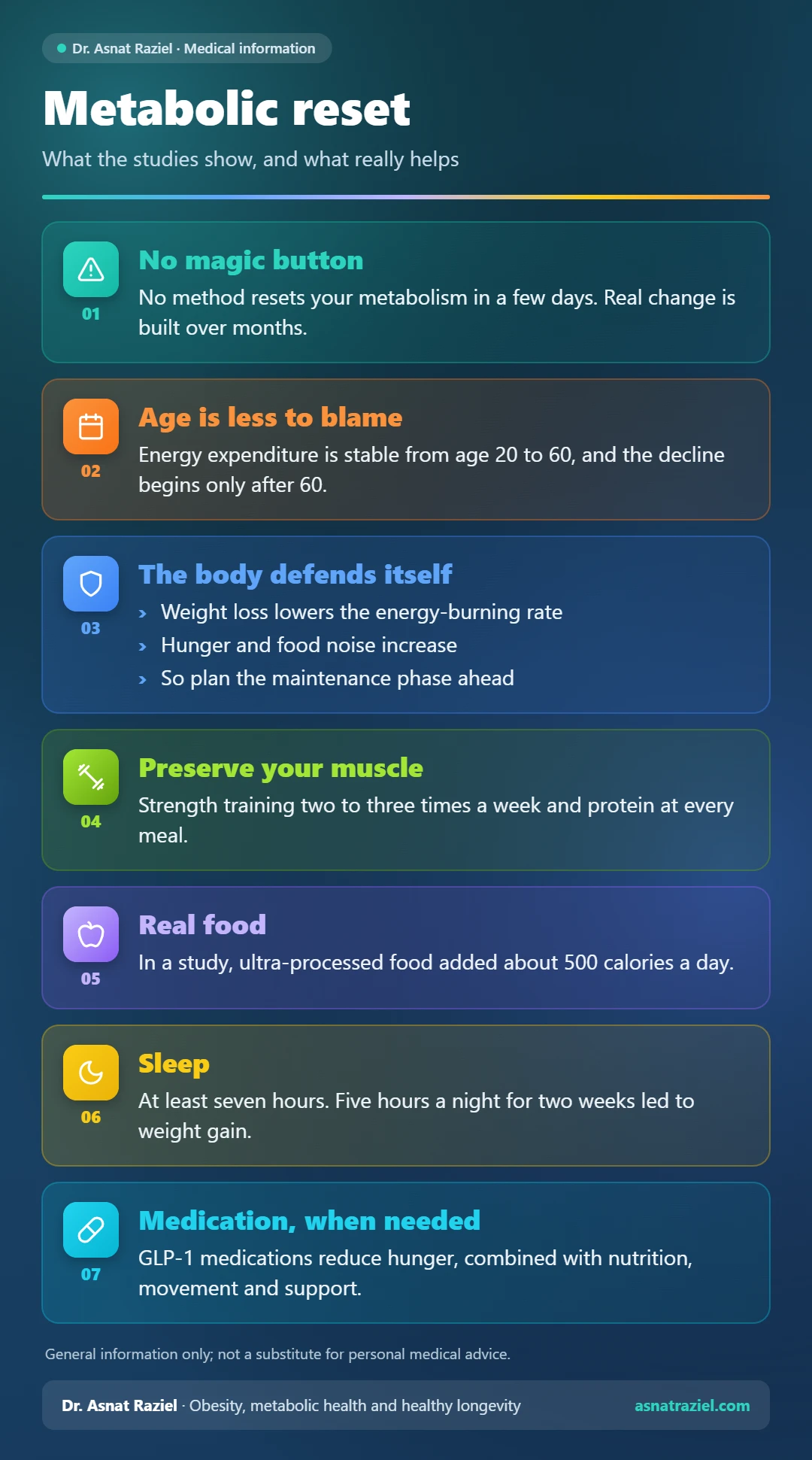
No. There is no proven method that resets your metabolism in a few days. Real change is built gradually, over months.
Does metabolism slow down after age 40?
According to a large study in Science, energy expenditure adjusted for fat-free mass is stable between the ages of 20 and 60. The decline begins only after age 60.
Why is it so hard to keep the weight off after a diet?
The body lowers its energy-burning rate and increases hunger. That is why it is important to preserve muscle, keep up a movement routine and stay under follow-up even after the weight loss.
Do supplements speed up metabolism?
For most supplements, there is no evidence of a significant effect on weight. Strength training, sleep and a high-quality diet have a much greater impact.
Sources
Persistent metabolic adaptation 6 years after “The Biggest Loser” competition
Daily energy expenditure through the human life course