By Dr. Asnat Raziel, bariatric surgeon specializing in obesity treatment, metabolic health and healthy longevity; Director of the Multidisciplinary Center for Obesity Treatment, Assia Medical, Assuta Ramat HaChayal, Tel Aviv
Heart disease in women: a silent risk that is easy to miss
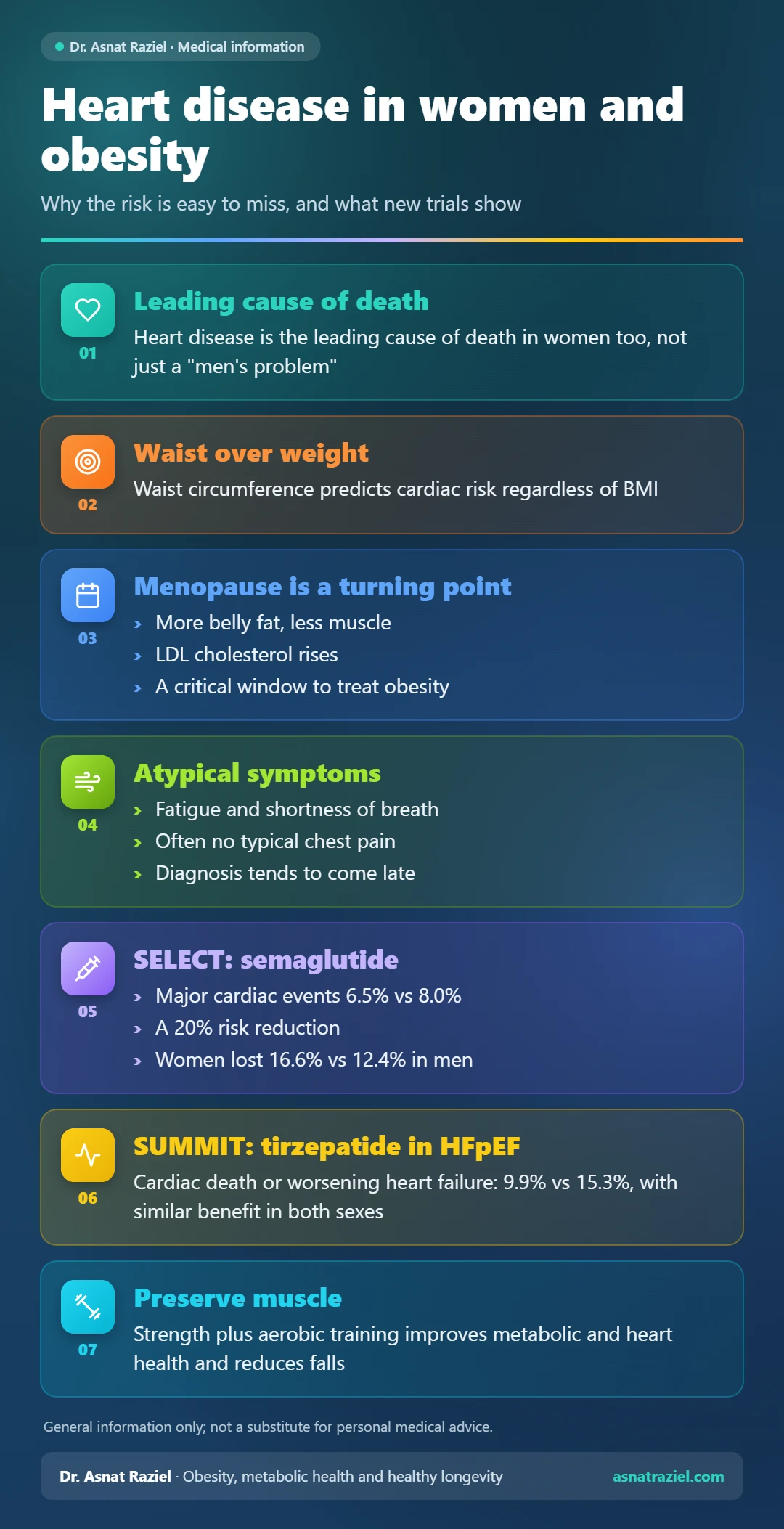
Heart disease in women is sometimes seen as a “men’s problem,” but in reality it is the leading cause of death in women too. In the United States, for example, it is the leading cause of death among women, according to the CDC. When obesity enters the picture, a woman’s cardiac risk takes on unique features. As a result, it is also much harder to diagnose. Understanding how obesity affects the heart differently in women is not an academic exercise. It is a prerequisite for precise treatment, and sometimes it saves lives.
Why the risk looks different in women
Women have different hormonal physiology, a different fat distribution and sometimes atypical cardiac symptoms. Men tend to develop “classic” coronary artery disease, meaning narrowing of the heart’s large arteries. In women with obesity, by contrast, we often see damage to the heart’s small blood vessels, chronic inflammation and a particular type of heart failure. These conditions cause shortness of breath and fatigue, but not always typical chest pain. Consequently, the diagnosis comes late.
The broader topic of obesity and women’s heart health deserves its own discussion. Here, we will focus on what has changed in recent years.
Belly fat and inflammation
Over the years, and especially around menopause, women’s fat shifts to the abdomen and builds up around the internal organs. This is visceral fat. It is inflammatory, releases inflammatory substances and worsens insulin resistance. According to the American Heart Association statement on obesity and cardiovascular disease, waist circumference predicts cardiac risk regardless of BMI (the ratio of weight to height). In other words, even a woman whose BMI is not especially high may be at risk.
Menopause: a turning point for heart disease in women
The drop in estrogen around menopause reduces the natural protection of the blood vessels and speeds up atherosclerosis. The American Heart Association statement describes clear changes during this period: more belly fat, less muscle mass and a rise in LDL, the “bad” cholesterol. Notably, some of the changes in blood lipids stem from menopause itself, not just from aging.
Many women gain weight at this stage, sometimes without any dramatic change in lifestyle. That makes it a critical window for intervention. Treating obesity at this point may prevent the shift from being at risk to having active heart disease. You will find practical information about this stage in my guide to obesity during menopause and treatment options.
Atypical symptoms and late diagnosis
Women with obesity often report “soft” symptoms: fatigue, shortness of breath with light exertion, sleep problems or declining fitness. In practice, many people blame these symptoms on stress, age or poor fitness. This is how developing heart disease gets missed. The American Heart Association describes differences between the sexes in how heart attacks present, in their mechanisms and in their outcomes. What’s more, a 2026 statement found diagnostic delays and misclassification in young women with acute coronary syndrome. For this reason, doctors need a high level of clinical awareness and proactive risk assessment.
Heart failure with preserved ejection fraction
One of the common ways obesity affects a woman’s heart is HFpEF, heart failure with preserved ejection fraction. In this condition, the heart contracts normally, but the heart muscle is stiff and fills with difficulty. Patients experience shortness of breath, swelling and fatigue. For years, there was no particularly effective treatment for it. Today, however, the situation has changed, as we will see below.
Treating obesity as heart treatment
Weight loss and metabolic improvement lower blood pressure, improve the function of the blood vessel walls, reduce inflammation and improve exercise tolerance. You can read about the connection to blood pressure in my article on treating high blood pressure through weight loss. Therefore, obesity medications and a multidisciplinary approach are not just “a way to slim down.” They are an important cardiac tool, especially for women at risk.
The best time to protect the heart is before any problem appears. I explain this in my article on primary prevention of heart disease.
What new studies show about heart disease in women
The SELECT trial included 17,604 people with obesity and existing heart disease, without diabetes. Semaglutide, the active ingredient in Wegovy, lowered major cardiac events to 6.5%, compared with 8.0% on placebo. That is a 20% reduction in risk. However, women made up only about 28% of participants. An analysis of outcomes by sex, published in JACC, found that the benefit was consistent in women and men. In addition, a 2026 analysis found that at peak treatment, women lost 16.6% of their body weight, compared with 12.4% in men. You can read more in my article on how Wegovy protects the heart.
In the SUMMIT trial, 731 patients with obesity and HFpEF received either tirzepatide, the active ingredient in Mounjaro, or a placebo. More than half of the participants were women. Cardiac death or worsening heart failure occurred in 9.9% of the drug group, compared with 15.3% on placebo. A 2026 analysis by sex showed a similar benefit in both sexes. In women, the link between weight loss and symptom improvement was especially strong.
Exercise and preserving muscle
For women, preserving muscle mass is critical. Muscle loss worsens insulin resistance and impairs functional fitness. That is why combining strength training with tailored aerobic activity improves metabolic and cardiac health. It also reduces the risk of falls and fractures. My article on preserving muscle mass explains how to protect your muscles while losing weight.
A gender-informed look ahead at heart disease in women
Looking at obesity through a gender lens changes outcomes. Early detection, treatment tailored to women and an understanding of atypical symptoms make it possible to prevent heart disease in women or delay its onset. Ultimately, treating obesity in women is not a luxury. It is a lifesaving intervention, especially around menopause.
This article provides general information and is not a substitute for personal medical advice.
References
Obesity and Cardiovascular Disease: A Scientific Statement From the American Heart Association
Semaglutide and Cardiovascular Outcomes in Obesity without Diabetes
Predictors of Peak Body Weight Loss With Semaglutide in the SELECT Trial
Tirzepatide for Heart Failure with Preserved Ejection Fraction and Obesity
The SELECT and SUMMIT trials were funded by Novo Nordisk and Eli Lilly, respectively.