By Dr. Asnat Raziel, bariatric surgeon specializing in obesity treatment, metabolic health and healthy longevity; Director of the Multidisciplinary Center for Obesity Treatment, Assia Medical, Assuta Ramat HaChayal, Tel Aviv
Visceral fat: why the scale doesn’t tell the whole story
Visceral fat, the deep fat inside the abdomen, is turning out to be a far more important measure than the number on the scale. For years, we measured success in obesity treatment by a single figure: kilograms. People step on the scale, check how much they have lost and decide whether the treatment worked. However, modern science shows that the story runs much deeper. Not every kilogram is equal to every other kilogram, and not all weight loss delivers the same benefit.
A new Israeli study, published in June 2026 in the journal Circulation, offers a fresh way to look at this. According to the findings, the most important factor for long-term health is not necessarily weight. Instead, the researchers point to the change in the amount of visceral fat, which builds up around the internal organs.
The fat you can’t see is the fat that puts you at risk
When people think about fat, they usually mean subcutaneous fat. This is the fat you can pinch, and it largely shapes how we look on the outside. But there is another, far more harmful type of fat: visceral fat.
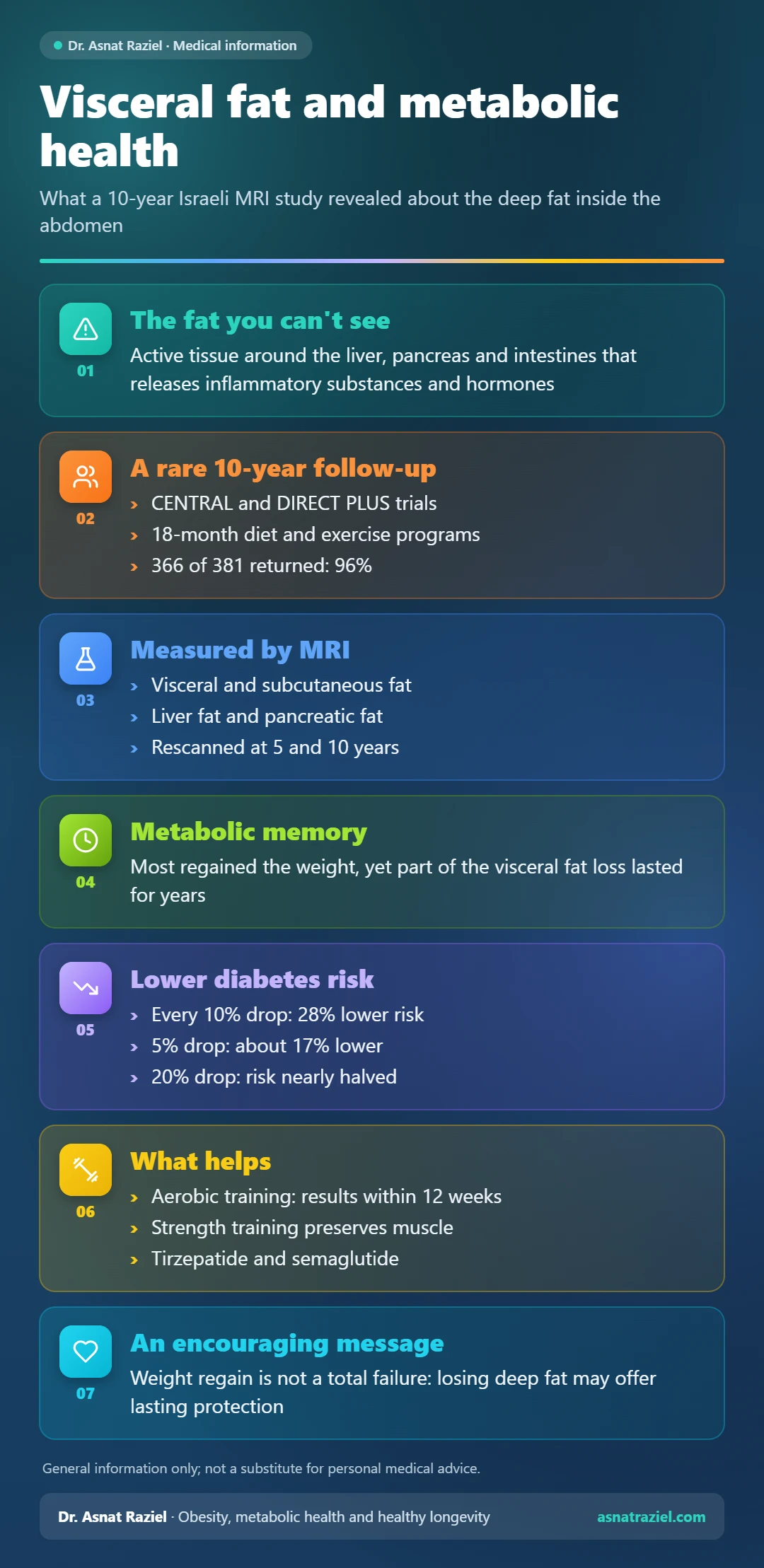
This fat accumulates around the liver, pancreas, intestines and major blood vessels. Unlike subcutaneous fat, it is active tissue that releases inflammatory substances and hormones. Having too much of it is linked to insulin resistance, type 2 diabetes, fatty liver and high blood pressure. In addition, a scientific statement from the American Heart Association concluded that excess visceral fat is an independent marker of cardiovascular risk.
This also explains why two people with the same BMI can be in completely opposite states of health. One person is metabolically healthy, while another has significant metabolic problems. The difference often lies in the amount of deep fat.
An Israeli study with a rare ten-year follow-up
Prof. Iris Shai of Ben-Gurion University of the Negev led the study, together with researchers from Germany and the United States. The team went back to the participants of two well-known nutrition trials: CENTRAL and DIRECT PLUS. In each trial, participants completed an 18-month program that combined diet and exercise.
What makes this study unique is that the researchers did not settle for weight or BMI. Participants had MRI scans that precisely measured the different fat stores: visceral fat, subcutaneous fat, liver fat and pancreatic fat. The researchers then scanned them again 5 and 10 years after the programs ended. What’s more, 366 of the 381 eligible participants returned for follow-up, or 96%.
The metabolic memory of visceral fat
One of the most interesting findings concerns weight regain. Most participants regained all the weight they had lost. And yet, part of the drop in abdominal fat, including visceral fat, lasted even years later. By contrast, liver fat and pancreatic fat came back completely, and pancreatic fat even rose above its starting point.
The researchers found that the body keeps a kind of “metabolic memory” of the loss of deep fat. Participants who reduced it had much better metabolic markers years later. In addition, their risk of developing type 2 diabetes went down. In the paper itself, every 10% drop in visceral fat was linked to a 28% lower risk of diabetes. According to the university’s announcement, a 5% drop was linked to roughly 17% lower risk, and a 20% drop nearly cut the risk in half.
This finding changes how we understand treatment success. In other words, even when the weight comes back, a period of healthy living may leave a biological imprint that lasts for years. That said, this is a follow-up study, so it shows an association and not necessarily cause and effect.
Not all weight loss is the same
In recent years, the concept of “quality of weight loss” has been gaining ground. The idea is that success is not just about kilograms, but also about which tissues the body loses. When a person loses weight, they may lose deep fat, subcutaneous fat, water and sometimes muscle too. The medical goal is to reduce mainly visceral fat and liver fat while preserving muscle mass.
That is why many experts recommend also checking waist circumference, body composition, blood sugar and blood lipids. Good nutrition also improves insulin sensitivity. Body composition, in fact, often matters more than weight alone.
Exercise and medications that hit the right target
Regular exercise reduces visceral fat even without dieting. A meta-analysis of 15 studies found that moderate- to high-intensity aerobic training has the strongest effect. Improvement appeared after as little as 12 weeks. Strength training, meanwhile, preserves muscle during weight loss. You can find a comparison of the two types of training in my article on aerobic vs. strength training.
The new obesity medications also act on deep fat. For example, an MRI substudy of SURPASS-3 showed that tirzepatide (Mounjaro) reduced liver fat and visceral fat volume compared with insulin. Likewise, the SELECT trial showed that semaglutide (Wegovy) cut major cardiac events by 20% in people with obesity and heart disease. The loss of deep fat may be part of the explanation, but this still needs more research. I looked at a different approach in my article on the CBL-514 fat injection.
An encouraging message for patients
One of the most important takeaways from this study is that regaining weight is not a total failure. For years, many people felt that if they did not keep off every kilogram, all their effort had been wasted. The new data paint a far more optimistic picture. Even a limited period of losing deep fat may provide lasting metabolic protection. If you struggle with this worry, you will find practical tools in my article on the fear of regaining weight.
Visceral fat and the future of obesity medicine
This Israeli study joins a clear global trend: a shift from weight to overall metabolic health. In the near future, the key question will not be only how many kilograms a patient has lost. Instead, we will ask how much visceral fat they lost, how much muscle they kept and how much their health markers improved.
Ultimately, the goal is not just to be lighter, but to be healthier. And the most important change often happens deep inside the abdomen, where the fat we cannot see is hiding. This is the fat that has a special impact on our health and our future. You can find more about liver fat in my guide to diagnosing and treating fatty liver.
This article provides general information and is not a substitute for personal medical advice.
References
Visceral Fat Loss Leaves Metabolic Legacy
Obesity and Cardiovascular Disease: A Scientific Statement From the American Heart Association
Semaglutide and Cardiovascular Outcomes in Obesity without Diabetes




