By Dr. Asnat Raziel, bariatric surgeon specializing in obesity treatment, metabolic health and healthy longevity; Director of the Multidisciplinary Center for Obesity Treatment, Assia Medical, Assuta Ramat HaChayal, Tel Aviv
Mounjaro and cholesterol: what you need to know
Mounjaro and cholesterol come up in my conversations with patients almost every day. People arrive with a blood test showing high triglycerides and low HDL, and they ask whether the injection will help with that too. The short answer is yes, to a degree. However, Mounjaro is not a lipid-lowering drug, and it does not replace standard cholesterol treatment.
Cholesterol is not the only metabolic marker worth checking. I also explain high uric acid and gout in a separate article.
What are high blood lipids?
A routine blood test measures several types of fat. LDL cholesterol, the “bad” cholesterol, enters the walls of blood vessels and builds up atherosclerosis. HDL cholesterol, the “good” cholesterol, helps clear cholesterol from the tissues. Triglycerides are fat that the body stores from excess calories, mainly from sugar, white flour and alcohol.
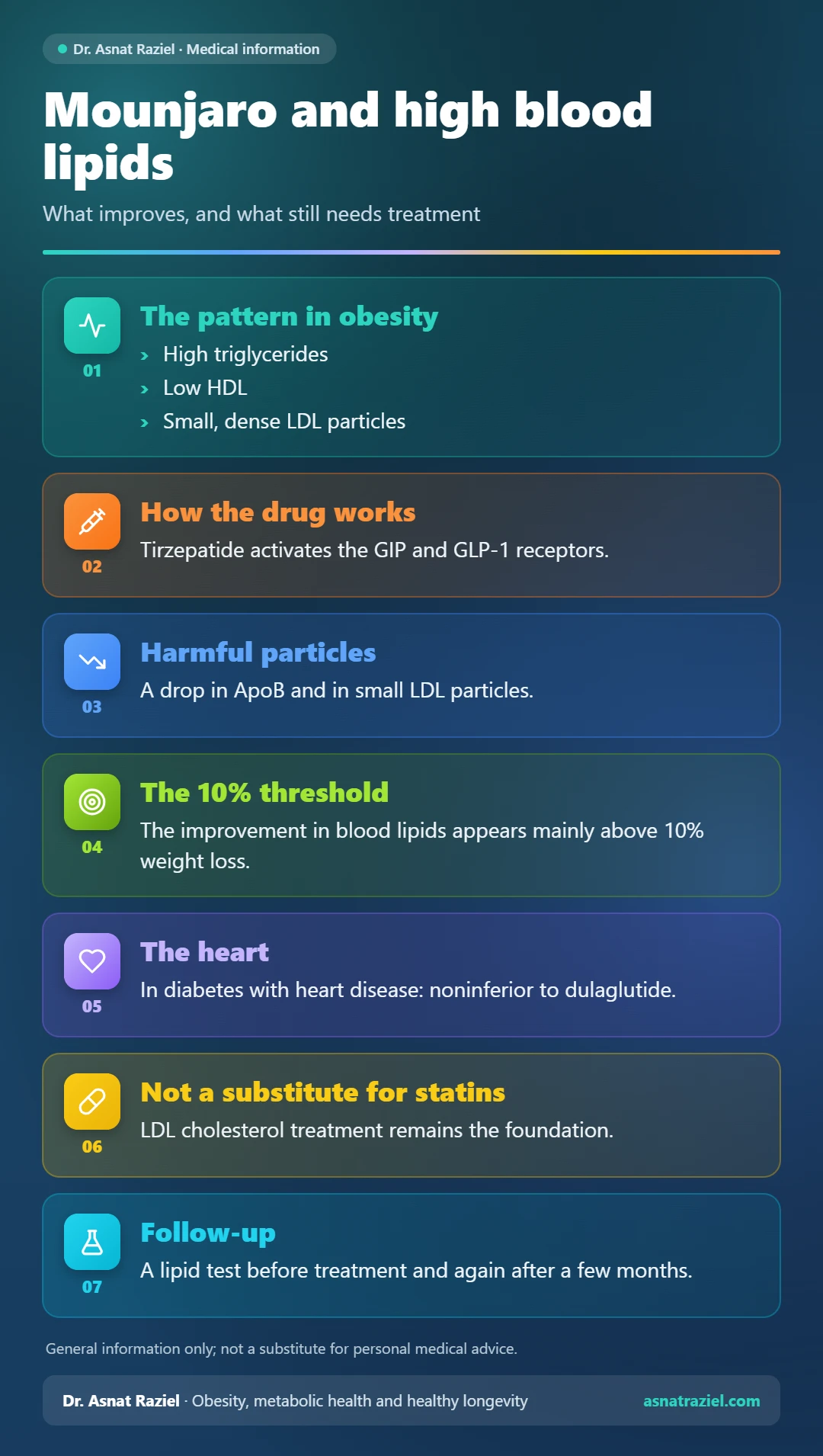
In obesity, and especially abdominal obesity, we usually see a typical pattern. Triglycerides are high, HDL is low, and LDL particles are especially small and dense. This pattern is linked to insulin resistance, and it raises the risk of heart disease even when LDL itself looks reasonable. That is why it often appears together with obesity and type 2 diabetes.
How Mounjaro works
The active ingredient in Mounjaro is tirzepatide. The drug activates receptors for two gut hormones: GLP-1 and GIP. In this way, it reduces hunger, increases fullness and improves blood sugar control. It is given as a once-weekly injection, and the dose is increased gradually.
I have written elsewhere about how it differs from semaglutide in diabetes. What the two drugs have in common is weight loss and improved insulin resistance. Both of these changes directly affect blood lipids.
Mounjaro and cholesterol: what the studies show
Triglycerides and harmful particles
In an analysis of a phase 2 trial in type 2 diabetes, researchers took an in-depth look at the lipid profile. After 26 weeks, tirzepatide lowered ApoB, the protein that carries the harmful particles, in a dose-dependent way. In addition, the 10 and 15 mg doses reduced small LDL particles and large triglyceride-rich particles. Interestingly, the change in ApoC-III, not the change in weight, best predicted the drop in triglycerides.
How much weight loss do you need?
The SURMOUNT-1 trial enrolled adults with obesity who did not have diabetes. An analysis of 1,605 participants who received tirzepatide examined the link between the amount of weight lost and the improvement in various measures. Blood pressure and waist circumference improved in an almost straight line. In contrast, improvements in triglycerides, HDL, LDL and non-HDL cholesterol appeared mainly after a loss of more than 10% of body weight. In other words, substantial weight loss matters for blood lipids.
Calculated risk of heart disease
Another SURMOUNT-1 analysis calculated the 10-year risk of atherosclerotic cardiovascular disease. Among participants without known heart disease, the calculated risk fell by 16.4% to 23.5% in the tirzepatide groups. In the placebo group, it rose by 12.7%. Moreover, an analysis of the SURMOUNT program found that 32% to 38% of patients on tirzepatide achieved, all at once, a 5% weight loss, a drop in blood pressure and a non-HDL cholesterol target. In the placebo group, only 2% to 8% did so.
Mounjaro and cholesterol: what about the heart?
Calculated risk is not the same as actual events. That is why the SURPASS-CVOT trial is especially important. It included 13,299 people with type 2 diabetes and cardiovascular disease. The trial compared tirzepatide with dulaglutide, a drug already proven to protect the heart. A major cardiac event occurred in 12.2% of patients on tirzepatide and in 13.1% of the comparison group. Tirzepatide proved noninferior, but it did not prove superior.
A similar trial in people with obesity without diabetes is still under way. In the meantime, you can also read about Mounjaro and the heart in real-world data.
Mounjaro and cholesterol: what to do in practice
First, Mounjaro does not replace statins. When LDL is high, or when there is heart disease, cholesterol-lowering treatment remains the foundation. Second, weight loss mainly improves triglycerides and HDL, and LDL less so. Therefore, it is important to check your lipid profile before and during treatment. For a wider view, see my guide to improving metabolic markers.
- A blood lipid test before starting treatment, and again after a few months.
- A diet lower in sugar, white flour and alcohol, which raise triglycerides.
- Plant fats, fish, legumes and fiber, which help your lipid profile.
- Regular physical activity, which raises HDL and improves the response to insulin.
- Continuing statins as recommended, even as your weight comes down.
An active lifestyle benefits the heart regardless of medication, as I have explained in my writing on a healthy lifestyle and lowering cardiac risk. For men, it is also worth checking hormone levels, because of the link between testosterone and diabetes. In addition, high triglycerides often go hand in hand with fatty liver, so it is worth checking the liver too.
You will find the full range of options on my page on medications for metabolic disease. The treatment decision is always made with your physician, based on your overall risk.
The bottom line
Mounjaro and high blood lipids are linked through weight and insulin resistance. In studies, tirzepatide improved triglycerides, harmful particles and calculated cardiac risk, especially when weight loss was substantial. Even so, the drug does not replace cholesterol treatment. If you have questions, you can read more about Dr. Asnat Raziel and the approach at my clinic.
This article provides general information and is not a substitute for personal medical advice.
Questions and answers
Does Mounjaro lower cholesterol?
It mainly improves triglycerides and HDL, and to a lesser extent LDL. The more weight you lose, the bigger the improvement.
Can I stop statins when I start Mounjaro?
No. Do not stop statin treatment without consulting your physician.
When treating cholesterol with Mounjaro, when should I retest?
It is common to test before treatment and again after a few months, once some weight has come off.
Is lowering cholesterol an approved use of Mounjaro?
No. The drug is approved for type 2 diabetes and obesity, and the improvement in lipids is a secondary effect.
References
Cardiovascular Outcomes with Tirzepatide versus Dulaglutide in Type 2 Diabetes
Most of the studies were funded by Eli Lilly and Company, the drug’s manufacturer.