By Dr. Asnat Raziel, bariatric surgeon specializing in obesity treatment, metabolic health and healthy longevity; Director of the Multidisciplinary Center for Obesity Treatment, Assia Medical, Assuta Ramat HaChayal, Tel Aviv
Testosterone and diabetes: what researchers presented at ENDO 2026
The link between testosterone and diabetes made headlines again in June 2026. At ENDO 2026, the annual meeting of the Endocrine Society in Chicago, researchers presented four-year follow-up results. They asked whether testosterone therapy, combined with a lifestyle program, reduces type 2 diabetes in older men with abdominal obesity and prediabetes. The answer is not simple. The treatment helped, but only when lifestyle change was part of the plan.
The study adds another layer to our understanding of how hormones, body composition and metabolic health interact. It also reminds us that preventing diabetes is not just about blood sugar levels. Instead, it depends on a wide range of factors.
How testosterone and diabetes are connected
In recent years, evidence has been building for a link between low testosterone and an increase in visceral fat, a loss of muscle mass and insulin resistance. In other words, men with low testosterone are at higher risk of metabolic disorders, even after adjusting for age and weight.
The explanation lies in what this hormone does. Testosterone supports muscle mass, efficient use of sugar and the way the body distributes fat. So when hormone levels drop, body composition changes. Over time, this shift can lead to gradual metabolic decline. I have written at length about the role of visceral fat in this process.
What about women?
The study focused on men. Even so, women also show a close link between hormones, body composition and metabolic health. After menopause, estrogen levels fall. This drop sometimes brings more belly fat, muscle loss and worsening insulin resistance.
Unlike in men, there is currently no evidence that testosterone therapy lowers diabetes risk in women. On the other hand, preserving muscle through exercise and a protein-rich diet helps a great deal. Treating obesity and tailoring hormone therapy when needed also support metabolic health. You can read more in my article on obesity during menopause.
What did the T4DM trial test?
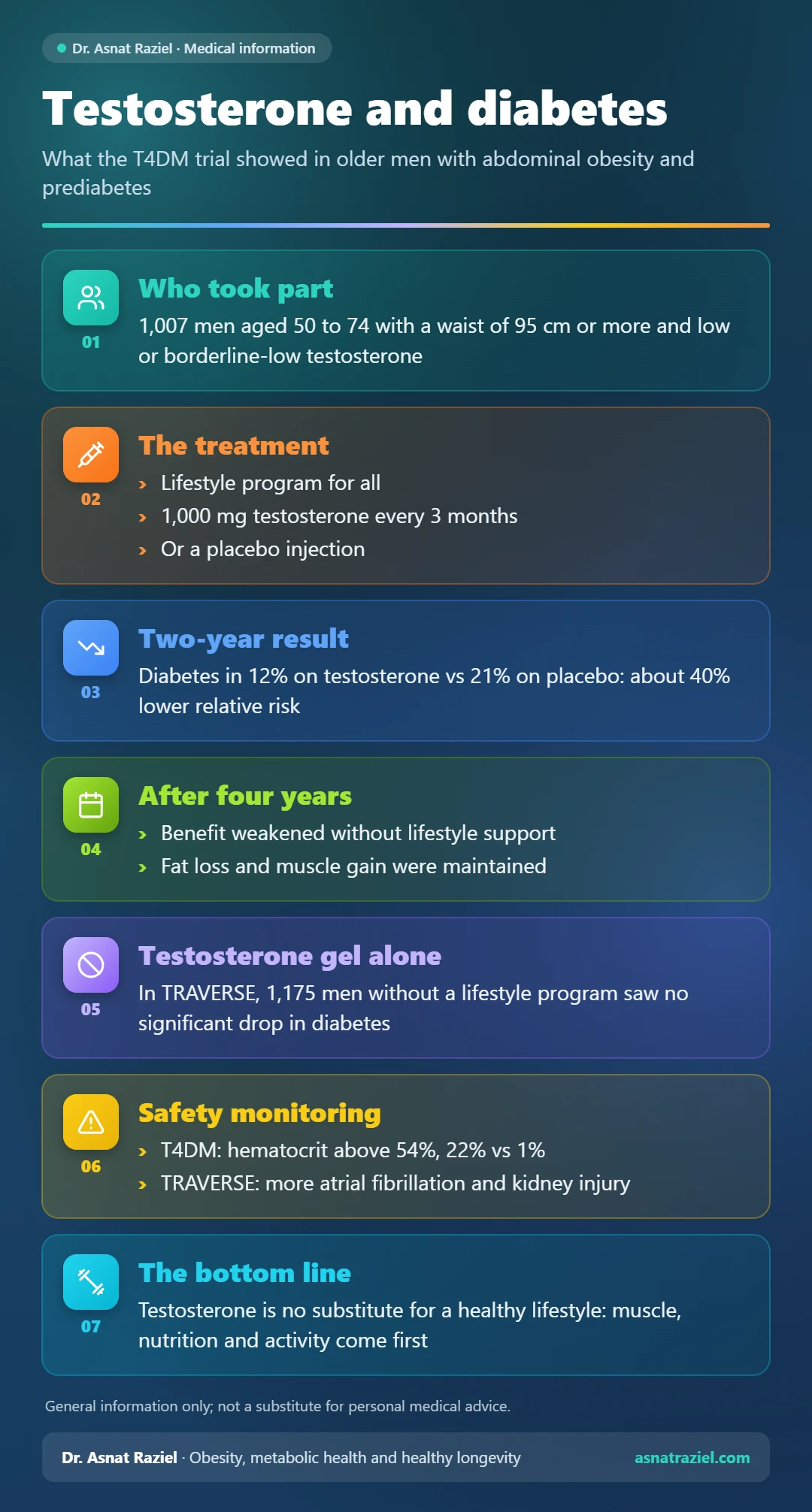
The new study builds on the Australian T4DM trial, published in 2021. The trial enrolled 1,007 men aged 50 to 74. All had a waist circumference of 95 cm or more, low or borderline-low testosterone, and either prediabetes or newly diagnosed diabetes. Every participant joined a lifestyle program. In addition, half received a testosterone injection (testosterone undecanoate) at a dose of 1,000 mg every three months, and half received a placebo injection.
After two years, doctors diagnosed diabetes in 12% of the men on testosterone, compared with 21% in the placebo group. That is a relative risk reduction of about 40%. In the extension phase, 121 participants continued their blinded treatment for two more years, but this time without the lifestyle program.
Testosterone and diabetes after four years: what researchers found
According to the Endocrine Society’s press release, most of the improvement in blood sugar control happened in the first two years. By year four the effect had weakened, yet blood sugar control remained better than in the placebo group. However, the University of Adelaide noted that by year four, the share of men with diabetes in the testosterone group had risen to a level similar to the placebo group.
By contrast, the changes in body composition held up well. Men on testosterone kept their fat loss and their gain in muscle mass. Their improved sex drive also lasted throughout follow-up. Overall quality of life, on the other hand, did not improve compared with placebo. Finally, the researchers did not identify any new safety concerns.
Not testosterone alone, but the combination
The key message of the study is simple: testosterone is not a substitute for a healthy lifestyle. The lead researcher, Prof. Gary Wittert, stressed that most of the benefit came when men combined treatment with weight loss and exercise. Once participants stopped receiving lifestyle support, some of the metabolic benefits faded.
Another finding strengthens this conclusion. In a substudy of the TRAVERSE trial, 1,175 men with testosterone deficiency and prediabetes received testosterone gel without a lifestyle program. In that study, progression to diabetes was not significantly lower than with placebo. Put differently, testosterone is not a “miracle drug.” Rather, it is one more tool in the metabolic medicine toolbox.
Obesity, muscle and diabetes risk
The study highlights how important muscle mass is for preventing diabetes. Muscle is one of the body’s main consumers of sugar. As a result, losing muscle with age impairs insulin sensitivity and raises the risk of diabetes. This dangerous combination of muscle loss and obesity has a name: sarcopenic obesity.
At the same time, fat that builds up around the abdominal organs promotes chronic inflammation and increases insulin resistance. For this reason, any intervention that reduces belly fat and preserves muscle may help. Examples include exercise, a high-protein diet, obesity medications or appropriate hormone therapy. The evidence for the power of lifestyle also appears in my article on prediabetes and a 21-year follow-up.
Who is testosterone therapy right for?
Testosterone therapy is not meant for every older man. Nor is it recommended as a routine way to prevent diabetes. According to the Endocrine Society guidelines, doctors should diagnose testosterone deficiency only when there are matching symptoms together with low levels on two fasting morning blood tests.
The treatment also requires careful monitoring. In T4DM, for example, hematocrit (the concentration of red blood cells) rose above 54% in 22% of men on testosterone, compared with 1% on placebo. In the TRAVERSE trial, treatment did not increase major cardiac events: 7.0% versus 7.3%. Still, the researchers saw a higher incidence of atrial fibrillation, acute kidney injury and pulmonary embolism. That is why the decision calls for a proper medical evaluation.
The bottom line on testosterone and diabetes
This study fits a broader trend in medicine. Obesity, prediabetes and diabetes are metabolic diseases that involve hormones, muscles, fat, the brain and behavior. Today we have effective tools: diabetes prevention medications based on the satiety hormones GLP-1 and GIP, advanced lifestyle programs, and hormone therapy for the right patients.
These tools may even overlap. Ynetnews reported early data suggesting that weight-loss drugs may raise testosterone in men with obesity or diabetes. The researchers stress, however, that the evidence is still preliminary.
Ultimately, the link between testosterone and diabetes teaches us that the future does not lie in a single treatment. Instead, it lies in a smart combination of personalized medicine, exercise, good nutrition and hormone therapy when it is truly needed. That is the key to preventing diabetes and staying healthy as we age.
This article provides general information and is not a substitute for personal medical advice.
References
Testosterone alone is not a replacement for lifestyle changes in older men at risk of T2D
Lifestyle key to diabetes prevention
Cardiovascular Safety of Testosterone-Replacement Therapy
Testosterone Therapy in Men With Hypogonadism: An Endocrine Society Clinical Practice Guideline
Funders of the T4DM trial included Australia’s National Health and Medical Research Council, Bayer, Eli Lilly and WW. Funders of the TRAVERSE trial included AbbVie.