By Dr. Asnat Raziel, bariatric surgeon specializing in obesity treatment, metabolic health and healthy longevity; Director of the Multidisciplinary Center for Obesity Treatment, Assia Medical, Assuta Ramat HaChayal, Tel Aviv
Stooped posture: a sign of aging you can change
A stooped posture is one of the most visible signs of aging, sometimes even before wrinkles and gray hair. The head juts forward, the shoulders round and the upper back bends. Suddenly, a person looks older than their age. It is easy to call this “age,” but at least in some cases it isn’t fate. Posture also depends on muscles, strength, movement and habits. That is why it can be an important target in longevity medicine.
Not every bent back means “old age”
We tend to blame age for a rounding back and a forward head. Yet these changes can start long before old age. They are especially common in people who sit for hours in front of a computer.
Of course, it is important to tell the difference between postural habits, which can be corrected, and structural kyphosis. The same goes for vertebral compression fractures, osteoporosis or other diseases. But the main message is clear: we shouldn’t accept every change in posture as an inevitable part of aging.
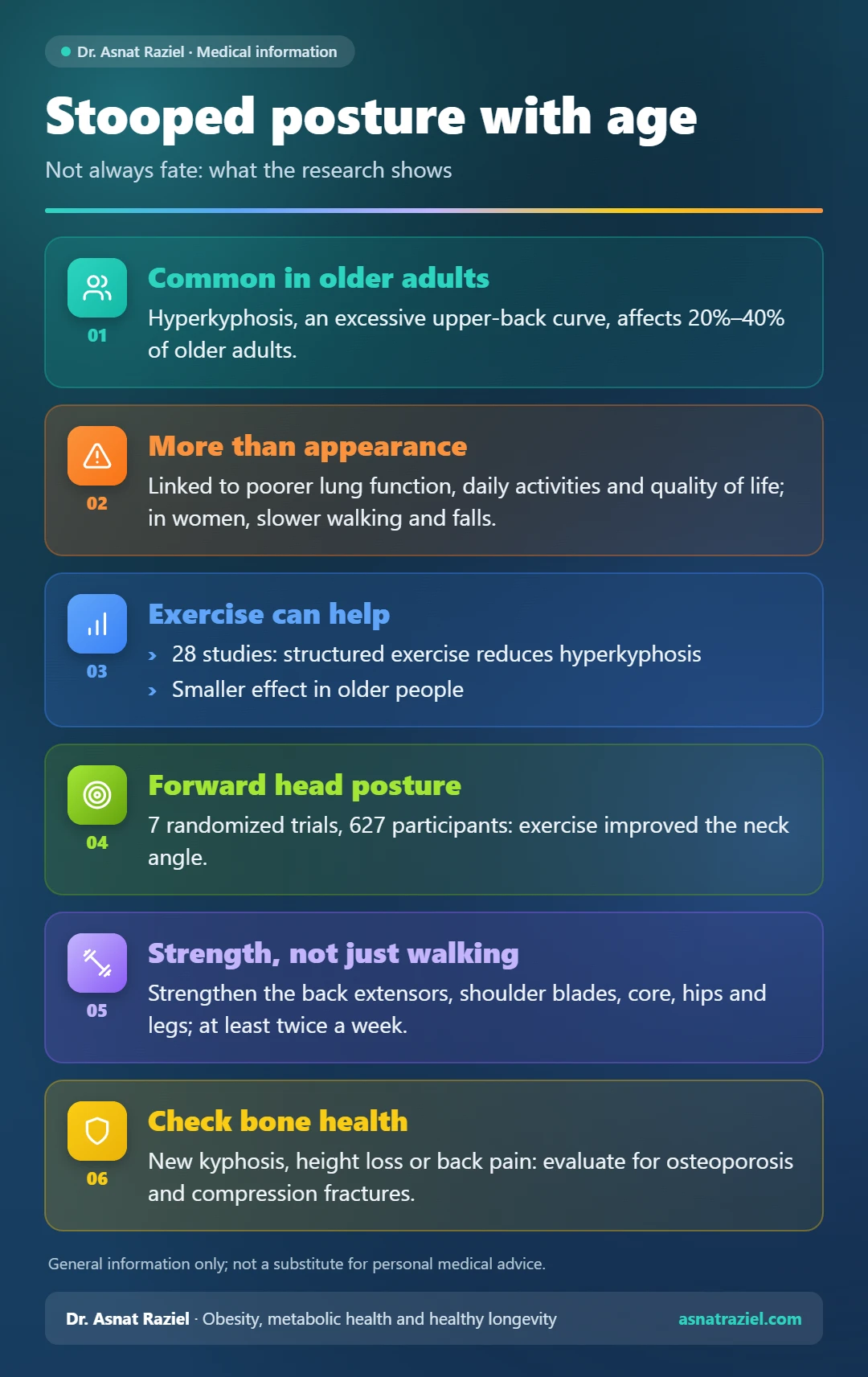
Hyperkyphosis is an excessive forward curve of the spine in the upper back. According to a systematic review on hyperkyphosis in older adults, it affects 20%–40% of older adults. Moreover, it isn’t just a cosmetic problem.
Stooped posture is part of your healthspan
Healthspan is the number of years we live in good health and with good function. In longevity medicine, we want not only to extend life, but also to preserve the ability to function during it. So good posture isn’t just a matter of appearance. According to the same review, hyperkyphosis may impair lung function, daily activities and quality of life. In women, it is also linked to slower walking, poorer balance and a risk of falls.
When a person walks upright, holds their head up and has good control of their body, we see the outward sign of a whole system. It includes muscles, bones, joints, balance and neuromuscular control. In this sense, posture is part of the function we want to preserve over the years.
Why do we start to stoop?
There is no single cause. Over the years, people may lose muscle mass and strength, and the muscles that keep the back upright may weaken. In addition, spinal mobility declines, and the discs and vertebrae change. Sometimes osteoporosis and compression fractures join in as well.
On top of that comes the modern lifestyle. We spend hours with our head tilted toward the phone or pushed forward toward the screen. The shoulders drift forward and the chest closes in. Meanwhile, we hardly ever do the opposite movements: straightening the back, opening the chest and drawing the shoulder blades back. Then, one day, we look at a photo taken from the side and discover that our posture has changed.
The good news: stooped posture can improve
This is where the research gets interesting. A systematic review and meta-analysis of 28 studies found low- to moderate-quality evidence that structured exercise programs reduce hyperkyphosis. The effect appeared in older people too, although it was small there compared with younger people.
In addition, a 2024 meta-analysis looked at 22 studies of therapeutic exercise. The analysis of upper-back kyphosis included 18 studies with 673 participants. Exercise significantly improved the kyphosis angle. However, most participants in these studies were relatively young, for example students, athletes and office workers.
There is encouraging data on forward head posture as well. A review of seven randomized trials with 627 participants found that therapeutic exercise improves the neck angle. It may also reduce neck pain. On the other hand, a new 2026 meta-analysis of 28 randomized trials found a large improvement in posture, but no consistent benefit for pain and function. In other words, “that’s just how it is at my age” isn’t always true, but there is no magic promise here either.
A video showing simple exercises to improve posture can help you get started. It is best to adapt the exercises to your own situation.
Stooped posture: walking alone isn’t enough
Walking is an excellent activity. It is important for the health of the heart, the brain and the metabolic system. But if the goal is to preserve posture, muscle and bone, walking alone won’t do it. You can read more about the differences in my article on aerobic vs. strength training.
One element comes up in almost every study: strengthening the muscles that hold the back upright. It is worth adding work on the shoulder girdle and shoulder blades, the core, the hips and the legs. In addition, mobility and stretching exercises tailored to the person are important.
This ties into a key principle of longevity. Strength training isn’t only for people who want to “build muscle.” It is an investment in the ability to get up from a chair, carry groceries, climb stairs and keep your balance. And in the end, it also helps you stay upright.
Muscle is an organ of healthy longevity
As we age, we lose muscle mass and strength unless we work to keep them. So it is worth seeing the back muscles as part of a “functional reserve.” We build that reserve in midlife and maintain it in older age. I also explain the link between muscle and function in my article on functional fitness. You can read about how to fight muscle loss in my article on building muscle after 60.
A 70- or 80-year-old needs muscles not only to be strong. They need them to keep living independently. And posture is often the first place where you see the difference. Grip strength is another simple measure of that same reserve.
What can you do about stooped posture today?
There is no need to wait for your back to round. It is a good idea to do full-body strength training at least twice a week, as the World Health Organization guidelines on physical activity recommend. Your workouts should include exercises for the back muscles and for the muscles that draw the shoulder blades together. It also helps to work on chest and shoulder mobility. Finally, break up long hours of sitting with short bouts of movement.
Every so often, lift your eyes from your phone and computer. Check where your head sits in relation to your shoulders. In older age, it is also important to check bone health. New and significant kyphosis, loss of height or back pain call for an evaluation for osteoporosis and vertebral compression fractures. Don’t settle for the explanation of “bad posture.”
Aging doesn’t have to look like stooping
This may be the most important point. Longevity doesn’t start with futuristic technology, a new supplement or a biological age test. Sometimes it starts with much more basic things: how much strength we have left, how we walk, whether we can get up from the floor and whether we stand upright.
We can’t stop time. However, we can strongly influence how our body meets it. So the next time you see a stooped posture in the mirror, don’t rush to say “it’s my age.” Sometimes it is actually a reminder that it’s time to get stronger.
This article provides general information and is not a substitute for personal medical advice.
Questions and answers
Can a back that has bent over the years be fully straightened?
It depends on the cause. Flexible changes that come from habits and muscle weakness may improve with the right exercise. In contrast, structural changes in the vertebrae or compression fractures don’t “straighten out” with exercise alone.
Is strength training suitable in older age too?
Absolutely, when it is tailored to your health and personal ability. In fact, preserving strength and muscle matters especially in older age.
When should you get checked?
When there is a significant or rapid change in posture, new pain, a noticeable loss of height, weakness or neurological symptoms. In these situations, it is a good idea to see a doctor.
References
Fix Your Posture. Your stoop isn’t age. Here’s what it is.
Exercise for Improving Age-Related Hyperkyphotic Posture: A Systematic Review
Effectiveness of Therapeutic Exercise on Forward Head Posture: A Systematic Review and Meta-analysis




