By Dr. Asnat Raziel, bariatric surgeon specializing in obesity treatment, metabolic health and healthy longevity; Director of the Multidisciplinary Center for Obesity Treatment, Assia Medical, Assuta Ramat HaChayal, Tel Aviv
Rapamycin and Alzheimer’s: a small study with an intriguing finding
Is there a link between rapamycin and Alzheimer’s? A new pilot study from the University of Missouri offers an early answer. A low dose of the drug increased blood flow in the brain in healthy carriers of the APOE4 gene. In participants without the gene, by contrast, the researchers did not see a similar change. However, this is a small, short study with no control group.
What is the APOE4 gene, and why does it matter?
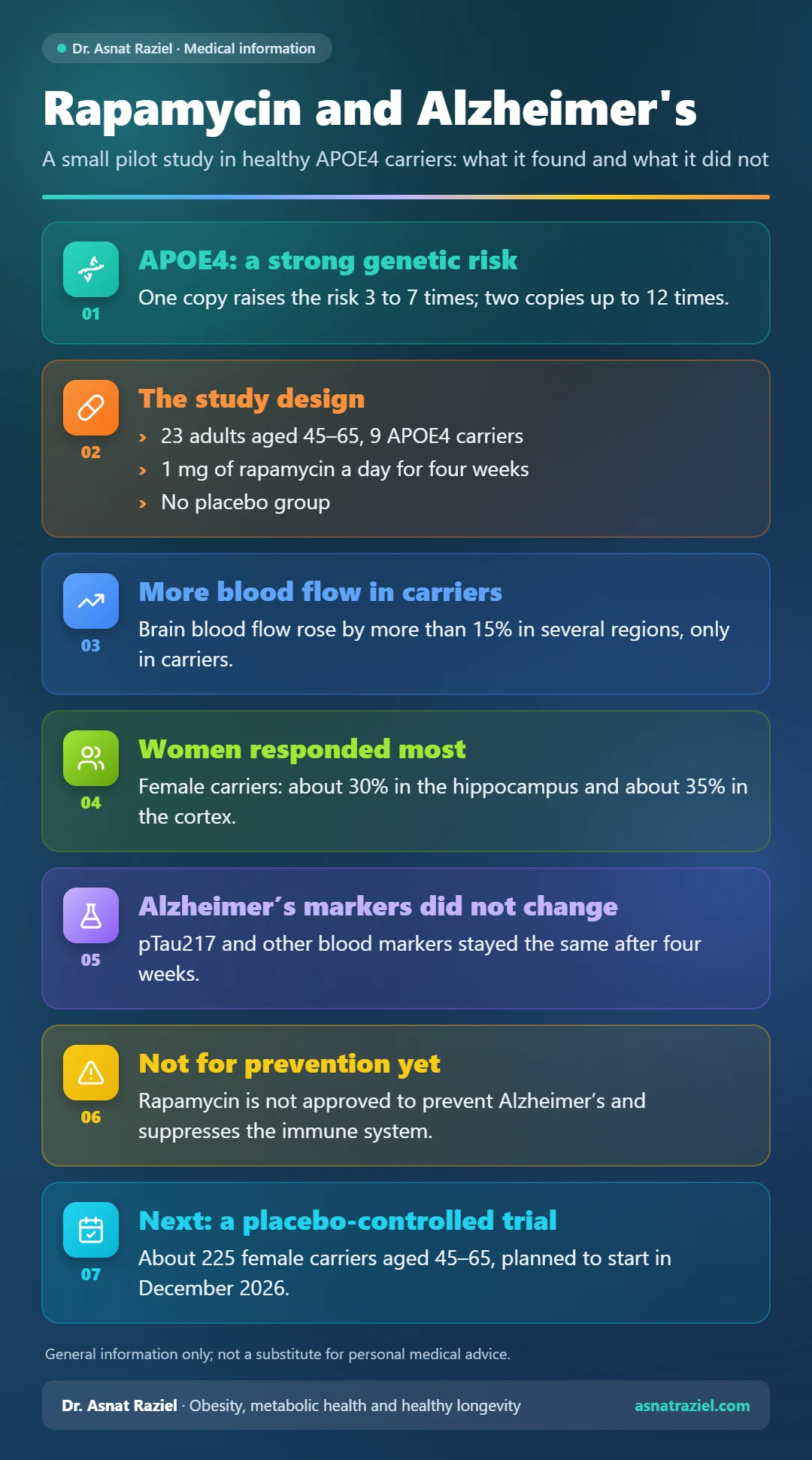
The APOE gene is responsible for making apolipoprotein E, a protein that transports fats in the body and the brain. This gene comes in several versions. The APOE4 version is the strongest genetic risk factor of all for late-onset Alzheimer’s. According to the researchers, one copy raises the risk 3 to 7 times. Two copies raise it up to 12 times. Still, carrying the gene is not destiny. Many carriers never develop the disease.
In carriers, changes in the brain begin decades before symptoms. One of the early signs is reduced blood flow in the brain. Researchers call this measure CBF, cerebral blood flow, meaning the amount of blood that reaches brain tissue. In addition, the researchers describe impaired use of glucose and changes in the gut microbiome. That is why they see these years as a window of opportunity for early intervention.
What is rapamycin?
Rapamycin, also known as sirolimus, is an old drug. The FDA approved it mainly to prevent rejection of transplanted organs. It inhibits mTOR, a central control pathway in the cell. This pathway responds to the availability of food, energy and growth factors. In animals, inhibiting mTOR extended lifespan. As a result, rapamycin features prominently on the list of longevity drugs. On the other hand, the evidence in humans is still limited.
The link to the brain is not new. In an earlier study in mice carrying APOE4, rapamycin restored blood flow in the brain. It also improved the integrity of the blood-brain barrier and the use of glucose. Now the researchers tested whether the finding holds up in humans too.
What did the rapamycin and Alzheimer’s study test?
The study was published in September 2026 in the Journal of Cerebral Blood Flow & Metabolism. Prof. Ai-Ling Lin of the University of Missouri led it. It included 23 adults aged 45 to 65 without cognitive impairment. Nine of them carried APOE4, and 14 did not.
All participants took 1 mg of rapamycin a day for four weeks. The researchers define this as a low dose. They measured blood flow in the brain with MRI, before and after treatment. In addition, they checked metabolic measures, inflammatory markers and Alzheimer’s markers in the blood. Finally, they examined the makeup of the gut bacteria.
What did the researchers find?
Brain blood flow rose only in carriers
In APOE4 carriers, blood flow in the brain rose significantly. The increase exceeded 15% in several brain regions. In non-carriers, by contrast, the researchers saw no significant change. In other words, the response to the drug depended on the gene.
More details appear in an early version of the paper. This is a preprint, a scientific draft that researchers publish before peer review. According to this version, the increase stood out in the frontal, parietal and occipital lobes. It also stood out in the caudate nucleus and the precuneus. These areas are essential for cognitive function.
Rapamycin, Alzheimer’s and women: the most striking response
The researchers also looked at differences between the sexes. This was an exploratory analysis only. According to the early version, female carriers responded most strongly of all. In them, blood flow rose by about 30% in the hippocampus and by about 35% in the cerebral cortex. Male carriers, on the other hand, showed no significant change.
This finding matters. As Prof. Lin noted in coverage of the study, nearly two-thirds of people with Alzheimer’s are women. The researchers suspect that sex hormones affect the mTOR pathway. However, this is a very small group. So a large study needs to confirm the finding.
Changes in the blood and the gut
According to the early version, carriers had lower levels of MCP-1. This is a protein that recruits inflammatory cells. In addition, short-chain fatty acids (SCFA) rose in their blood. Gut bacteria produce them, and they support gut health. On the other hand, the inflammatory marker IL-6 rose in both groups. Moreover, Alzheimer’s markers in the blood, including pTau217, did not change. In other words, four weeks of treatment did not change the markers of the disease itself.
Safety: what did the researchers report?
According to the paper’s abstract, side effects were minimal. The early version gives details: two participants reported loose stools. Participants also reported a runny nose, abdominal pain and eyelid swelling. Blood counts stayed within the normal range. Liver and kidney function also barely changed. In carriers, the researchers saw a small rise in HbA1c, a measure of average blood sugar. Even so, the value stayed within the accepted range.
Four weeks tell us nothing about safety over years. Rapamycin is a drug that suppresses the immune system. Even at a low dose, the researchers mention effects such as an acne-like rash, mouth sores and higher cholesterol. That is why such treatment requires medical monitoring.
What is still unknown about rapamycin and Alzheimer’s?
First, the study had no placebo group. So it is hard to know how much of the change comes from the drug itself. Second, the sample was small: 23 participants, and only nine carriers. In addition, according to the early version, all participants were of European ancestry. Third, the researchers measured blood flow, not memory or function. Higher blood flow is not proof of Alzheimer’s prevention. No study has yet shown that rapamycin prevents the disease in humans.
The next stage is already on its way. The team has registered a follow-up trial that is randomized, blinded and placebo-controlled. According to the registration, it will include about 225 female carriers aged 45 to 65. It is scheduled to start in December 2026. As Prof. Lin puts it, slowing brain aging in people at high risk may reduce their risk of developing the disease.
What can you do today?
Rapamycin is not approved for preventing Alzheimer’s. Therefore, there is no place for taking it for this purpose outside a clinical trial. APOE testing is not a routine test either. It is worth considering it with a doctor or a genetic counselor, because the result may cause worry.
On the other hand, there are steps the evidence already supports today. For example, controlling blood pressure and blood sugar, physical activity and social ties support brain health. In addition, good sleep allows the brain to clean itself every night. These steps suit everyone, carriers and non-carriers alike.
The bottom line on rapamycin and Alzheimer’s
The study on rapamycin and Alzheimer’s points to a promising direction in personalized medicine. An old drug improved an early brain measure, mainly in women who carry APOE4. However, this is only a first step. Only large, long, controlled studies will reveal whether the improvement translates into protection against the disease.
The information in this article is general only and is not personal medical advice. Consult your treating physician before making any change to your treatment.
References
Effects of Sirolimus on Asymptomatic ApoE4 Carriers
Rapamycin Boosts Brain Blood Flow in Alzheimer’s Gene Carriers