By Dr. Asnat Raziel, bariatric surgeon specializing in obesity treatment, metabolic health and healthy longevity; Director of the Multidisciplinary Center for Obesity Treatment, Assia Medical, Assuta Ramat HaChayal, Tel Aviv
Retatrutide and fatty liver: why this drug is drawing attention
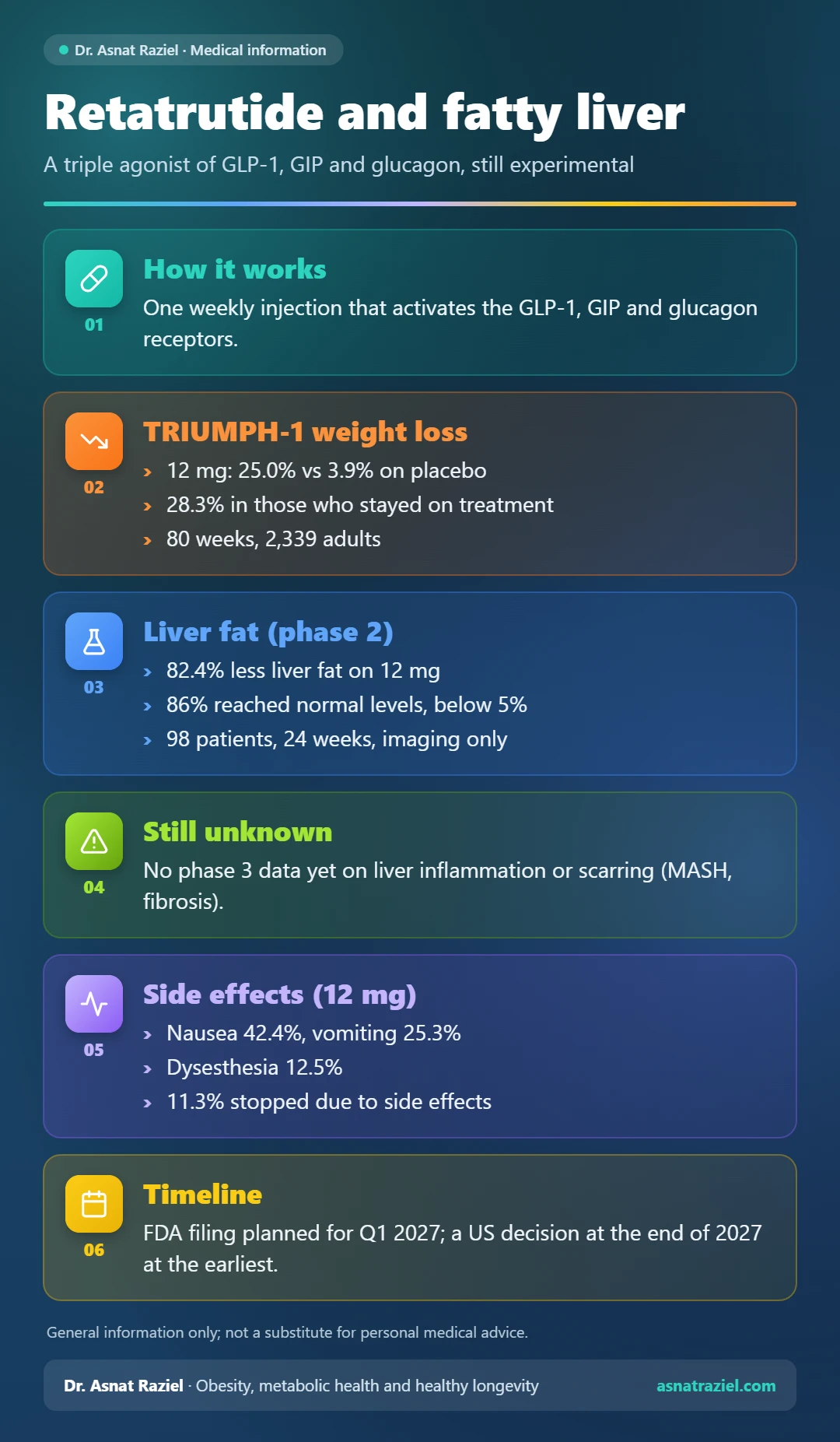
Retatrutide and fatty liver are among the most intriguing topics in obesity medicine today. This experimental once-weekly injection comes from Eli Lilly. It activates three hormone receptors at once: GLP-1, GIP and glucagon. In 2026, the company presented results from large phase 3 trials. The results show dramatic weight loss, along with promising data on liver fat.
It is important to be precise from the start. At the time of writing, no regulator anywhere in the world has approved the drug yet. So everything here rests on clinical trials, not on broad clinical experience.
A new generation of obesity drugs
Until now, we have mainly known semaglutide, the active ingredient in Ozempic and Wegovy. It acts on the GLP-1 receptor alone. Mounjaro, or tirzepatide, acts on both GLP-1 and GIP. Retatrutide adds a third component: activation of the glucagon receptor. This component increases energy expenditure and encourages the body to break down fat, especially in the liver. You can find a review of the earlier trials in my article on retatrutide research.
What the TRIUMPH-1 trial showed
The TRIUMPH-1 trial, published in NEJM in September 2026, enrolled 2,339 adults with obesity and without diabetes. Participants received retatrutide at 4, 9 or 12 mg, or a placebo, for 80 weeks. In the analysis of all participants, the 12 mg group lost 25.0% of their body weight. By contrast, the placebo group lost only 3.9%. On the 9 mg dose, weight loss reached 23.7%, and on the 4 mg dose, 17.6%.
The number in the May headlines was much higher. According to the company’s May 2026 announcement, people who stayed on treatment lost 28.3% on the 12 mg dose. In addition, 45.3% of participants on that dose lost at least 30% of their weight. In a group with a BMI of 35 or more that continued to 104 weeks, weight loss reached 30.3%. The difference between these numbers comes from the statistical method, not from any contradiction in the data.
Retatrutide and fatty liver: what we know so far
For now, the strongest data on retatrutide and fatty liver come from a phase 2 trial. A substudy published in Nature Medicine included 98 patients with MASLD, metabolic dysfunction-associated steatotic liver disease. All of them had at least 10% fat in the liver. After 24 weeks, liver fat dropped by 82.4% on the 12 mg dose and by 81.4% on the 8 mg dose. In the placebo group, by contrast, liver fat barely changed.
What’s more, 86% of patients on the 12 mg dose reached normal liver fat levels, below 5%. The researchers found that the drop in liver fat went hand in hand with weight loss, less belly fat and better insulin sensitivity. However, this was a small study that measured fat on imaging. It did not look at inflammation or scarring on a biopsy.
Retatrutide and advanced fatty liver: what we still don’t know
MASH is the inflammatory form of fatty liver. Over time, it can lead to fibrosis, meaning scarring of the liver, and even to cirrhosis. Over the past decade, fatty liver has become one of the leading causes of liver transplants in Western countries. So the key question is whether retatrutide also improves inflammation and scarring, not just fat.
Phase 3 results in fatty liver have not come out yet. The company lists MASLD among the conditions it is studying, but it has not presented results. Meanwhile, other drugs already have this kind of data. For example, Wegovy received approval for treating MASH, as I describe in my article on Wegovy for fatty liver. Tirzepatide has also shown results on biopsies, which you can read about in my article on tirzepatide and MASH.
Not just weight: waist, lipids and knee pain
In TRIUMPH-1, waist circumference shrank by an average of 24.1 cm on the 12 mg dose, compared with 3.6 cm on placebo. In addition, the company reported improvements in triglycerides, non-HDL cholesterol, systolic blood pressure and hs-CRP, a blood marker of inflammation. However, the announcement did not give the actual numbers.
Other trials in the program looked at related conditions. The TRIUMPH-4 trial enrolled 445 patients with obesity and knee osteoarthritis. After 68 weeks, those who stayed on the 12 mg dose lost 28.7% of their weight. At the same time, their knee pain score fell by 74.3%. In the TRIUMPH-2 trial, in patients with type 2 diabetes, weight loss on the 12 mg dose reached 18.8%, compared with 5.1% on placebo.
What about side effects?
As with other drugs in the incretin family, most side effects involved the digestive system. In TRIUMPH-1, on the 12 mg dose, 42.4% reported nausea, compared with 14.8% on placebo. Vomiting occurred in 25.3%, compared with 4.8% on placebo. In addition, 12.5% reported dysesthesia, an abnormal skin sensation such as tingling or burning. According to the company, this sensation was usually mild to moderate, and in most patients it went away during treatment.
Finally, 11.3% of patients on the 12 mg dose stopped treatment because of side effects, compared with 4.9% on placebo. In other words, some patients will struggle to reach the high dose. Managing nausea well and eating the right way help a great deal, as I explain in my nutrition guide for weight-loss injections.
When will the drug reach the market?
As of October 2026, retatrutide is still in the research stage. According to a July 2026 report, the company plans to file for FDA approval in the first quarter of 2027. If it files as planned, a US decision could come at the end of 2027 at the earliest. In Israel, the drug will need to go through its own registration.
Retatrutide and fatty liver: an alternative to surgery?
It is still too early to say. Still, weight loss of about 25%–30% of body weight comes close to the results of some bariatric operations. So it seems that obesity treatment will become far more personal and precise. Some patients will choose advanced drugs, others surgery, and many will combine the two approaches. I also discuss long-term care in my article on obesity maintenance treatment. I have also written a detailed comparison of obesity drugs and bariatric surgery.
The bottom line
Retatrutide marks another leap in the effectiveness of obesity drugs. In addition, the data on retatrutide and fatty liver are encouraging, but they rely mainly on measuring fat with imaging. Ultimately, the right treatment decision is one you make together with your care team, based on your health and your goals. Until the drug arrives, there are already effective options today for treating obesity and fatty liver. My article on the new obesity drugs will help you get to know them.
The information in this article is general and does not replace personal medical advice.
References
Retatrutide, a Triple Hormone Receptor Agonist, for Treatment of Obesity
Lilly’s triple agonist, retatrutide, delivered powerful weight loss in pivotal Phase 3 obesity trial
Lilly Prepares for Retatrutide FDA Filing Following Additional Phase 3 Data in Diabetes, CVD
The trials were funded by Eli Lilly, the drug’s manufacturer.




