By Dr. Asnat Raziel, bariatric surgeon specializing in obesity treatment, metabolic health and healthy longevity; Director of the Multidisciplinary Center for Obesity Treatment, Assia Medical, Assuta Ramat HaChayal, Tel Aviv
GLP-1 and body image: when medicine meets culture
GLP-1 and body image are now tightly linked. Until recently, positive body image was a central message in the conversation about health. In recent years, however, weight-loss injections have changed the picture. Medications such as Ozempic, Wegovy and Mounjaro have changed the way we perceive weight, health and personal identity. This raises a deep question: what happened to the idea of accepting your own body? In this article, I look at who is drawn to these drugs, who is most vulnerable, and what to ask before you start.
From medical treatment to social norm
GLP-1 medications mimic a natural fullness hormone that the gut releases after a meal. Drug makers first developed them to treat diabetes. Later, regulators also approved them to treat obesity in patients who meet medical criteria. In practice, however, their use has spread far beyond that.
Today, weight loss is not only a medical goal; it has become a social standard. When society presents an effective, fast solution, the pressure to use it grows. This affects the way people see themselves and their bodies. I analyze this phenomenon in my article on public attitudes toward weight-loss injections.
GLP-1 and body image: who is drawn to treatment?
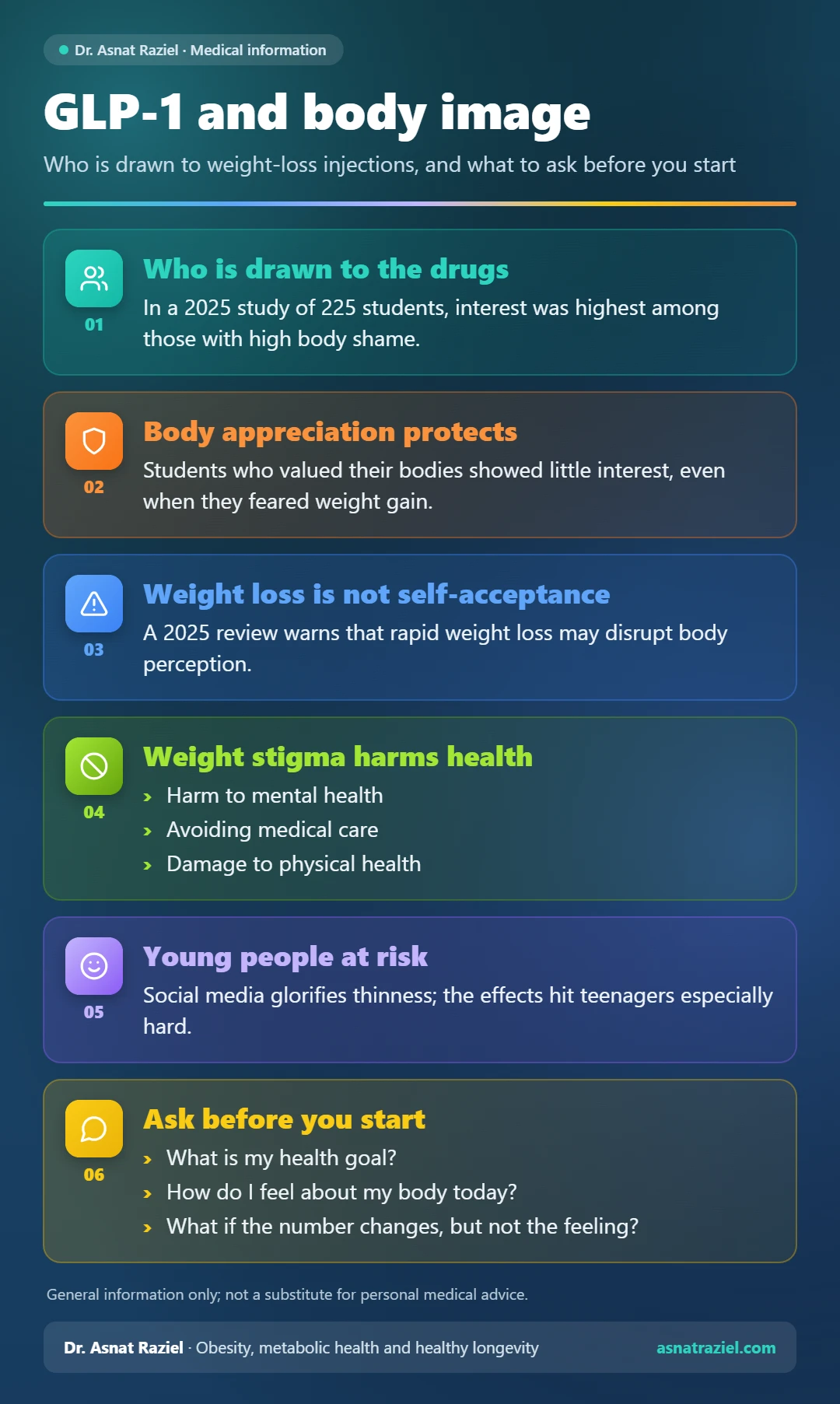
In a study published in 2025 in the journal Body Image, 225 college students with an average age of 20 took part. The researchers asked how interested they were in trying GLP-1 medications. They also measured body shame, constant monitoring of appearance, fear of weight gain and prejudice toward people with excess weight.
The results were clear. Those most interested in the drugs, and those most willing to put up with their side effects, reported high body shame and a strong fear of weight gain. By contrast, participants who valued their bodies highly expressed little interest in the drugs, even when they feared weight gain. Researchers call this body appreciation, meaning an attitude of respect and gratitude toward the body. In other words, positive body image may act as a protective factor.
The conclusion: the link between GLP-1 and body image runs deep. Sometimes, it is precisely the emotionally vulnerable who are drawn to treatment.
Changing your body does not necessarily change how you feel
A common assumption about GLP-1 and body image is that weight loss will automatically improve how you see your body. However, to date there has been almost no research testing this directly with GLP-1 medications. Charlotte Markey, the researcher who led the study, notes that these are questions that still have no clear answer. In her view, the improvement in how people feel may be only temporary.
Moreover, a 2025 scientific review warns that rapid weight loss with medication may disrupt body perception. An outward change does not guarantee an inner one. A person can lose weight and still not like their body. I have written about this in depth in a separate article on distorted body image after major weight loss.
Have we lost our balance?
For years, medical discourse tried to move away from a focus on weight alone. The goal was to shift to overall health: a balanced diet, physical activity, good sleep, stress management and social connections. In 2025, an international commission of The Lancet also concluded that body mass index (BMI) is not suitable as the sole measure of a person’s health.
Yet the enthusiasm for these drugs is shifting the focus back to weight. This recreates a problematic message: people see a thin body as healthy, even when reality is far more complex.
Stigma, positive body image and health consequences
When we present a body with excess weight as a problem that needs fixing, we reinforce stigma. An international consensus statement by experts concluded that weight stigma harms health. In addition, people who experience it often receive inadequate medical care. Stigma is linked to:
- Harm to mental health.
- Avoiding medical care.
- Damage to physical health.
That is why the conversation about weight-loss injections is not just a cultural one. It has real medical consequences. You can read more about this in my article on the health harms of weight stigma and on the importance of respectful language toward people with obesity.
When treatment becomes an expectation
A turning point comes when medical treatment becomes a social norm. Once there is a way to lose weight, people feel they must use it. The hidden message may be: a good body is a controlled body. And sometimes, a body on medication.
This pressure comes from many sources: friends, social media and sometimes the healthcare system itself. On the other hand, the decision to start treatment should stem from medical need and free choice. It should not stem from social pressure or shame.
What happens to body image in young people?
The main concern relates to the younger generation. Today, GLP-1 medications are also approved for teenagers with obesity. Israel’s 2026 national health basket, for example, included the Wegovy injection for adolescents aged 12 to 18. I discuss this further in my article on Wegovy for teens and children.
When the message is that hunger can be reduced with a drug, a fundamental question arises: how does this affect body perception? The 2025 review points out that social media discourse glorifies thinness and worsens stigma. It also notes that these effects hit teenagers especially hard.
If young people learn that a good body is a small body that eats little, we may see a rise in body image problems and eating disorders. That is why it is important to recognize warning signs early. You can read about this in my article on diagnosing eating disorders at any weight.
Who is most vulnerable: GLP-1 and body image in brief
Putting the research together, a few groups need extra care. First, people with high body shame and a strong fear of weight gain, who in the 2025 study of 225 students were the most interested in the drugs. Second, teenagers, who are especially exposed to social media messages that glorify thinness. Third, people who experience weight stigma, which is linked to harm to mental health and to avoiding medical care. In contrast, high body appreciation appeared to protect against this pull. For all of these groups, a conversation about body image belongs in the treatment plan from the start.
Positive body image is not a trend
Some argue that the body positivity movement is no longer relevant. But in scientific terms, positive body image is not the glorification of the body. A foundational review in the field defines it as a whole: appreciation of the body, acceptance and love of it, a broad view of beauty and a protective way of interpreting information. The researchers also describe it as a protective factor.
Put simply, it is the ability to treat your body with respect, attentiveness and compassion. It is a basic component of mental health.
Between advanced medicine and human balance
GLP-1 medications are a breakthrough. They are effective and sometimes lifesaving. However, they do not resolve the tension between GLP-1 and body image. The real challenge is to combine advanced medicine with a broad approach: a healthy lifestyle, emotional support and self-acceptance.
In practice, it is worth asking a few questions before and during treatment. What is my health goal? How do I feel about my body today? And what will I do if the number on the scale changes, but the feeling does not? An open conversation with your doctor, and sometimes with a mental health professional, helps maintain balance.
Bottom line: GLP-1 and body image in the age of medication
Weight-loss injections and body image are a complex subject that connects biology, psychology and culture. As technology advances, it is important to keep a balance. So it is worth asking not only how to lose weight. It is also worth asking how to feel good in the body we live in. Ultimately, positive body image is part of health, not a competitor to it.
The information in this article is general and does not replace personal medical advice.
References
Body image and interest in GLP-1 weight loss medications
GLP-1: Weight loss medications, body image and health – what happened to body positivity?
Definition and diagnostic criteria of clinical obesity
Joint international consensus statement for ending stigma of obesity
What is and what is not positive body image? Conceptual foundations and construct definition




