By Dr. Asnat Raziel, bariatric surgeon specializing in obesity treatment, metabolic health and healthy longevity; Director of the Multidisciplinary Center for Obesity Treatment, Assia Medical, Assuta Ramat HaChayal, Tel Aviv
Ashwagandha root or leaf: what you should know
Ashwagandha root extract (Withania somnifera) has become a hit in recent years in the world of wellness, the world of personal health and well-being. The plant comes from Indian Ayurvedic medicine. Today companies market it mainly to reduce stress, improve sleep and sometimes to boost physical performance. But as its use grows, an important question arises: is an extract made from the root alone safer than one that also includes the leaves?
A new white paper, and who is behind it
In August 2026, NutraIngredients published the white paper Beyond Root and Leaf. According to the paper, you cannot judge safety by the part of the plant alone. Instead, you need to look at the full chemical composition, the concentration of the active compounds, the dose and the manufacturing process. Above all, you need to check what studies in humans have shown.
That said, it is important to know who wrote the paper. It is sponsored content from the company Arjuna Natural, the maker of the Shoden extract. This extract is made from a combination of root and leaves. So it is worth weighing the claims against independent research and the positions of regulators.
What is in the plant: withanolides and withaferin A
The best-known active compounds in ashwagandha are withanolides, a group of natural steroidal compounds. However, the root and the leaves differ in their composition. The NIH Office of Dietary Supplements also notes a difference in chemical composition between root and leaf. In addition, it notes that most supplements on the market are based on the root.
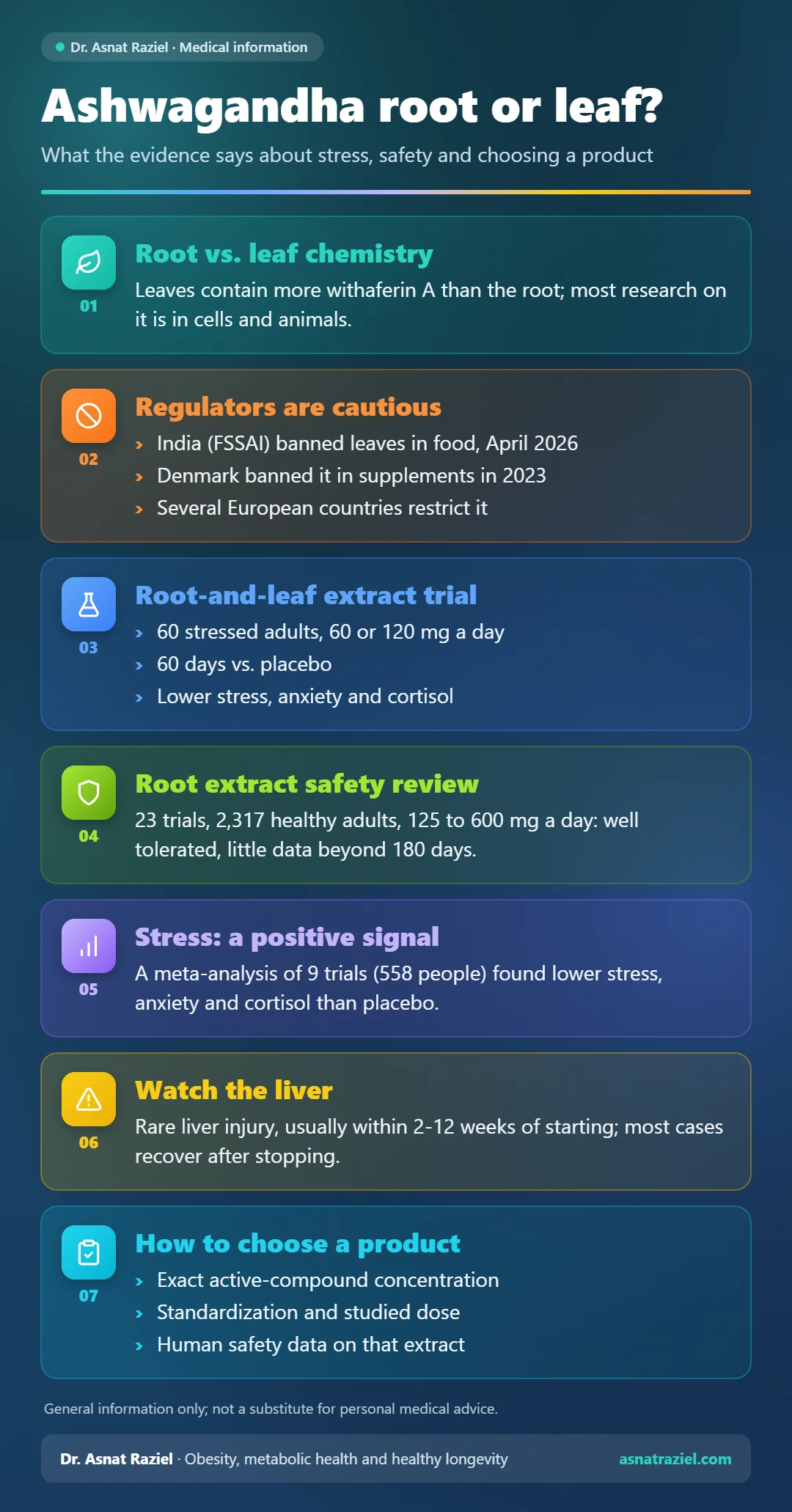
One compound draws special interest: withaferin A. Its concentration in the leaves is high compared with the root. Researchers have studied it mainly in cells and in animals. This is exactly where the controversy begins. Makers of ashwagandha root extracts see the high concentration in the leaves as a reason to prefer the root. On the other hand, the paper’s authors argue that you cannot draw conclusions about humans directly from lab experiments.
India banned the use of the leaves
This debate is not theoretical. On April 16, 2026, India’s food safety authority, FSSAI, banned the use of ashwagandha leaves in food, in any form. The decision followed a letter from the Ministry of AYUSH, India’s ministry of traditional medicine. The ministry instructed manufacturers to use the root only and to state the plant part on the label.
Makers of ashwagandha root extracts welcomed the decision. In contrast, makers of root-and-leaf extracts opposed it, and some appealed. In their view, the concern about withaferin A rests mainly on lab studies. Meanwhile, in Europe, several countries have already restricted the plant, and Denmark banned it in food supplements in 2023.
Ashwagandha root and leaf supplements: what the studies showed
Here the picture gets interesting. In a randomized, double-blind study from 2024, researchers tested Shoden against a placebo. The extract combines root and leaves and contains 35% withanolide glycosides. The study included 60 adults with high levels of stress and anxiety. They took 60 or 120 mg a day, or a placebo, for 60 days. The researchers reported improvements in stress and anxiety scores and a drop in cortisol, the stress hormone.
In addition, a 2026 safety study looked at 62 healthy people. The participants took 480 mg a day of the same extract for 90 days. The researchers saw no significant change in liver and kidney function, blood tests or vital signs. However, this was an open-label study with no placebo group, and it lasted only three months. Employees of the manufacturer also led it. So it tells us only about short-term safety, and it does not rule out rare side effects.
Ashwagandha root alone also has a safety record
On the other hand, a systematic review of standardized root extracts came out in 2026. The review included 23 randomized trials and 2,317 healthy participants. Doses ranged from 125 to 600 mg a day. Treatment lasted anywhere from a single dose to 180 days. According to the authors, participants tolerated the extracts well. Even so, there are almost no data beyond 180 days.
In other words, “ashwagandha” is not a uniform product. Two capsules with the same word on the package can contain very different extracts. The difference lies in the plant part, the extraction method and the concentration of withanolides. You can read about the plant’s place in the world of longevity in my article on ashwagandha and longevity.
Does ashwagandha reduce stress?
Beyond safety, there is also some basis for effectiveness. A 2024 meta-analysis included nine randomized trials and 558 participants. According to the analysis, ashwagandha lowered stress and anxiety scores and cortisol levels compared with placebo. But the studies used different extracts and doses. Some tested root only, and some tested root and leaves. If you are looking for other ways to cope with stress, you will find information in my article on stress and obesity.
So there is a positive signal when it comes to stress. However, there is still no single dose that suits everyone. Also, a supplement does not replace good sleep, movement and relaxation tools. You can read about the link between sleep and health in my article on sleep, metabolism and longevity.
Ashwagandha supplements and the liver
This is where we need caution. In most short studies, people tolerated ashwagandha well. However, there are rare reports of liver injury. The NIH’s LiverTox database describes cases that usually appeared within 2-12 weeks of starting the supplement. Jaundice and itching sometimes occurred. In most cases, the liver recovered after people stopped the supplement. Still, the database also describes severe cases, mainly in people with existing liver disease.
The NIH also notes that the data mainly support use for up to about three months. There is not enough information on safety over years. In short, “natural” does not mean “risk-free.” If you have fatty liver disease, read about diagnosing and treating fatty liver before adding supplements.
How to choose an ashwagandha supplement
The takeaway from this debate is that the question “root or leaves?” is not enough. The plant part matters, and ashwagandha root has a long tradition and a large body of research. But it is worth checking a few more details as well:
- The exact concentration of the active compounds.
- How the manufacturer standardized the extract.
- The dose at which researchers tested the product.
- Whether there are human safety studies on that specific extract.
A root extract that researchers have tested in studies is not the same as a random root powder. By the same token, the presence of leaves in an extract does not, on its own, prove that it is dangerous. Similar considerations apply to other new products in the longevity world, such as peptide injections.
The bottom line on ashwagandha root and leaf
Ashwagandha illustrates a shift in the world of dietary supplements. The question is no longer just “Which plant is in the capsule?” The more precise question is which active compound, at what concentration, at what dose and based on which human studies.
Current research points to potential for reducing stress and anxiety. It also points to reasonable short-term safety for certain standardized extracts. However, information on long-term use is still lacking, and there are rare reports of liver injury. Therefore, it is wrong to treat all ashwagandha products as one product. Nor is it right to judge safety by the words “root” or “root and leaf” alone. For a broad look at evidence-based tools for long-term health, see my article on wellness and lifestyle medicine.
Questions and answers
Can ashwagandha help reduce stress?
Studies and meta-analyses point to a possible reduction in stress, anxiety and cortisol. However, the extracts and doses in the studies differ widely from one another.
Is it better to choose an ashwagandha root extract only?
Root extracts have a long tradition and a broad research base. In addition, there are also human studies on root-and-leaf extracts. That is why you cannot determine safety by the plant part alone.
Is ashwagandha safe for long-term use?
There is not yet enough high-quality data to say. Most studies lasted up to three or six months.
Who should be especially careful?
During pregnancy and breastfeeding, it is best to avoid ashwagandha. Caution is also important with liver disease, thyroid problems, autoimmune diseases and in combination with certain medications. So it is worth talking to your doctor before regular use.
The information in this article is general and does not replace personal medical advice.
References
Beyond Root and Leaf: Whitepaper on Ashwagandha
Ashwagandha: Is it helpful for stress, anxiety, or sleep? – Health Professional Fact Sheet
India bans ashwagandha leaf use in any form, industry reacts
The white paper is sponsored content from Arjuna Natural, and the company’s researchers conducted the 2026 safety study. Both studies on Shoden tested the company’s extract.




