By Dr. Asnat Raziel, bariatric surgeon specializing in obesity treatment, metabolic health and healthy longevity; Director of the Multidisciplinary Center for Obesity Treatment, Assia Medical, Assuta Ramat HaChayal, Tel Aviv
Dietary GABA: what the new study found
Dietary GABA reduced anxiety-like behavior in mice, but only when it was given together with a meal. That is the central finding of a new Japanese study in The Journal of Physiological Sciences. The researchers, from Kyoto Prefectural University, also traced the exact route. It starts in the gut and runs through the right branch of the vagus nerve. It ends at oxytocin neurons in the hypothalamus. When they blocked any one of these steps, the calming effect disappeared.
Why this question matters
GABA (gamma-aminobutyric acid) is the main inhibitory neurotransmitter in the brain. It also occurs naturally in fermented foods, tea, vegetables and grains. In addition, food companies market it as a supplement for stress relief and better sleep.
Here is the puzzle. GABA crosses the blood-brain barrier very poorly. Its blood level also rises only slightly after you swallow it. So if oral GABA affects the brain at all, it probably does not get there directly. For that reason, the researchers looked for a different route altogether: a nerve pathway that starts in the gut.
An earlier systematic review gathered 14 placebo-controlled trials in humans. Its authors rated the evidence as limited for stress. For sleep, it was very limited. They also noted that the trials were too different from one another for a meta-analysis. In other words, how GABA might work remained an open question.
Dietary GABA alone is not enough
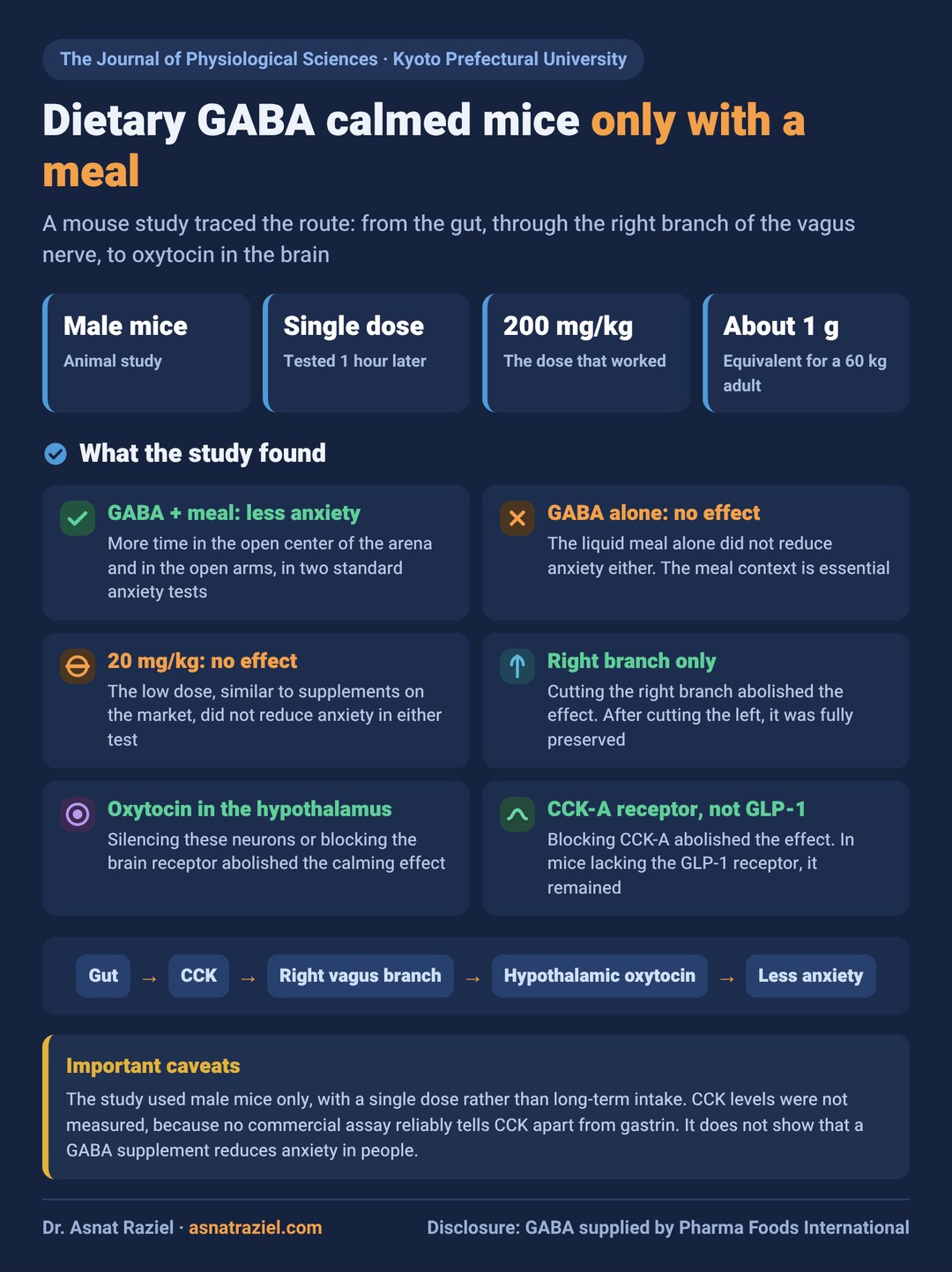
The researchers gave male mice a single dose through a tube into the stomach. One hour later, the mice went through two accepted anxiety tests. In the open field test, the team measured time spent in the exposed center of the arena. On the elevated plus maze, they measured time spent on the open arms. Across both tests, more time in the exposed area means less anxiety.
The groups received saline, GABA alone, a liquid meal alone, or GABA together with the meal. Only GABA plus the meal clearly increased time in the center and on the open arms. GABA alone had no effect, and the meal alone had no effect either. What is more, all groups covered a similar distance. So this was not general sedation or reduced activity.
The dose that worked was 200 milligrams per kilogram. When the researchers cut the volume of the meal in half, the calming effect held. However, a dose of 20 milligrams per kilogram did not reduce anxiety in either test. In a previous study by the same group, that lower dose did reduce food intake.
The right side of the vagus nerve is the key
This is where it gets surprising. The vagus nerve is the main communication line between the digestive system and the brain. It tells the brain what has entered the stomach and intestine. So the researchers cut either the right or the left branch of the nerve below the diaphragm.
After the left branch was cut, the calming effect stayed fully intact. After the right branch was cut, it disappeared completely. In a further check, neither cut changed how fast food moved through the intestine. Slower digestion therefore does not explain the difference.
This finding fits a picture that has been building in recent years. Earlier studies linked the left branch to appetite control and glucose metabolism. They linked the right branch to reward and to social and emotional function. In other words, the two sides of the same nerve have different jobs.
Dietary GABA activates oxytocin neurons
Next, the researchers looked for where the signal arrives in the brain. They stained for a marker of nerve-cell activation. The liquid meal activated three areas of the hypothalamus. Adding GABA boosted activation in exactly those areas. What they share is neurons that produce oxytocin.
Oxytocin is best known for its role in childbirth and breastfeeding. However, it also helps regulate anxiety and emotional function. Indeed, GABA plus the meal clearly activated oxytocin neurons in one key area, the paraventricular nucleus. The number of these neurons did not change.
Then came the test of cause and effect. When the researchers silenced these oxytocin neurons chemogenetically, the calming effect disappeared. When they injected an oxytocin receptor blocker into the brain’s ventricles, it disappeared as well. So this is an essential step in the pathway, not a side finding.
The switch in the gut: CCK, not GLP-1
Still, one question remained: how exactly does GABA strengthen the signal the meal sends to the nerve? The two main suspects are gut hormones released in response to food. Cholecystokinin (CCK) and GLP-1 both act directly on vagus nerve fibers.
The results were clear. Blocking the CCK-A receptor with a drug abolished the calming effect completely. By contrast, in mice lacking the GLP-1 receptor, the calming effect remained fully intact. This was despite the fact that GABA did increase GLP-1 release into the blood leaving the gut. So the higher GLP-1 release is real, but it is not what lowers anxiety.
Finally, the team used mice lacking the CCK-A receptor, mainly in the vagus nerve fibers. In these mice, GABA with the meal did not activate the brainstem area that receives vagal signals. It also did not activate the oxytocin neurons, and it did not reduce anxiety. This is the complete pathway: gut → CCK → right branch of the vagus → oxytocin in the hypothalamus.
What this means for supplement doses
Caution is needed here, and the researchers themselves stress it. The researchers used the standard FDA conversion factor. By that measure, the dose that worked equals about 1 gram for a 60-kilogram adult. That is a high dose. It is similar to a single dose of a GABA-containing drug once used in Japan.
By contrast, the lower dose equals about 100 milligrams for a person. That is the usual dose in supplements on the market. That dose did not reduce anxiety in either test. Therefore, the study does not show that a GABA supplement from the shelf will reduce anxiety in people.
Limitations worth knowing
First, the researchers studied male mice only, not people. Second, they gave a single dose rather than long-term intake. They note that the mechanisms of repeated intake may be different. Third, CCK levels were not measured. No commercial assay reliably tells CCK apart from the similar hormone gastrin.
In addition, the exact molecular target of GABA is still unknown. The leading hypothesis is that GABA acts on hormone-producing cells in the gut wall. Alternatively, it may make the nerve fibers more sensitive to the CCK that the meal releases. What is more, one of the researchers reports research funding from a company that produces GABA. The company supplied the GABA, but did not design the study, run it or analyze the data.
Dietary GABA and the conversation between gut and brain
Beyond GABA itself, there is a principle here that interests me greatly in my work with patients. A food component that barely reaches the brain still changes emotional behavior. It does so through a nerve signal that starts in the gut. These are the same nerve and the same gut hormones involved in the physiology of satiety. Now it turns out that they affect mood as well.
This insight matters for anyone who deals with emotional eating. A signal from the gut can calm. That helps explain why stress and food are linked in both directions. My article on the link between stress and obesity covers the opposite direction.
Dietary GABA: what you can do today
Eat regular meals: skipping meals weakens the signal the gut sends to the brain.
Include fermented foods: fermented foods, green tea, vegetables and whole grains naturally contain GABA. They are healthy foods in any case.
If you take a supplement, take it with food: according to the mechanism the study describes, there was no effect on an empty stomach.
Do not replace treatment: ongoing anxiety calls for assessment and professional treatment. A supplement is not a substitute for that.
Take care of the basics first: healthy sleep and stress-relief techniques rest on much stronger evidence than any supplement.
Bottom line
This study does not say that a GABA supplement calms people. It says something else, and in my view no less interesting. A food component can change emotional behavior through a defined nerve pathway. The pathway starts in the gut and ends at oxytocin in the brain. In addition, the effect depends on context. It needs the meal around it, not the component alone. Ultimately, dietary GABA shows that food talks to the brain through nerves too. It does not rely on the blood alone.
The information in this article is general information and is not personal medical advice. Do not stop or change any medication without consulting your treating physician.
References
Disclosure: one of the study’s authors reports research support from Pharma Foods International. The company supplied the GABA but did not design the study, run the experiments or analyze the data.