By Dr. Asnat Raziel, bariatric surgeon specializing in obesity treatment, metabolic health and healthy longevity; Director of the Multidisciplinary Center for Obesity Treatment, Assia Medical, Assuta Ramat HaChayal, Tel Aviv
Retatrutide dose: the key message from ObesityWeek
At ObesityWeek, the session on the TRIUMPH trial program put retatrutide dose at the center. Retatrutide is an investigational once-weekly injection from Lilly. At the highest dose, it cut body weight by an average of 28.3%. Yet the key message from the meeting was different: not every patient needs to lose 30%. The low dose, 4 mg, achieved a 19% loss, with a dropout rate similar to placebo.
Four speakers presented the first phase 3 results of the drug. Dr. Deborah Horn summed it up well. In her words, the question is no longer how much weight we can lose. The question is how reliably, how simply, for whom, and whether health truly improves.
I published a first summary of the session in my article on retatrutide in clinical practice. Here I focus on the practical question: which dose suits whom.
How the triple drug works
Retatrutide is a single molecule that activates three hormone receptors: GLP-1, GIP and glucagon. For comparison, tirzepatide, the active ingredient in Mounjaro, activates two receptors. Semaglutide, the active ingredient in Wegovy, activates one. In addition, a fatty chain attached to the molecule extends its half-life to about six days. So one injection a week is enough.
The gap the drug tries to close
Dr. Horn opened with US data. Only about 2.3% of eligible adults without diabetes received semaglutide or tirzepatide. Moreover, between a fifth and a half of patients do not reach a 15% loss, even at the maximum dose. About 65% also stop treatment within a year. The main reasons are cost (48%) and side effects (15%).
Therefore, in her view, treatment gaps do not stem mainly from a lack of efficacy. The problem is reach, reliability of response and persistence.
How the TRIUMPH trials were built
The two main trials were double-blind. Researchers randomly assigned participants to placebo or to one of three maintenance doses: 4, 9 or 12 mg a week. Everyone also received lifestyle counseling. Treatment started at 2 mg, and the dose rose every four weeks. For example, the 4 mg arm needed only one step up. The main outcome was the change in weight after 80 weeks, about a year and a half.
The TRIUMPH-1 trial included 2,339 participants with obesity and without diabetes. Their average BMI was 40.0, and 65.5% were women. By contrast, TRIUMPH-2 included 1,152 participants with type 2 diabetes. Their average BMI was 38.2, and baseline HbA1c was 7.7%. HbA1c reflects average blood sugar over the past three months. Within the trials, the researchers also ran studies on sleep apnea and knee osteoarthritis.
How much weight was lost at each retatrutide dose
Weight loss grew with the dose in both trials. As expected, it was smaller in type 2 diabetes. The figures below refer to people who stayed on treatment.
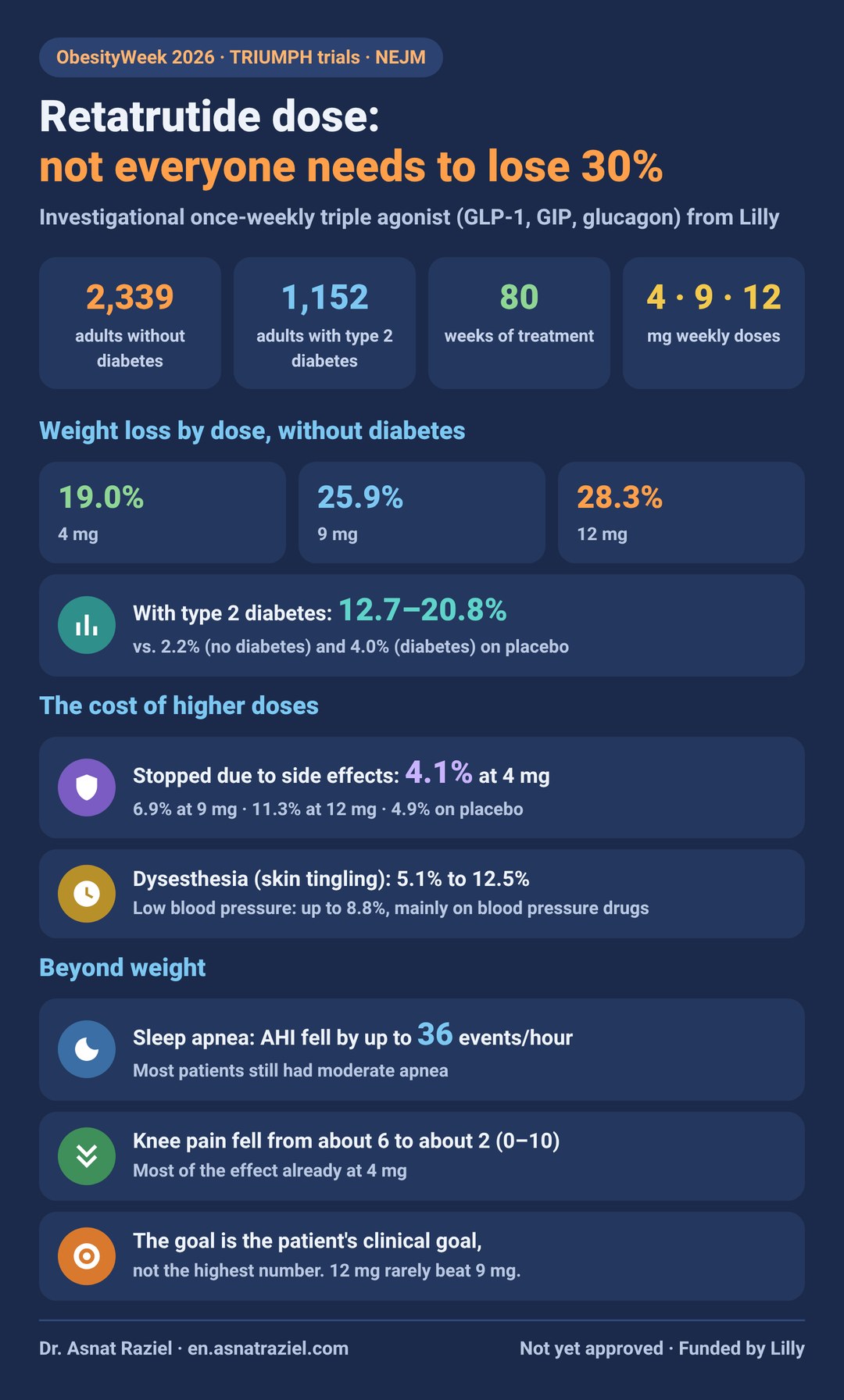
Without diabetes (TRIUMPH-1): 19.0% at 4 mg, 25.9% at 9 mg and 28.3% at 12 mg, vs. 2.2% with placebo.
With type 2 diabetes (TRIUMPH-2): 12.7%, 19.1% and 20.8% respectively, vs. 4.0% with placebo.
Without diabetes, 62% of people on 4 mg lost 15% or more. On 12 mg, 88% did. In type 2 diabetes, the rates were 37% and 67%. In other words, even at the top dose, about a third of patients with diabetes did not reach 15%.
Important to know: some participants stopped treatment. Counting everyone, the loss in TRIUMPH-1 was 17.6%, 23.7% and 25.0%, vs. 3.9% with placebo.
What about the 30%?
In the TRIUMPH-1 extension to week 104, about two years, the loss reached 30.3% at the top dose. However, this figure needs careful reading. The extension included 532 participants who met set criteria. They had a baseline BMI of 35 or more and a BMI of 22 or more at week 80. They also tolerated dose increases well. Put simply, this was a selected group that was already doing well. So the result does not represent all patients.
Beyond weight: blood pressure, inflammation and blood sugar
Heart and metabolic measures improved consistently, and more so at higher doses. Still, the gap between 9 and 12 mg was small for most measures. In TRIUMPH-1, waist circumference fell by 16.3, 21.8 and 24.1 cm, vs. 3.6 cm with placebo. Systolic blood pressure, the upper number, fell by 8.5, 11.3 and 12.3 mmHg, vs. 1.1 with placebo. In addition, hsCRP, a marker of general inflammation, fell by 57.9% to 63.8%, vs. 23.5% with placebo.
Blood fats improved too. In TRIUMPH-1, triglycerides fell by up to 41.0%, and LDL, the “bad cholesterol”, by up to 20.3%. Moreover, 91% to 96% of participants with prediabetes returned to normal blood sugar, vs. 53% with placebo.
In type 2 diabetes, HbA1c fell by 1.41, 1.63 and 1.54 percentage points. That is, 9 mg did as well as 12 mg. Also, 14% to 22% of patients cut back on blood pressure drugs, vs. 4% with placebo. In phase 2 data, liver fat fell by about 82% at the higher doses. Still, there are no data yet on fibrosis, or liver scarring.
Retatrutide dose and side effects
The common side effects were digestive, mainly while the dose was going up. In TRIUMPH-1, up to 42.4% of patients reported nausea, and up to 25.3% reported vomiting. The most important finding: the cost of the higher doses rises faster than their benefit.
At 4 mg, 4.1% stopped treatment because of side effects, vs. 4.9% with placebo. At 9 mg the rate rose to 6.9%, and at 12 mg to 11.3%. Similarly, 7.7% of people on 4 and 9 mg reported serious adverse events. On 12 mg it was 10.5%, vs. 5.5% with placebo.
Dysesthesia and low blood pressure
A relatively unusual effect is dysesthesia: an abnormal skin sensation, such as tingling or sensitivity to touch. It is not known from other drugs in this family. In TRIUMPH-1 it appeared in 5.1%, 12.3% and 12.5% across the doses, vs. 0.9% with placebo. Most cases were mild to moderate. In addition, low blood pressure appeared in 2.7%, 5.3% and 8.8%, vs. 0.9% with placebo. It occurred mainly in patients who already took blood pressure drugs.
By contrast, rates of pancreatitis, gallbladder events and heart events were low, with no consistent difference from placebo. In type 2 diabetes, level 2 low blood sugar (hypoglycemia) occurred in up to 3.1%. There were no severe level 3 events. Eye (retina) events occurred in 3.8% to 4.9% of people on the drug, vs. 9.1% with placebo.
Retatrutide dose and sleep apnea: big improvement, not always a cure
Two studies published in NEJM looked at patients with moderate to severe sleep apnea. The AHI counts breathing pauses per hour of sleep. At the start it was about 56 to 59. Data shown at the meeting were clear. In TRIUMPH-1-OSA it fell by 25.7, 36.1 and 33.8 events per hour, vs. 11.1 with placebo. Between 53.6% and 68.2% of patients cut their AHI by half or more, vs. 23.1% with placebo.
Full remission means an AHI below 5. Up to 26.6% of patients without diabetes reached it, and up to 17.7% with diabetes. Here too, 12 mg added nothing over 9 mg. Still, the clinical meaning is sobering. The AHI fell from about 55 to about 25 to 30 events per hour. So most patients still had moderate sleep apnea. For now, the drug does not replace a repeat sleep test and CPAP treatment.
Retatrutide dose and knee pain: clear relief, high placebo response
Dr. Beverly Tchang presented the knee studies. TRIUMPH-1-OA included 574 patients, and TRIUMPH-4 included 445. In both, weight loss reached 28.7% at 12 mg. The pain score fell from about 6 to about 2, on a scale of 0 to 10. In addition, up to 18.6% of patients reported no pain at all.
However, two findings call for caution. First, the placebo response was high: 38% to 46% of the placebo group halved their pain. Second, most of the effect on pain came already at 4 mg. Meanwhile, dropouts at 12 mg reached 15% to 18%.
Comparison with Wegovy and Mounjaro
Dr. Jaime Almandoz presented an indirect comparison with earlier trials. In STEP UP, semaglutide 7.2 mg achieved a 20.7% loss without diabetes. In SURMOUNT, tirzepatide 15 mg achieved 22.5%. So retatrutide 4 mg (19.0%) is similar to them, and only 9 and 12 mg clearly exceed them.
In type 2 diabetes, the picture is mixed. Semaglutide cut body weight by 14.1%, and tirzepatide by 15.7%. Yet retatrutide’s edge in weight did not translate into an edge in HbA1c. Tirzepatide lowered it by 2.22 points, vs. 1.41 to 1.63 with retatrutide. On the other hand, indirect comparisons are limited by nature: trial length, populations and methods differ. Only a head-to-head trial against tirzepatide, now underway, will allow a firm conclusion.
A personal retatrutide dose: the goal is not 30% for everyone
Dr. Horn pointed to the gap between trials and the real world. In SURMOUNT-1, 78% of people on tirzepatide 15 mg lost at least 15% of their weight. Yet in real-world data, the average loss after a year was only 8.7%. In addition, 81% of patients stayed on low maintenance doses. Men are also treated less often than women, 9% vs. 15%, even though obesity rates are similar.
Her central message: the target is the patient’s clinical goal, not 30% for everyone. The amount of weight lost matters when it changes health. For example, remission of type 2 diabetes was 5.4% with a loss of under 10%. With a loss of 10% to 19% it rose to 48%, and with 20% to 29% to 69%. Finally, with a loss of 30% or more it reached 90%.
A retatrutide dose of 4 mg
The 4 mg dose achieved a 19.0% loss, and 61.8% of patients lost 15% or more. All this came with one step up and a dropout rate similar to placebo. According to Dr. Horn, such a dose reduces the need for coaching and follow-up. So it also suits primary care, and it may improve persistence. Moreover, consider participants with a BMI of 30 to 35 without diabetes. On 4 mg, 79.5% of them reached a BMI below 30.
Matching treatment intensity to disease severity
Dr. Horn offered a way of thinking, and stressed that it is a hypothesis, not a treatment guideline. In this view, doses of 2 to 4 mg would suit overweight with a related condition, and class 1 obesity. Doses of 9 to 12 mg would suit class 2 and 3 obesity. They would also suit complications that need a loss of 15% or more, such as sleep apnea. She also noted the opposite worry: that a low, convenient dose will be given to everyone without distinction.
Practical guidance from the clinic
This guidance is for the treating doctor, and you should never change medications on your own. First, a patient who feels dizzy when standing up or during effort should check their blood pressure. In that case, the doctor may lower or stop blood pressure drugs to prevent falls. Second, in diabetes, sulfonylurea drugs are stopped when treatment starts. In well-controlled diabetes, the insulin dose is cut by half and home glucose checks resume. Finally, in poorly controlled diabetes, insulin is reduced gradually under close follow-up.
What we still do not know
The speakers themselves noted several limits. The phase 3 trials did not measure body composition. In phase 2, about 64.6% of the weight lost was fat, but in a small sample. In addition, comparisons with other drugs are indirect, and the liver data come from phase 2 only.
Moreover, most results at the meeting were shown for people who stayed on treatment. Dropouts rise with the dose. So the gap between 9 and 12 mg across all patients is likely to shrink further. There are no data yet on heart events, and the cause of dysesthesia is unclear. Lastly, we lack data on what happens after stopping treatment. We also lack data on lowering the dose once the goal is reached.
What you can do today
Retatrutide is not yet approved, neither in Israel nor in the US. According to Lilly’s announcement, the company plans to file with the FDA in the first quarter of 2027. Please be careful: unapproved versions of retatrutide are sold online. There is no certainty about their content, purity or dose, so do not use them.
The good news is that effective treatments already exist, and the TRIUMPH message applies to them too. First, set a personal health goal with your doctor: better blood sugar, lower blood pressure, better sleep or easier knees. In addition, if you snore or feel tired during the day, ask for a sleep test. With current drugs, raise the dose gradually and as needed. I explain how in my Mounjaro dosage guide. Finally, always combine nutrition, movement and sleep.
Bottom line on retatrutide dose
Retatrutide pushes drug treatment toward results that were, until now, reserved for bariatric surgery. It brings a loss of 25% to 28%, along with better sleep apnea, knee pain and heart measures. This matters most in class 2 and 3 obesity. Still, the top retatrutide dose is not necessarily the right one. For most measures, 12 mg added nothing over 9 mg, while side effects kept rising. So the choice of dose should follow the clinical goal and the patient, not the highest number.
This article is general information and does not replace personal medical advice. Any treatment decision should be made together with your doctor.
Questions and answers
Is retatrutide approved in Israel?
No. It is an investigational drug and is not yet approved anywhere. According to Lilly, an FDA filing is planned for the first quarter of 2027.
What is the difference between retatrutide and Mounjaro?
Mounjaro activates two receptors, GLP-1 and GIP. Retatrutide adds the glucagon receptor. In an indirect comparison, the 9 and 12 mg doses led to more weight loss. However, a head-to-head trial has not ended yet.
Is the highest dose always better?
No. For most measures, 12 mg added nothing over 9 mg, while side effects and dropouts rose. The 4 mg dose cut weight by 19%, with dropouts at placebo level.
Further reading on the site:
Retatrutide in clinical practice
Eating disorders and obesity
References
Retatrutide, a Triple Hormone Receptor Agonist, for Treatment of Obesity
Retatrutide Once Weekly for Treatment of Obstructive Sleep Apnea
Retatrutide Once Weekly in Adults with Knee Osteoarthritis Pain and Obesity
A Study of Retatrutide (LY3437943) Compared to Tirzepatide (LY3298176) in Adults Who Have Obesity
Unapproved GLP-1 Drugs Retatrutide and Zenagamtide Sold Online Are No Bargain
The studies were funded by Lilly. This article is based on the TRIUMPH session at ObesityWeek, with Dr. Jaime Almandoz, Dr. Jeremy McDonnell, Dr. Beverly Tchang and Dr. Deborah Horn.