By Dr. Asnat Raziel, bariatric surgeon specializing in obesity treatment, metabolic health and healthy longevity; Director of the Multidisciplinary Center for Obesity Treatment, Assia Medical, Assuta Ramat HaChayal, Tel Aviv
Atrial fibrillation and obesity: what is new
Atrial fibrillation is the most common heart rhythm disorder, and it is especially common in people with obesity and diabetes. Now a large meta-analysis of 94 randomized trials found that injectable semaglutide lowered how often it appeared. This matters because the evidence comes from controlled trials, not only from observation.
Put simply, a treatment that lowers weight may also help keep the heartbeat steady. Still, it is important to understand what the research shows and what it does not prove yet.
What atrial fibrillation is and why weight matters
In atrial fibrillation, the upper chambers of the heart contract in a chaotic way. The result is an irregular and sometimes fast pulse. Some people feel palpitations, fatigue or shortness of breath. Others feel nothing at all. The main danger is a blood clot forming in the heart, which can cause a stroke.
Obesity raises the risk in several ways. First, it raises blood pressure and puts strain on the heart. It also goes hand in hand with sleep apnea and chronic inflammation. Moreover, fat that builds up around the heart itself damages the tissue of the atria.
The study: 94 trials and 155,989 participants
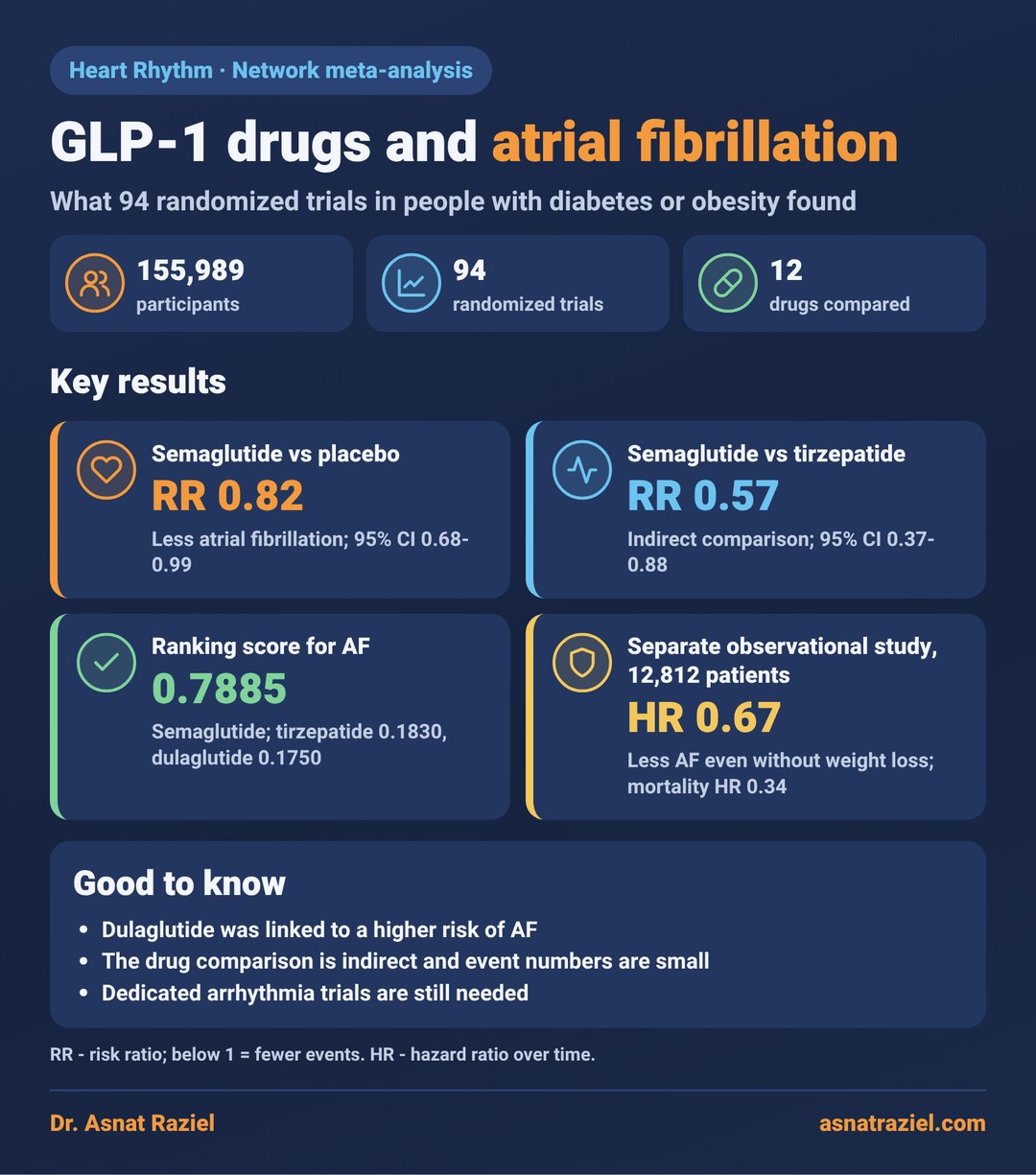
Researchers from Brazil and the United States pooled every randomized trial of GLP-1 drugs and combined agonists published through December 2025. Participants had diabetes or obesity. In total, the analysis included 94 trials with 155,989 participants, comparing 12 different drugs.
The method is a network meta-analysis, which compares several treatments at once, even when no trial compared them head to head. The journal Heart Rhythm published the study. The main outcome was new-onset arrhythmia, and atrial fibrillation in particular.
What they found about atrial fibrillation
Injectable semaglutide, the active ingredient in Wegovy and Ozempic, stood out as the most effective option. Compared with placebo, it lowered the risk of atrial fibrillation: risk ratio 0.82 (95% CI, 0.68-0.99). In other words, roughly 18% fewer new cases.
Compared with tirzepatide, the active ingredient in Mounjaro, semaglutide showed a risk ratio of 0.57 (95% CI, 0.37-0.88). In the overall ranking, semaglutide scored 0.7885, versus 0.1830 for tirzepatide and 0.1750 for dulaglutide (Trulicity).
By contrast, dulaglutide showed a higher risk of atrial fibrillation. Lixisenatide, on the other hand, showed fewer conduction blocks in the heart. The authors stress that we still need studies focused on arrhythmias to confirm these findings.
Not only because of weight loss
Another study, from the University of Virginia, supports the same direction. The researchers followed 12,812 patients who started a GLP-1 drug and compared them with a matched control group. In results published this spring, the risk of atrial fibrillation was lower (hazard ratio 0.67), and mortality was much lower (hazard ratio 0.34).
The interesting finding is that the protection appeared in every weight group, even in people who gained weight. In addition, only semaglutide showed a significant drop in atrial fibrillation, and it appeared after 24 months of treatment. So the drug may have a direct effect on the heart, beyond weight loss. However, this is an observational study, so it shows an association, not cause and effect.
What this means for choosing a drug
This does not mean tirzepatide is “bad for the heart.” The comparison between the drugs is indirect, and the number of atrial fibrillation cases in each trial is small. Mounjaro also produces more weight loss on average, and it has proven benefits of its own. A new genetic study even shows that in some people the response to these drugs is completely different.
That is why the decision is always personal. For example, for a patient with obesity and a history of atrial fibrillation, or a high risk of it, the semaglutide data is one more consideration. For a patient who needs a large weight loss, tirzepatide may be the better fit.
What you can do today about atrial fibrillation
Medications available in Israel
Semaglutide (Wegovy, Ozempic) and tirzepatide (Mounjaro) are approved in Israel and in the United States. Coverage and price vary by health fund and indication, so check with your health fund. You choose the drug together with a physician, based on your medical conditions and the heart medications you already take.
Tests worth doing
If you feel an irregular heartbeat, do not wait. A simple ECG, and sometimes a Holter monitor that records the pulse for a full day, diagnoses most cases. It is also worth checking blood pressure, blood sugar, blood lipids and thyroid function. Snoring and morning fatigue call for a sleep study.
Lifestyle that protects heart rhythm
Weight loss itself reduces atrial fibrillation. Regular aerobic activity, such as brisk walking, swimming or cycling, improves heart fitness. Strength training twice a week preserves muscle during weight loss. Alcohol, on the other hand, is a well-known trigger, so it is wise to cut it back sharply.
Seven to eight hours of sleep, treating sleep apnea and managing stress complete the picture. At our center, care is multidisciplinary: a dietitian, a psychologist, an exercise physiologist, medication and surgery when needed. This combination treats both weight and the risk factors for heart disease.
Bottom line on atrial fibrillation and GLP-1 drugs
The evidence is building: GLP-1 drugs, led by semaglutide, are linked to less atrial fibrillation. This is another step in understanding that treating obesity means treating the heart. Dedicated trials are still needed, but you can act today: get checked, treat your weight and change habits.
This article provides general information and does not replace personal medical advice.
References
Glucagon-like peptide-1 receptor agonists and risk of arrhythmias: A network meta-analysis
Glucagon-like peptide-1 and atrial fibrillation incidence: Associations independent of weight loss
Rare GLP1R variants attenuate weight loss with semaglutide but not tirzepatide