By Dr. Asnat Raziel, bariatric surgeon specializing in obesity treatment, metabolic health and healthy longevity; Director of the Multidisciplinary Center for Obesity Treatment, Assia Medical, Assuta Ramat HaChayal, Tel Aviv
STEP Young trial: what NEJM published
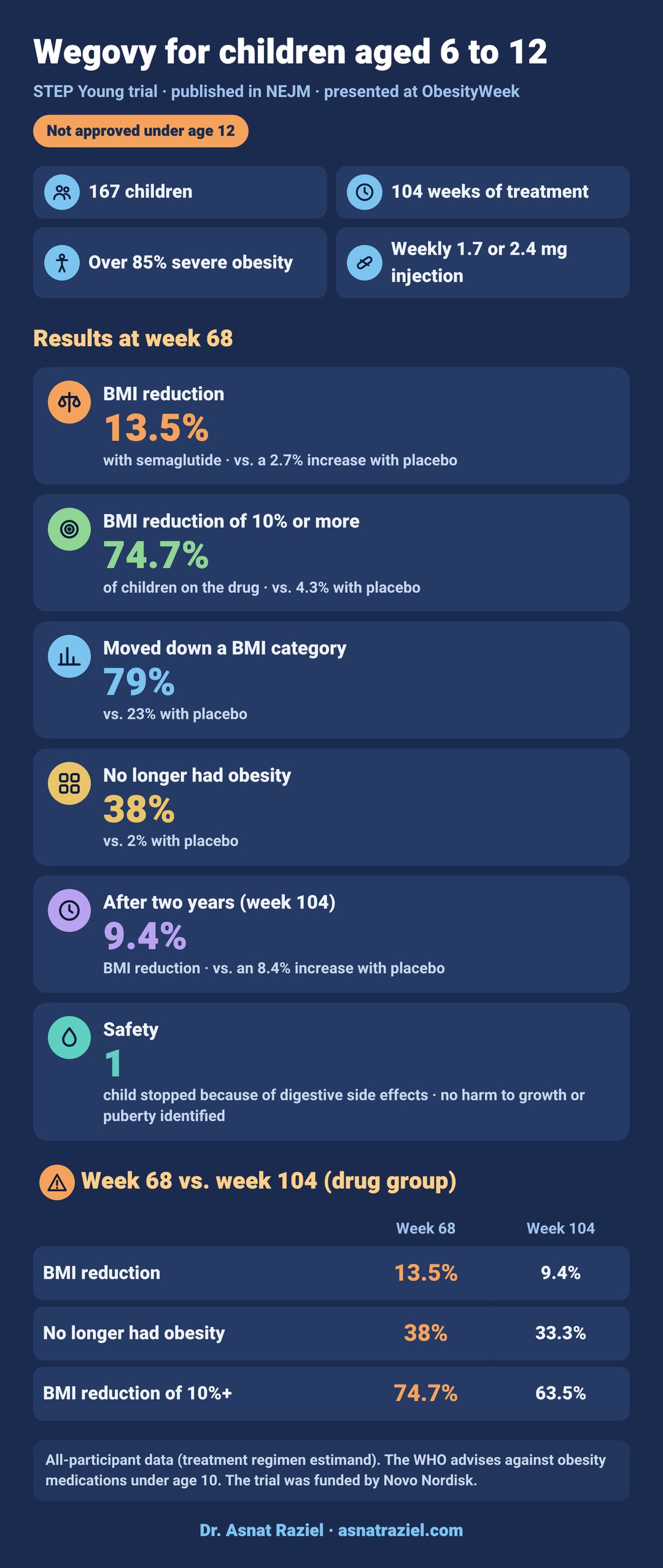
The STEP Young trial is the first to test Wegovy (semaglutide) in children aged 6 to 12 with obesity. The New England Journal of Medicine published the full results today, and the researchers presented them at ObesityWeek in the United States. After 68 weeks, BMI fell by 13.5% in children who received the drug. In children on placebo, by contrast, it rose by 2.7%.
I wrote about the first results of the trial about a month ago. At that point the company had released only one number. Now we have the full data, including two years of follow-up, safety results and the debate the trial has sparked.
Why obesity at a young age matters so much
Childhood obesity is not a cosmetic issue. It raises the risk of type 2 diabetes, abnormal blood fats, high blood pressure and sleep apnea. It also harms quality of life, and many children face bullying and stigma because of it. I explain more in my article on obesity that starts in early childhood.
According to the World Obesity Atlas, about 177 million children and teens aged 5 to 19 were living with obesity in 2025. What is more, one modeling analysis estimated that young children with severe obesity that persists could lose close to half of their expected life span. This is a theoretical calculation, but it shows how large the risk is.
How the STEP Young trial worked
This was a randomized, double-blind, placebo-controlled phase 3 trial. It enrolled 167 children aged 6 to 12 with obesity. The researchers assigned 112 children to semaglutide and 55 to placebo. Over 85% of the children had severe obesity, class 2 or 3, at the start.
The children received a weekly injection for 104 weeks. The maximum dose was 2.4 mg for children who weighed over 60 kg, and 1.7 mg for children who weighed 45 to 60 kg. In addition, all families received support for a reduced-calorie diet and physical activity. At the end of treatment, the children stopped the injections for 7 weeks. Novo Nordisk funded the STEP Young trial, and the trial registration is public.
How doctors measure obesity in children
In children, BMI changes with age and growth. That is why doctors compare it with growth charts for age and sex. Obesity means a BMI at or above the 95th percentile. Severe obesity, class 2, starts at 120% of the 95th percentile, and class 3 at 140%.
STEP Young trial: the results at week 68
First, the main result: BMI fell by 13.5% with semaglutide and rose by 2.7% with placebo. The difference between the groups was 16.2 percentage points. In an analysis that assumes every child stayed on treatment, BMI fell by 17.4%, compared with a 2.2% rise on placebo.
In addition, 79% of the children on the drug moved down at least one BMI category, compared with 23% on placebo. Also, 38% of them no longer met the definition of obesity, compared with just 2% on placebo. A BMI reduction of 10% or more occurred in 74.7% of the children on the drug, compared with 4.3% on placebo.
Heart and metabolic measures improved too. Prof. Ania Jastreboff of Yale, the lead investigator, said the treatment may shift children back toward a healthier path. However, the detailed figures for these measures appear only in the full paper.
What happened after two years
At week 104, BMI in the drug group was 9.4% below where it started. On placebo, by contrast, it had risen by 8.4%. In other words, the gap between the groups did not shrink, and even widened slightly, to 17.8 percentage points. Among the children on the drug, 33.3% no longer had obesity, compared with 2.4% on placebo.
That said, the children regained some of the BMI reduction between week 68 and week 104, even though the children stayed on treatment. In addition, the researchers did not adjust the week 104 data for multiple comparisons. So these data cannot support firm conclusions.
STEP Young trial: what we know about safety
Side effects occurred in 96% of the children on the drug and in 93% of those on placebo. The most common were digestive, such as nausea, vomiting and diarrhea. They were more frequent with semaglutide, but only one child stopped treatment because of them.
Importantly, the researchers found no harm to growth or pubertal development. Still, as in adults, no one should use the drug who has a personal or family history of medullary thyroid cancer or MEN 2 syndrome.
The debate: should medication start as early as age six?
The trial comes shortly after the World Health Organization issued its first guidelines on obesity in children. They advise against obesity medications under age 10, because of missing long-term safety data. Instead, they recommend healthy eating, physical activity and behavioral support.
In addition, according to a New York Times report, doctors are divided. Some ask not whether the drug works, but whether it is right to give it to children who are still growing. Others argue that waiting until age 18 is not an option for severe obesity. Open questions include nutritional deficiencies, eating disorders, muscle loss and whether treatment would need to be lifelong.
Where things stand today
Regulators have not yet approved Wegovy for children under 12. The company said it will ask the FDA for approval. In the meantime, approval covers ages 12 and up. For example, in the STEP TEENS trial, adolescents saw a significant drop in BMI. I cover this in my articles on the STEP TEENS results and on Mounjaro for teens.
So for parents of a child with severe obesity, the first step is to see a pediatrician and a multidisciplinary team. Build a plan that covers food, movement, sleep and emotional support, without judgment or shame. Above all, parents should make any decision about medication at a young age together with a specialist, after weighing the benefits and the risks.
Limitations of the trial
First, Novo Nordisk funded the trial, and the number of participants is relatively small. Second, some of the data come from an analysis that assumes full adherence, which reflects an ideal scenario. Finally, two years is a short time in a child’s life. There are still no data on growth, puberty and mental health over many years, nor on what happens when treatment stops.
Bottom line on the STEP Young trial
The STEP Young trial shows that semaglutide lowers BMI in children aged 6 to 12 with severe obesity, and that the gap between the groups holds at two years. However, the World Health Organization still advises against medication under age 10, and long-term safety questions remain open. Ultimately, children with severe obesity need professional, early and respectful care that combines lifestyle and support for the whole family.
This article is general information and is not a substitute for personal medical advice.
References
Semaglutide for the Treatment of Obesity in Children 6 to <12 Years of Age
New Data Paves the Way for Weight-Loss Drugs in Children as Young as 6
WHO guidelines on the integrated management of obesity in children
Novo Nordisk, which makes Wegovy, funded the trial.