By Dr. Asnat Raziel, bariatric surgeon specializing in obesity treatment, metabolic health and healthy longevity; Director of the Multidisciplinary Center for Obesity Treatment, Assia Medical, Assuta Ramat HaChayal, Tel Aviv
The CG-0416 pill at ObesityWeek
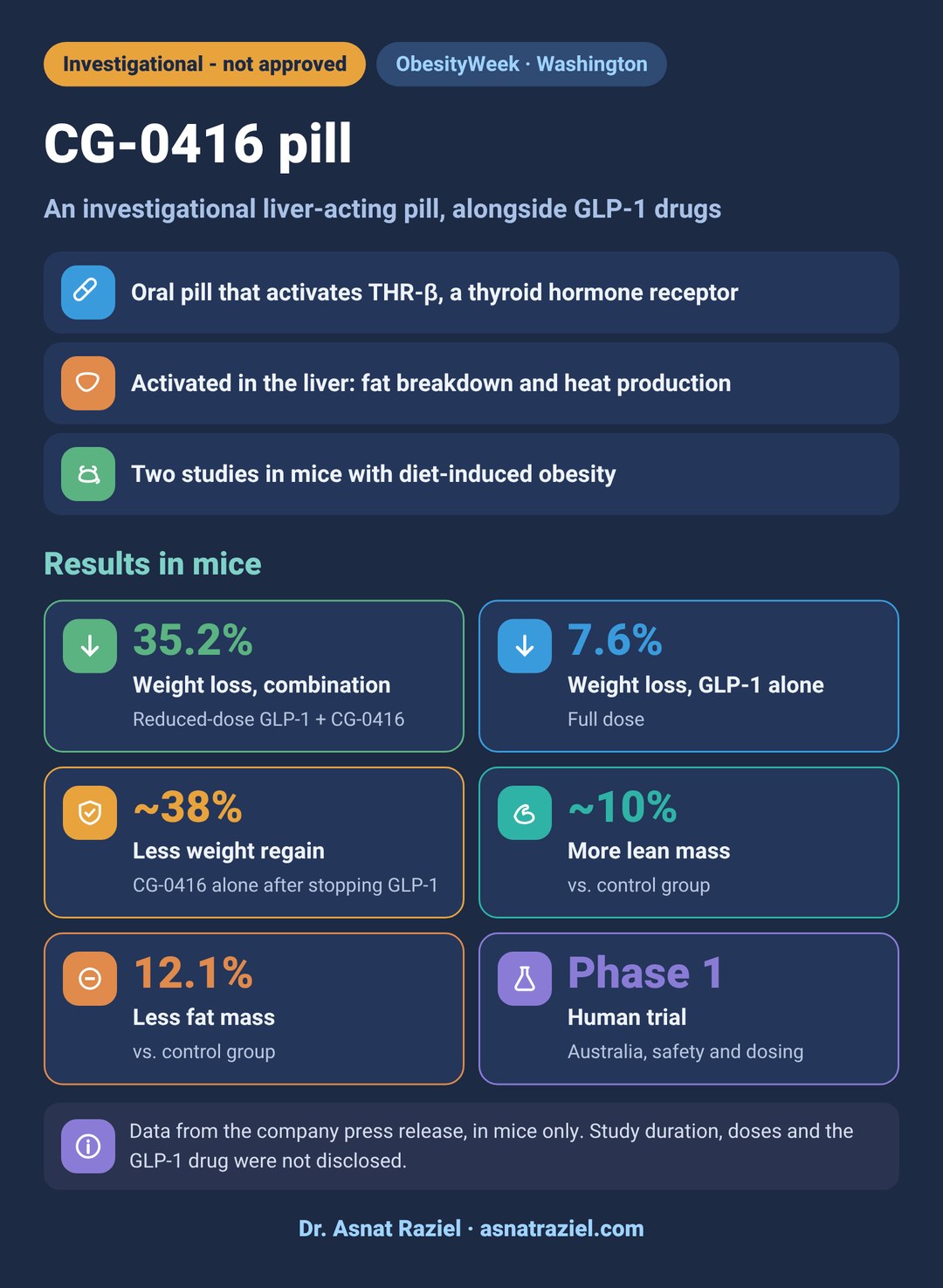
The CG-0416 pill is a new investigational drug from the Chinese company CureGene. The company presented two studies in mice at ObesityWeek, the American obesity meeting in Washington. In the first, combining it with a GLP-1 drug led to 35.2% weight loss. In the second, continuing the pill alone after stopping the GLP-1 drug cut weight regain by about 38%.
Let me stress this up front: these are mouse data only. CG-0416 is an investigational drug, and it is not approved for use in Israel or the US. The first trial in humans began only this year.
Why this matters: regaining weight after the shots
Many patients ask me what will happen when they stop their weekly shot. It is a fair question. After stopping GLP-1 drugs, many people regain weight. So researchers are looking for ways to keep the results after treatment ends. I wrote about why weight-loss drugs work better for some people than others in a separate article.
GLP-1 drugs work mainly on appetite in the brain. The approach behind CG-0416 is quite different. It works on metabolism in the liver, not on the hunger centers.
How the CG-0416 pill works
The pill activates a receptor called THR-β (thyroid hormone receptor beta). Through this receptor, thyroid hormone increases fat breakdown in the liver. In other words, the drug tries to mimic part of thyroid hormone’s effect, but only in the liver.
To do that, the company designed the pill as a prodrug – a drug that enters the body in an inactive form and becomes active only in its target organ. According to the company, a liver enzyme breaks the pill down in a single step and releases the active compound there. The goal is high exposure in the liver and low exposure in the rest of the body.
According to the company, this increases fat breakdown and heat production through a protein called UCP-1. However, the company has not yet published full data on the mechanism.
The same family as a fatty liver drug
The idea is not entirely new. A drug called resmetirom, sold in the US as Rezdiffra, acts on the same liver receptor. In 2024 the FDA approved it as the first treatment for liver scarring caused by fatty liver disease.
Still, resmetirom was approved to treat the liver, not for weight loss. CG-0416, by contrast, also targets body weight itself, and above all its use alongside GLP-1 drugs.
Study one: the CG-0416 pill combined with GLP-1
In the first study, the researchers used mice that had become obese on a high-fat diet. One group received a GLP-1 drug alone, at full dose. A second group received a reduced dose of the same drug together with CG-0416.
Combination: 35.2% loss of body weight.
GLP-1 alone, at full dose: 7.6% loss of body weight.
Eating: food intake did not rise in the combination group.
That said, the company did not disclose the study length, the doses or which GLP-1 drug it used.
Study two: keeping the weight off after stopping
The second study asked an even more important question. First, the mice received CG-0416 together with a GLP-1 drug. Then the researchers stopped the GLP-1 drug and continued CG-0416 alone. Finally, they compared the results with a control group.
Weight regain: about 38% less than in the control group.
Lean mass: about 10% higher than in the control group. Lean mass means everything that is not fat – muscle, organs and bone.
Fat mass: 12.1% lower.
Side effects: according to the company, no side effects typical of GLP-1 drugs were seen.
Protecting muscle matters in any weight loss. I covered it in my article on weight-loss drugs across the lifespan.
What we still don’t know about the CG-0416 pill
First, all of the data come from mice. Results in mice do not always carry over to people. Second, the data come from a company press release, without a full scientific publication or statistical analysis. Third, there is no safety information in humans yet.
I also found a small inconsistency in the release. The company wrote that the difference between the groups was roughly 3.6-fold. However, by the published numbers, 35.2% versus 7.6% is about 4.6-fold. That is why I have reported the numbers themselves here.
What about people? According to the company, a phase 1 trial in Australia is under way, and another trial in China is expected to start soon. A phase 1 trial tests safety and dosing, not how well a drug works for weight loss.
What this means for you today
For now, this drug is far from the clinic, probably by several years. Even so, the direction is interesting: combining drugs with different mechanisms, and keeping weight off after the shots stop. Other approaches like this were also presented at the meeting, including new Israeli research on obesity.
What can you do today? If you are taking a GLP-1 drug, don’t stop suddenly and without a plan. Plan the next step with your doctor, add strength training and protein, and keep track of your weight. If you have fatty liver disease, a simple blood test can detect liver scarring in time.
The bottom line
The CG-0416 pill is a promising idea, but at a very early stage. In mice, combining it with a GLP-1 drug boosted weight loss. In addition, continuing the pill alone reduced weight regain. However, only trials in humans will show whether this is a real treatment. I will keep following it and share updates.
This article provides general information and is not personal medical advice. Talk to your doctor before making any change to your treatment.
References
CureGene Presents Two Preclinical Studies of CG-0416 at Obesity Week 2026
CureGene doses first participant in Phase I trial of liver-targeting CG-0416
FDA approves first treatment for patients with liver scarring due to fatty liver disease
The mouse studies were conducted and funded by CureGene, the company developing the drug.