By Dr. Asnat Raziel, bariatric surgeon specializing in obesity treatment, metabolic health and healthy longevity; Director of the Multidisciplinary Center for Obesity Treatment, Assia Medical, Assuta Ramat HaChayal, Tel Aviv
Resting metabolic rate after weight loss: what the study found
Resting metabolic rate drops when you lose weight, and it does so even when your body composition improves. That is the message of a new Israeli study presented at ObesityWeek. The study was led by dietitian Dr. Brurya Tal, the first author of the work. For one year, the team followed 66 adults with metabolic obesity.
On average, participants lost 8.89 kg, and their body fat percentage went down. However, their bodies burned about 107 fewer calories a day at rest. Moreover, this slowdown was not explained by the change in lean and fat percentages. There was another interesting finding, too. At the end of the year, a higher resting burn went hand in hand with higher blood pressure.
What is resting metabolic rate, and why does it matter?
Resting metabolic rate (RMR) is the energy your body burns when you are doing nothing at all. Your body uses it for breathing, for your heartbeat and for your brain. It also fuels your liver and kidneys and keeps you warm.
It is the largest part of the energy you spend each day. Body size and body composition largely determine it. For example, muscle tissue uses far more energy than fat tissue.
When you lose weight, your body gets smaller, so you would expect it to burn less. The real question is whether the slowdown is larger than expected. So the researchers asked whether it comes only from losing tissue. The other possibility is a protective response of the body, known as metabolic adaptation.
The study: a year on a high-protein Mediterranean diet
Dr. Brurya Tal led the study with a team from the Sagol Center for the Metabolic Syndrome at Tel Aviv Sourasky Medical Center (Ichilov). Researchers from its Institute of Endocrinology, Metabolism and Hypertension and from Tel Aviv University also took part. The senior author is Naftali Stern.
- 66 adults with metabolic obesity, with a mean age of 53.8 years: 37 men (56%) and 29 women (44%).
- All participants received recommendations for a high-protein Mediterranean diet, with moderate calorie restriction and moderate physical activity.
- At the start and after 12 months, the team measured body composition with a DEXA scan.
- They measured resting metabolism by indirect calorimetry, which tracks oxygen use and carbon dioxide output.
- Blood pressure was tracked with 24-hour ambulatory monitoring.
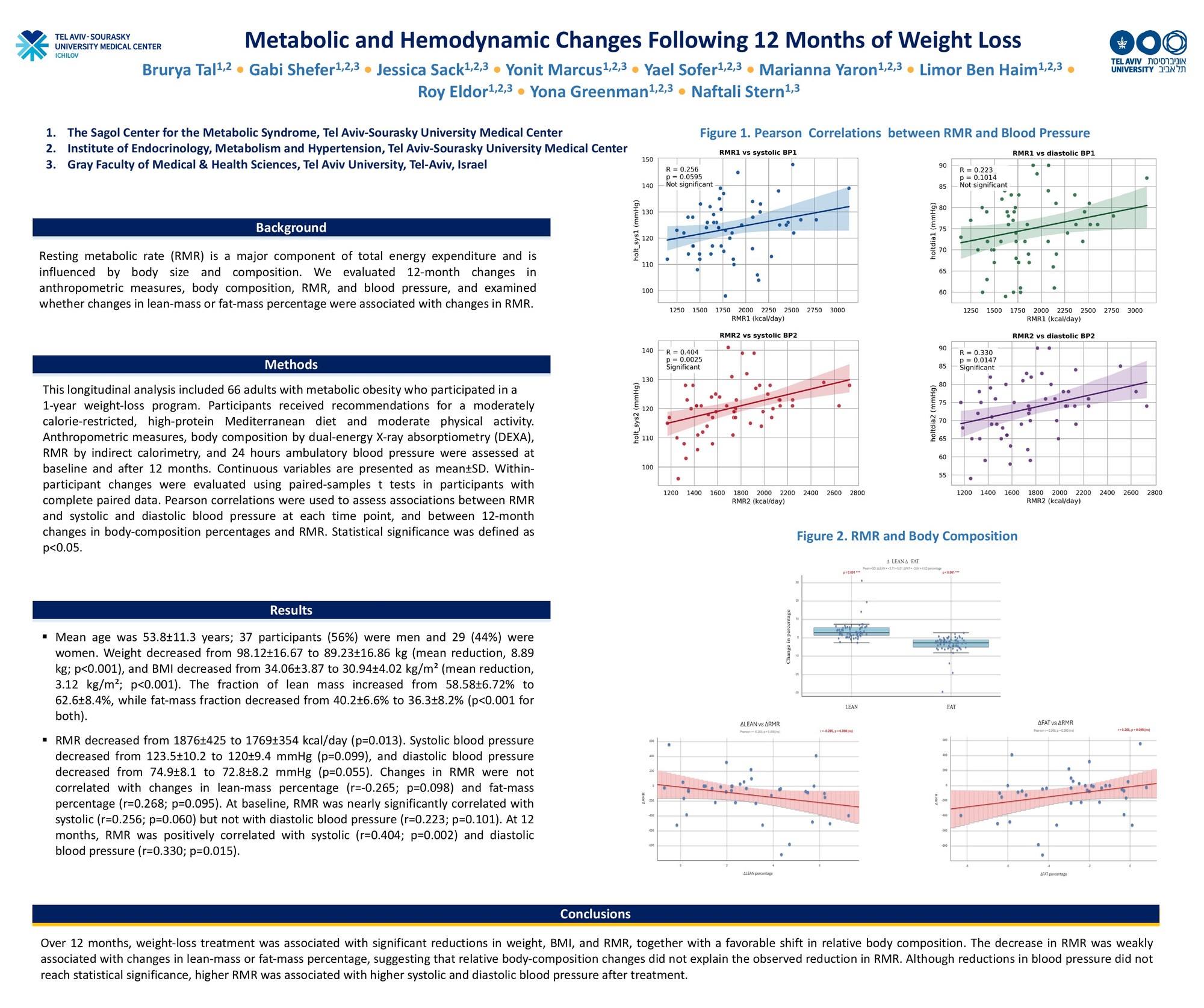
This is the poster presented at the conference. Click the image to open it at full size.
The results: weight loss and better body composition
- Body weight fell from 98.12 to 89.23 kg on average, a loss of 8.89 kg (p<0.001).
- Body mass index (BMI) fell from 34.06 to 30.94 (p<0.001).
- The share of lean mass rose from 58.58% to 62.6% of body weight (p<0.001).
- The share of fat mass fell from 40.2% to 36.3% (p<0.001).
Keep in mind that these are percentages, not kilograms. When fat drops faster than muscle, the relative share of lean mass rises. That can happen even if some muscle was actually lost. Overall, the picture shows a favorable shift in body composition.
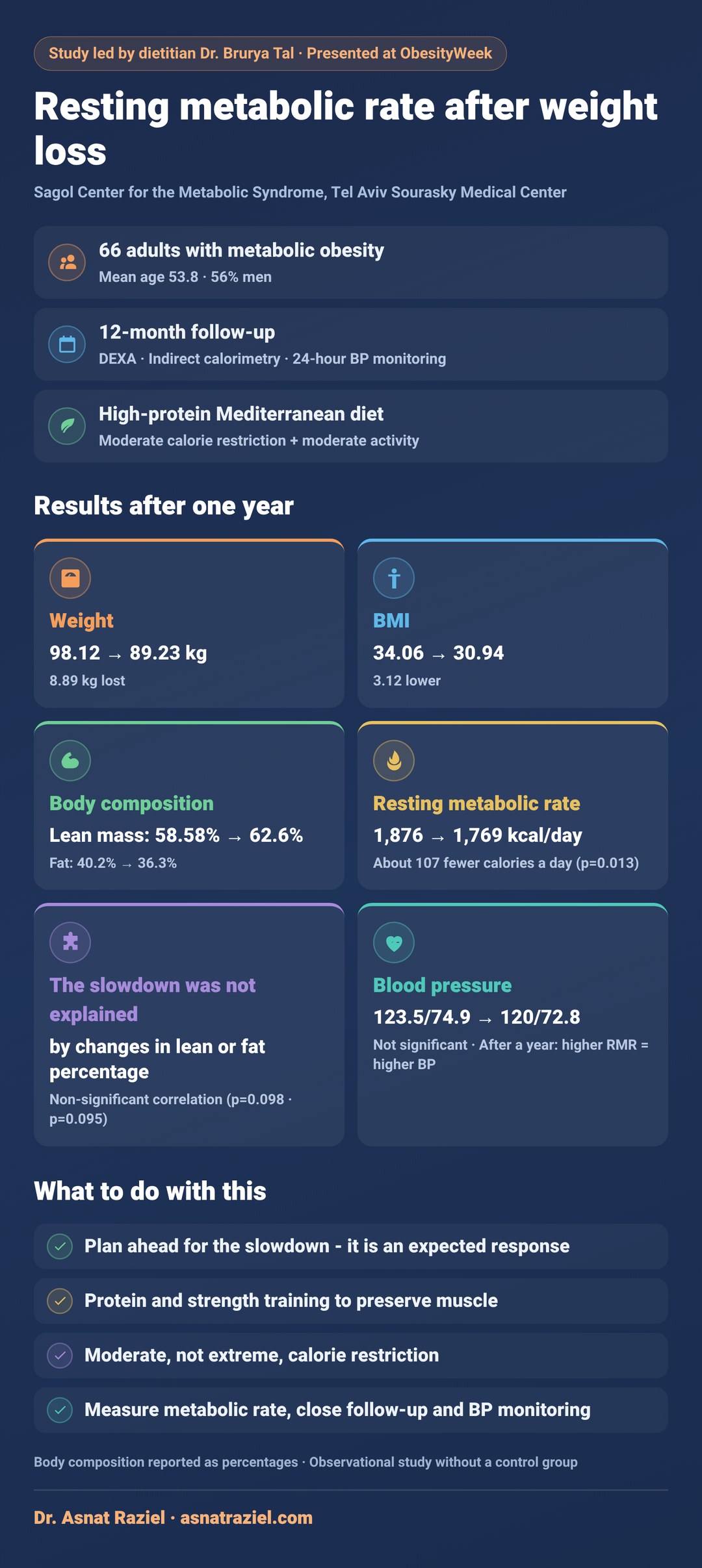
Resting metabolic rate fell, and body composition did not explain it
Resting metabolic rate fell from 1,876 to 1,769 calories a day on average (p=0.013). In other words, the body burned about 107 fewer calories each day.
Here comes the key finding. The change in metabolic rate was not significantly correlated with the change in lean-mass percentage (r=-0.265; p=0.098). Nor did the change in fat percentage explain it (r=0.268; p=0.095). Put simply, the relative improvement in body composition did not explain the slowdown. This fits the view that the slowdown also has a component of metabolic adaptation.
Resting metabolic rate: what the wider research shows
Dr. Tal’s findings fit in with a series of new studies from around the world.
Building muscle does not stop the slowdown
A study in recreational athletes followed 36 people who lost weight. They did strength training and ate enough protein. Even so, their resting energy expenditure fell by about 140 calories a day. The drop was also larger than the researchers predicted from weight and body composition. What is more, it appeared even in those who gained lean mass. This strongly supports Dr. Tal’s finding.
The mechanisms that slow the body down
A review in Nature Reviews Endocrinology summarized the mechanisms that drive weight regain. They include changes in hunger and fullness hormones, lower resting energy expenditure and changes in fat breakdown. In addition, another review described how obesity itself changes fat tissue, muscle and the brain. These changes make it harder to lose weight and keep it off.
Planned breaks from dieting
A meta-analysis of 12 controlled trials included 881 participants. It compared continuous dieting with dieting that includes planned breaks. Both approaches improved weight and body composition to a similar degree. By contrast, resting metabolic rate fell significantly only with continuous dieting. With planned breaks, the slowdown was smaller.
Strength training preserves muscle
An Israeli study of 304 adults looked at a low-calorie diet with different types of exercise. Among the men, only strength training came with a gain in lean mass: +0.8 kg. By contrast, aerobic training came with a loss of 1.1 kg, and no exercise with a loss of 2.8 kg. Strength training also brought the largest drop in fat: 8.9 kg.
Protecting muscle in the age of weight loss drugs
A systematic review in Annals of Internal Medicine looked at body composition on incretin-based drugs. It covered liraglutide, semaglutide, tirzepatide and dulaglutide. At the median, 28.3% of the weight lost was attributed to a drop in muscle-related measures. In 65% of the studies, the share exceeded the usual benchmark of about a quarter of the weight lost. Even about half of the programs without drugs showed muscle loss above the benchmark. You can read more in my article on body composition on weight loss drugs.
Resting metabolic rate and blood pressure: a link that grew stronger
Systolic (upper) blood pressure fell from 123.5 to 120 mmHg (p=0.099). Diastolic (lower) pressure fell from 74.9 to 72.8 mmHg (p=0.055). These drops did not reach statistical significance. It is worth noting that participants’ average blood pressure was already in the normal range at the start.
The interesting finding concerns the link between metabolic rate and blood pressure. At baseline, the link with systolic pressure came close to significance (r=0.256; p=0.060). However, there was no significant link with diastolic pressure (r=0.223; p=0.101). After 12 months, the link grew stronger and became significant. A higher resting burn went with higher systolic pressure (r=0.404; p=0.002). The same was true for diastolic pressure (r=0.330; p=0.015).
The study did not examine the reason for this link. Still, the research suggests one possible direction: the sympathetic nervous system, the body’s “stress system.” It raises both energy expenditure and blood pressure. A systematic review of 16 studies found increased sympathetic activity in metabolic syndrome, linked with higher blood pressure. In addition, a controlled trial showed that weight loss lowers sympathetic activity and improves blood pressure. So this is an interesting hypothesis for further research, not a conclusion of the current study.
How to support your resting metabolic rate: what to do in practice
- Plan ahead for the slowdown: it is an expected response of the body, not a personal failure. Build a plan for the maintenance phase from day one. Read more about continuing obesity treatment over time.
- Protein and strength training: they help preserve muscle, including during drug treatment. Still, on their own they do not prevent the slowdown. Here are my tips on a physical activity prescription.
- Moderate restriction: extreme dieting slows the body down more sharply. That is why it is worth reading about moderate calorie restriction.
- Measure instead of estimating: indirect calorimetry measures each patient’s own energy expenditure. This way, the dietitian can adjust the personal nutrition plan to real changes.
- Keep an eye on blood pressure: continue monitoring it during treatment and afterward.
- Close support: a dietitian and a multidisciplinary team can spot a slowdown in time and adjust diet and activity.
Study limitations
This is an observational study of a single group of 66 participants, with no control group. The researchers analyzed only those with complete data at both time points. In addition, body composition was reported as percentages, not kilograms. Finally, correlation does not prove causation. That is why the link with blood pressure needs further study.
Bottom line: resting metabolic rate and keeping the weight off
The study led by dietitian Dr. Brurya Tal examined a one-year program. It combined a high-protein Mediterranean diet, moderate calorie restriction and moderate physical activity. On average, participants lost almost 9 kg, and their body composition improved. At the same time, resting metabolic rate fell, and the relative change in lean and fat percentages did not explain the slowdown.
Together with new studies from around the world, the message is clear. The body responds to weight loss with a metabolic slowdown. Long-term success therefore takes a personal plan, muscle preservation, measurement and follow-up. In the end, professional support matters even after you reach your goal weight.
This article provides general information and is not a substitute for personal medical or nutritional advice.
References
Metabolic and Hemodynamic Changes Following 12 Months of Weight Loss
Obesity-induced and weight-loss-induced physiological factors affecting weight regain
Obesity-induced tissue alterations resist weight loss: A mechanistic review
Resistance training as a key strategy for high-quality weight loss in men and women
Effect of Incretin-Based and Nonpharmacologic Weight Loss on Body Composition: A Systematic Review