By Dr. Asnat Raziel, bariatric surgeon specializing in obesity treatment, metabolic health and healthy longevity; Director of the Multidisciplinary Center for Obesity Treatment, Assia Medical, Assuta Ramat HaChayal, Tel Aviv
Response to weight loss drugs: why the same drug works differently
Response to weight loss drugs is not the same for everyone, and every clinician who treats obesity knows it. One person loses 25% of their weight, while another barely moves. At ObesityWeek, Dr. Andres Acosta of Mayo Clinic presented nearly 14 years of research on this question. His message was sharp: one-size-fits-all care does not work, and it will not work in the future either.
In cancer care, he noted, doctors have long looked beyond tumor size. They test biology, hormones and genetics, and choose treatment accordingly. Obesity care, in his view, should move the same way in the coming years.
The big gap between the average and the patient
Among the first 113 patients who received semaglutide 2.4 mg at Mayo Clinic, average weight loss after one year was 13.4%. However, the spread between patients was huge. Acosta stressed that this variation exists across every type of treatment: lifestyle, endoscopic procedures, surgery and medications.
So he suggests looking well beyond BMI. First, blood sugar control. Second, inflammation and fibrosis. Then appetite and reward, and the body’s energy balance.
Four types of obesity
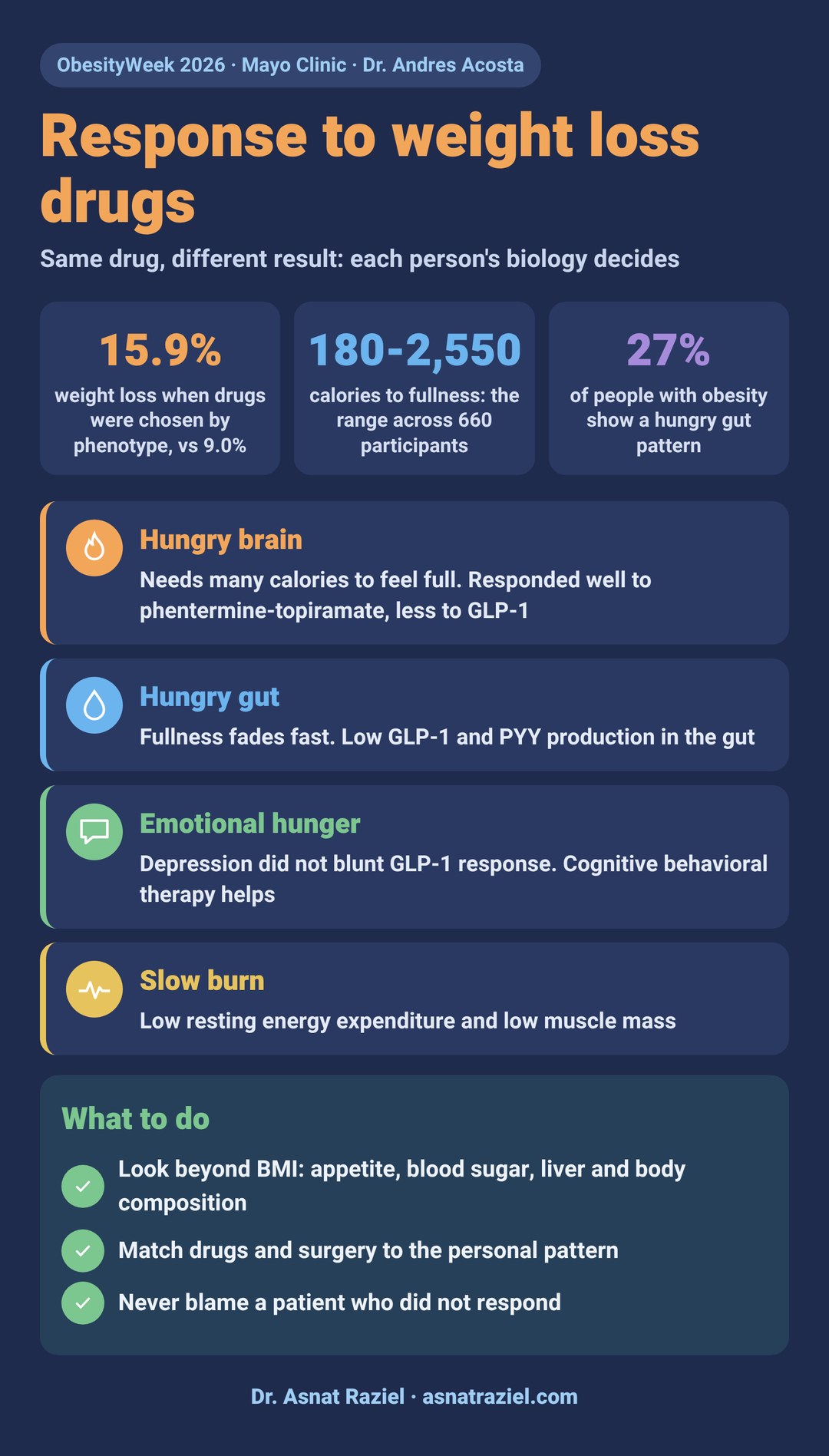
Acosta’s group defines four phenotypes, meaning biological and behavioral patterns:
Hungry brain: it takes many calories to feel full during a meal.
Hungry gut: fullness after a meal fades fast, and hunger returns.
Emotional hunger: eating in response to anxiety, stress or emotions.
Slow burn: low resting energy expenditure and low muscle mass.
In an earlier study by the group, choosing a drug by phenotype led to 15.9% weight loss, compared with 9.0% with usual selection.
Hungry brain: how many calories until full
To measure the “hungry brain,” participants eat a meal until maximal fullness. In 660 participants, the range was striking: from 180 to 2,550 calories. Still, Acosta warned against generalizing. Even people with a similar BMI ate very different amounts.
The researchers built a genetic score based on 41 genes in the gut, brain and fat tissue axis. Using machine learning, the model identified the phenotype with about 82% accuracy. The results were published in Cell Metabolism.
Response to weight loss drugs by genetic score
This is where the data become practical. In a trial of phentermine and topiramate, people with a “hungry brain” lost 16.5%, compared with 9.2% in others. In a liraglutide study, however, the trend reversed: those with a high score lost only 3.4%, compared with 6.7%.
Semaglutide showed a similar picture. At Mayo Clinic, people with a high score lost 10% at one year, compared with 19.5%. That paper is still under review. Among 3,144 patients on tirzepatide, those with a high score lost about 15% at two years, compared with about 19.5%. In other words, the score may help match each person with the right drug.
A model that combines genetics and clinical data
A combined model, which also includes age, clinical measures and past treatments, split tirzepatide patients into three groups. Weight loss at one year was 9.8% in the high-risk group, 15% in the intermediate group and 20% in the low-risk group. Still, Acosta stressed that more prospective validation is needed.
Surgery: which operation for which patient
As a bariatric surgeon, I found the surgical findings the most interesting. According to the talk, after Roux-en-Y gastric bypass, people with a high score lost 28% but regained down to just 12.4%. By contrast, those with a low score kept off 25% even after ten years.
After sleeve gastrectomy, the picture flipped. People with a high score kept off 22% at ten years, and those with a low score 13.1%. Acosta’s conclusion: a “hungry brain” fits the sleeve better, and a “hungry gut” fits the bypass. Above all, don’t blame patients who regain weight. Sometimes the operation simply did not fit their biology.
Hungry gut and emotional hunger
According to Acosta, about 27% of people with obesity have a “hungry gut” pattern: rapid stomach emptying and hunger between meals. Gut biopsies showed low production of GLP-1 and PYY. Surprisingly, in a small group on tirzepatide, some of them responded very well, losing 21% within six months.
For emotional hunger, depression did not blunt the response to semaglutide or tirzepatide. Patients with anxiety or depression also responded well to naltrexone and bupropion, a less expensive drug. Alongside medication, Acosta also recommended cognitive behavioral therapy. Treatment choices also change across life stages, as I described in my article on weight loss drugs from teens to older adults.
Response to weight loss drugs and stopping treatment
According to Acosta, more than 60% of patients stop their medication. Cost is the top reason, followed by lack of results and side effects. In an analysis of 34,000 patients on semaglutide or tirzepatide, the group built a model that predicts who will regain weight after stopping. In high-risk patients, half the lost weight returns within two months to two years.
What this means for you
If a drug did not work for you, it is not a personal failure. It may simply not match your biology. So ask your doctor questions such as: how much do I eat before I feel full? Does hunger come back soon after a meal? Does stress make me eat? The answers help guide treatment. It is also worth checking blood sugar, liver function and body composition on weight loss drugs, not just weight.
Bottom line on response to weight loss drugs
Response to weight loss drugs depends on each person’s biology, not just willpower. The Mayo Clinic research shows that appetite measures and genetics can predict which treatment will work best. Still, most of the data need further validation. In the end, the future is precision obesity medicine, which fits the treatment to the person rather than the person to the treatment.
This article is general information and does not replace personal medical advice.
Sources
Genetic and physiological insights into satiation variability predict responses to obesity treatment
The researcher disclosed a commercial relationship with Phenomix Sciences, a Mayo Clinic spinoff.