By Dr. Asnat Raziel, bariatric surgeon specializing in obesity treatment, metabolic health and healthy longevity; Director of the Multidisciplinary Center for Obesity Treatment, Assia Medical, Assuta Ramat HaChayal, Tel Aviv
What happened after longevity medicine training
Short, online longevity medicine training may change the way doctors talk with their patients. That is the finding of a new international study. The researchers linked the training to greater professional confidence, more conversations about healthy years of life, and the use of prevention principles in daily practice. However, the researchers stress an important point. The results rely on self-reports from a select group, and they do not yet show that patients’ health improved.
Longevity medicine enters the exam room
For years, medicine focused mainly on diagnosing and treating disease that had already appeared. Longevity medicine aims to step in earlier. Its question is much broader: how do we preserve function, independence and metabolic health over many years?
The field draws on the science of aging, known as geroscience, which studies the biological mechanisms that aging and chronic diseases share. It includes assessment of lifestyle, heart health, sleep, physical activity, cognitive function and body composition. In addition, it deals with newer areas such as biomarkers, biological clocks and artificial intelligence for risk assessment. I also wrote about this broad approach in my article on lifestyle medicine and longevity.
However, this rapid progress created a problem. Most doctors never learned in their training to tell evidence-based prevention apart from tests and treatments that are still unproven. Against this background, a study in the journal JMIR Medical Education appeared in March 2026. It asked whether structured training changes the way doctors think and work.
Longevity medicine training in under three hours
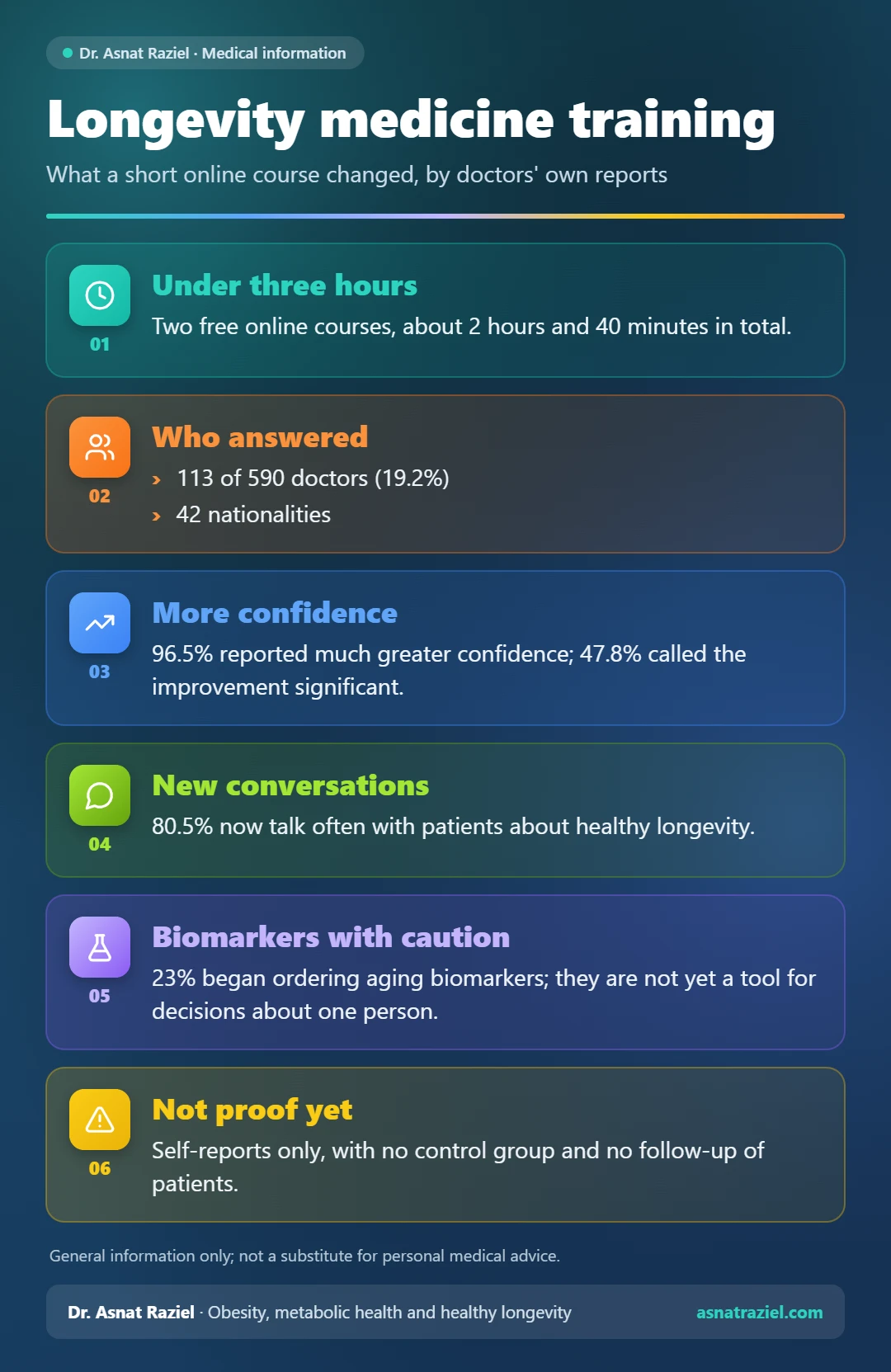
The researchers looked at two online courses in healthy longevity medicine. The courses were free and self-paced, and they carried continuing medical education credit. Together, they took about two hours and 40 minutes. At the end, participants took a test and needed a score of at least 80.
The curriculum covered the mechanisms of aging, its epidemiology and the path from basic research to the clinic. It also dealt with possible interventions, psychological aspects, measuring biological age and the use of artificial intelligence in medical work.
Between 2021 and 2024, 6,464 people enrolled in the courses. Of these, 3,223 completed them and passed the test. After removing those who were not licensed physicians, the researchers sent the survey to 590 practicing doctors. In the end, 113 answered it in full, a response rate of 19.2%. The respondents came from 42 nationalities, and most worked in family medicine and internal medicine.
Almost everyone felt their understanding improved
The standout finding is the rise in professional confidence. In total, 96.5% of respondents reported much greater confidence in their knowledge of the field, and 47.8% described the improvement as significant.
Keep in mind that the study measured a feeling. It did not test actual knowledge before and after the course. Still, the figure points to a clear gap in current medical training and to demand for structured programs.
The effect did not stop at a feeling, either. In fact, 55.8% of the doctors said they now include longevity principles in the routine assessment of all their patients. Another 39.8% include them on special request. In other words, for most respondents the material made its way into the exam room, at least according to their own reports.
After longevity medicine training, the conversation changes
One of the most interesting changes involved communication with patients. Overall, 80.5% of respondents said they now talk often about healthy longevity and about staying fully functional.
This is a meaningful shift. Longevity medicine is not a single test or a new drug. Instead, it calls for conversations about physical activity, muscle mass, sleep, nutrition, stress, social ties and metabolic health. When the conversation changes, the goals change too. The aim is no longer just to fix a lab value, but to build a long-term plan to keep moving and functioning.
Moreover, 52.2% said the training completely changed their view of aging. In addition, 84.9% believed that medical education in this field will help societies cope with population aging. This ties in with the goals of the World Health Organization’s Decade of Healthy Ageing, 2021 to 2030.
Biomarkers: closer to the clinic, but not a verdict
The courses included an introduction to biomarkers of aging. After the training, 23% of respondents began ordering these tests for the first time. Meanwhile, 48.7% increased how often they use them.
This is an intriguing figure, and it calls for caution. According to the researchers, aging clocks and biomarkers are mainly suited to research and to tracking trends today. They are not yet a tool for clinical decisions about a single person. Similarly, a consensus of aging-biomarker researchers stresses that there is no single agreed test. Each clock was built to measure something different, so their results don’t always match. You can read more in my article on epigenetic clocks and biological age.
Therefore, a biomarker should complement a full medical assessment, not replace it. The condition is that the doctor understands what the test measures, how well it has been validated, and whether there is a basis for acting on it.
Not every doctor gained the same thing
The researchers divided the respondents into two groups. One group included family, primary care and preventive medicine doctors. The other included specialists in other fields.
The specialists were 4.46 times more likely to report a rise in confidence. They were also almost three times more likely to report many more conversations with patients about longevity. By contrast, community doctors built the principles into routine assessment to a much greater extent. They also rated the training as especially effective.
The researchers suggest a possible explanation. Family doctors already know prevention, risk assessment and lifestyle change. So the course added less new knowledge for them, but it fit easily into their work. The conclusion: one program does not suit every specialty. A family doctor, a cardiologist and a sports physician need the same scientific foundation, but different tools.
Longevity medicine training that changed careers
The reported impact went beyond daily work. For example, 34.5% joined a professional group of longevity doctors. Also, 21.2% opened a new clinic in the field, 3.5% joined an existing clinic, and 8.9% did both. On the other hand, 31.9% said their career did not change in any meaningful way.
Almost all participants, 95.6%, supported formal certification in the field, and 99.1% wanted to keep learning. In addition, 71.7% expected the field to be recognized as an official medical specialty, and 73.5% expected it to become part of mainstream medicine. This trend is already taking shape. For instance, in May 2026 China launched a national training program in longevity medicine for licensed physicians. Furthermore, as of early November 2026 the Harvard T.H. Chan School of Public Health is developing an online course in longevity medicine for doctors in every field.
The system still rewards late care
In their open answers, the doctors pointed to obstacles that have nothing to do with knowledge. The main one is the payment structure, which rewards the number of visits and procedures rather than prevention. In-depth advice on nutrition, sleep and stress takes time, but it is not always paid for.
Respondents also mentioned the lack of uniform guidelines, unequal access to tests and the absence of regulatory recognition. This may be the study’s most important message. Training is necessary, but it is not enough. We also need standards, institutional recognition and economic models that encourage prevention. In addition, we need oversight that separates evidence-based medicine from commercial promises. That is also why, in multidisciplinary obesity care, I see the whole team as part of prevention.
Longevity medicine training: encouraging, but not proof
The study has important limitations. Only about one in five doctors answered the survey, and they were likely doctors who were already interested in the field. All results are based on self-reports. There was no objective knowledge test, no control group and no follow-up of patients’ health. Also, this is a cross-sectional study, so it cannot show that the course itself caused the changes.
It is also worth noting that most of the authors volunteer for the organization that runs the courses. The next step should include studies that measure knowledge before and after training and that look at the quality of clinical decisions. It would also be worth checking whether training improves prevention without leading to unnecessary tests.
The bottom line
The study does not prove that longevity medicine training lengthens patients’ lives. What it does show is that even short training changes the professional language and widens the conversation with patients. Health is not just the absence of disease, but a functional ability that we need to nurture over decades. For this future to be truly medical, it must rest on training, scientific scrutiny, ethics and professional humility. If you are interested in a first step, read about healthy aging in everyday life, or about what a longevity clinic actually offers.
This article is general information and does not replace personal medical advice.
References
Biomarkers of aging for the identification and evaluation of longevity interventions
WHO’s work on the UN Decade of Healthy Ageing (2021–2030)
Longevity Medicine: From Science to Clinical Practice
China Launches Standardized Physician Education in Longevity
The study received no outside funding. Most of the authors volunteer at the Longevity Education Hub, which runs the courses, and one author is a founder and shareholder of Insilico Medicine.