By Dr. Asnat Raziel, bariatric surgeon specializing in obesity treatment, metabolic health and healthy longevity; Director of the Multidisciplinary Center for Obesity Treatment, Assia Medical, Assuta Ramat HaChayal, Tel Aviv
Why parents want to reduce teen screen time
Many parents want to reduce teen screen time, and the latest data explain why. Screen time in adolescence has become one of the biggest health challenges of this generation. The smartphone is almost a natural extension of the hand. However, for a growing share of young people in Israel, use crosses the line from habit into real addiction. Recent data point to a close link between long hours on screens and harm to emotional, social and physical well-being. The phenomenon is not unique to Israel, but here it has reached unusual proportions.
In this article, I focus on what actually helps teenagers: steps taken by schools, by families and by teens themselves. For the long-term effects of screens on the aging brain, see my separate article on digital dementia and screen time.
Almost everyone is online, and many struggle to disconnect
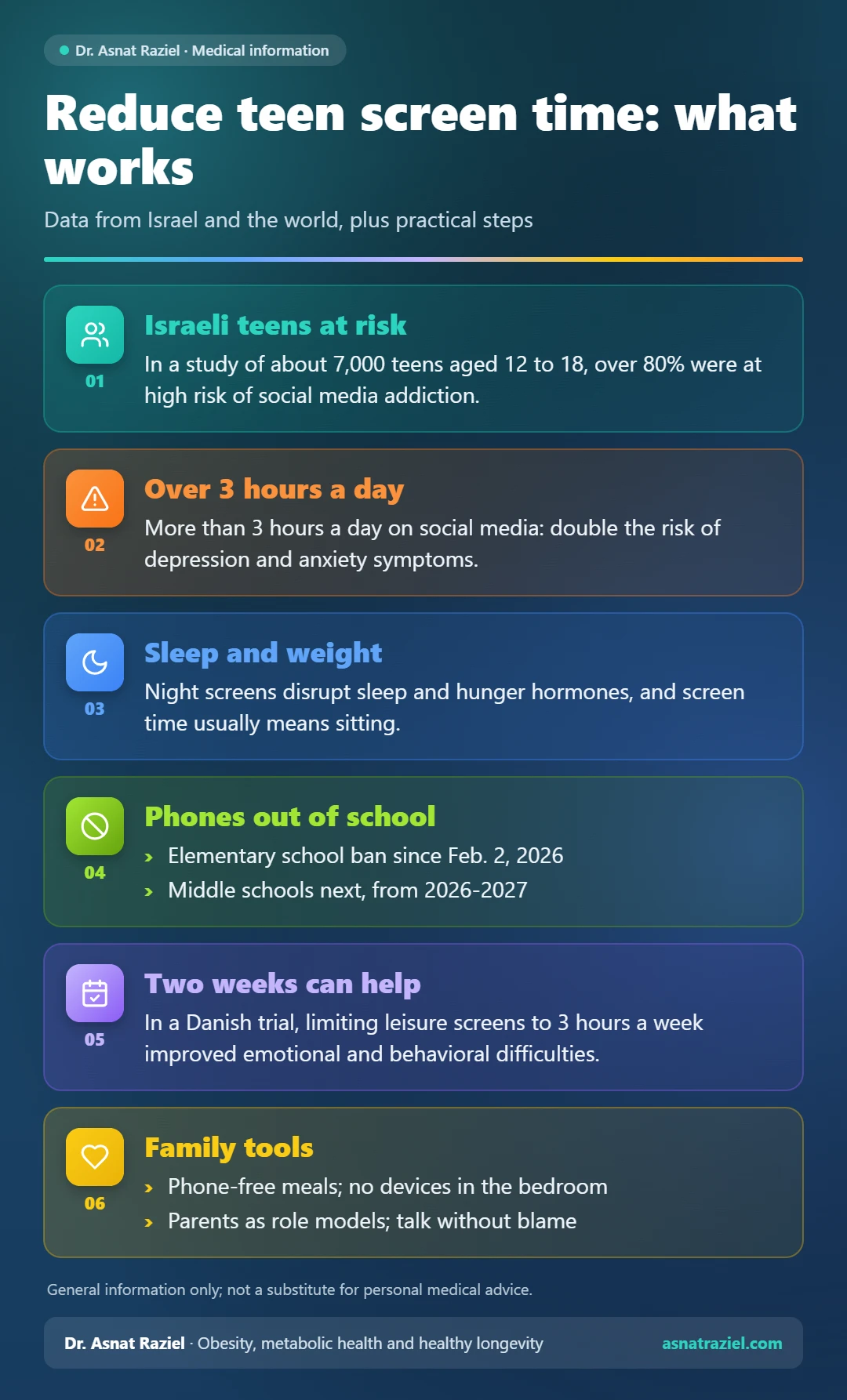
A study by Prof. Yaniv Efrati of Bar-Ilan University, funded by the research fund of Israel’s National Insurance Institute, included about 7,000 Jewish and Arab adolescents aged 12 to 18. According to the report, more than 80% of them were at high risk of social media addiction. In addition, the researchers identified a risk of online gaming addiction in a considerable share of the participants. The study took place during the war, which increased the pressure on the younger generation.
Behavioral addiction shows up as difficulty stopping, a need to keep increasing the time spent and restlessness when the device is out of reach. That is why long hours in front of a screen sometimes come at the expense of sleep, schoolwork and friendships.
The screen as an unhealthy way to regulate emotions
Behind the numbers lies a familiar emotional dynamic. Boredom, frustration or anger often trigger an escape to the screen. Instead of a conversation with parents, physical activity or meeting friends, the phone offers instant relief. However, that relief is short-lived, and the emotional cost can be heavy.
Child health experts warn against using the phone as a substitute for emotional regulation. When teenagers soothe themselves by scrolling, watching or gaming, they miss a chance to develop healthy coping skills. This creates a closed loop: distress leads to the screen, the screen pulls the teen away from a supportive environment, and loneliness and anxiety grow. I wrote about the link between emotional stress and weight in my article on stress and obesity.
What research around the world shows
The findings in Israel fit well with the global picture. A 2025 meta-analysis in the journal Psychological Bulletin included 117 longitudinal studies and nearly 293,000 children under the age of 10. The researchers found a two-way link. In other words, a lot of screen time predicted later emotional and behavioral difficulties, and children with such difficulties tended to turn to screens. Video games showed the strongest link in both directions.
The picture is similar for teenagers. A 2023 advisory from the US Surgeon General stated that adolescents who spend more than three hours a day on social media face double the risk of symptoms of depression and anxiety.
The brain’s reward system
Another important factor is the brain’s reward system. Every like, message or gaming achievement activates a mechanism linked to dopamine, a chemical involved in pleasure and the anticipation of reward. This instant reinforcement creates a desire to return to the same experience again and again. On the other hand, when it fades, a sense of emptiness often remains. In this way, the screen becomes emotional compensation instead of a real solution.
In addition, screens at night disrupt sleep. Short sleep throws off hunger and satiety hormones, so it also affects weight. Moreover, an hour in front of a screen is usually an hour spent sitting. Less movement and snacking in front of the screen contribute to weight gain over time. I wrote about this in my article on sleep deprivation and obesity. These effects matter especially in adolescence, as I explained in my article on the consequences of obesity in children and teens.
How Israeli schools are trying to reduce teen screen time
The growing distress has not escaped decision-makers. Since February 2, 2026, Israel has banned phone use in elementary schools, including during breaks and before classes start. Phones are allowed only in lessons where staff approve their use for learning. In May 2026, the Ministry of Education announced that it would extend the ban to middle schools starting in the 2026-2027 school year, with gradual implementation.
The stated goal is to reduce distractions, encourage face-to-face communication and create a calm learning environment. Alongside enforcement, the ministry is planning programs for digital literacy, balanced use of technology and stronger emotional and social skills.
Can you reduce teen screen time in two weeks?
Studies outside Israel also offer hope. In a Danish trial published in JAMA Network Open, 89 families with 181 children and adolescents aged 4 to 17 took part. Families in the intervention group limited leisure screen time to no more than three hours per week, for two weeks. After just two weeks, there was a significant improvement in emotional and behavioral difficulties. The biggest improvement was in emotional symptoms, relationships with peers and positive social behavior. It turns out that even a short change in habits can make a difference.
A two-week family plan to reduce teen screen time
The Danish trial suggests a simple starting point for families. First, agree on a clear goal for a limited period, such as cutting leisure screen time for two weeks. Second, make it a family project, because parents’ own phone habits set the example. Third, fill the freed-up time with what screens tend to crowd out: sleep, physical activity and face-to-face time with friends. Finally, watch for the changes the researchers measured, such as mood, relationships with peers and social behavior.
Not a war on technology, but balance
The conclusion from the data is clear. Screen addiction in adolescence is a real phenomenon that requires attention. However, the goal is not to ban technology, but to teach smart, balanced use. A few tools are especially helpful:
- Clear boundaries, such as phone-free family meals.
- Taking devices out of the bedroom at night.
- Parents setting a personal example in how they use their phones.
- Encouraging physical activity and face-to-face social meetings.
- Open conversation about the digital experience, without blame.
If screen use is affecting functioning, sleep or mood, it is worth seeking professional advice. Sometimes another difficulty, such as ADHD, lies behind compulsive use. You can read more in my article on obesity and ADHD.
The bottom line on how to reduce teen screen time
Screen time in adolescence affects mental health, sleep and the body. A combination of system-wide steps, family support and building emotional regulation skills can help young people break the cycle of dependence. Ultimately, in a world where we are all online all the time, the real challenge is learning when and how to disconnect.
The information in this article is general and does not replace personal medical advice.
References
Teen addiction during the war: online shopping, gaming and sex (Ynet, in Hebrew)
Social Media and Youth Mental Health: The U.S. Surgeon General’s Advisory
Starting in February: a complete ban on mobile phone use in elementary schools (Mako, in Hebrew)




