By Dr. Asnat Raziel, bariatric surgeon specializing in obesity treatment, metabolic health and healthy longevity; Director of the Multidisciplinary Center for Obesity Treatment, Assia Medical, Assuta Ramat HaChayal, Tel Aviv
Obesity treatment options start with a new understanding
Obesity treatment options are broader today than ever before: bariatric surgery, new medications and holistic, multidisciplinary care. In this article, I review what the major studies show about each one, and how to choose among them. I have written separately about why obesity is defined as a chronic disease. Here, the focus is on the treatment itself.
The starting point is simple: obesity is not a personal failure. It is a chronic, complex and relapsing disease. So instead of blame, medicine now offers accurate diagnosis and a combination of tools.
From blame to a medical definition of disease
For years, obesity was seen as a lifestyle problem. The assumption was simple: people eat too much and move too little. As a result, the solution was almost always the same: diet, willpower and exercise.
Today the picture is completely different. In January 2025, an international commission of The Lancet Diabetes & Endocrinology published a new definition. According to it, clinical obesity is a chronic, systemic disease. Excess fat tissue causes it directly, and it impairs organ function or the ability to carry out daily activities. In addition, the commission stated that BMI, the ratio of weight to height, is not enough on its own for diagnosis. More than 75 medical organizations worldwide have endorsed the definition.
The World Health Organization has also joined in. In December 2025, it published its first guideline on drug treatment for obesity. The guideline describes obesity as a chronic, relapsing disease that affects more than a billion people. However, it stresses that medication alone will not solve the problem.
Why the body fights weight loss
When a person loses weight, the body reacts. Hunger rises and energy expenditure falls. In this way, the body tries to return to its previous weight.
An Australian study in the New England Journal of Medicine showed this clearly. The researchers enrolled 50 participants with overweight or obesity in a 10-week low-calorie diet program. On average, participants lost 13.5 kg. Yet even a year later, levels of the hormones that regulate hunger and satiety, such as leptin and ghrelin, had not returned to their original levels. At the same time, appetite remained high.
This understanding changed the medical approach. Obesity is not a personal failure. It is a chronic disease, and so obesity treatment options must be personalized and based on science. Genes play a part too, as I explain in my article on the genetics of obesity and the hungry brain.
The moment I realized treatment is broader than surgery
When I started working in bariatric surgery, I saw impressive results. Patients lost dozens of kilograms. Their diabetes improved and their blood pressure dropped. Their quality of life improved as well.
Over the years, though, I saw a much deeper picture. Some patients went through a major physical change but continued to struggle with emotional eating, past trauma or an unsupportive environment.
I realized that obesity is not only about the stomach or calories. It is about a whole life: habits, mind, family, work, sleep and body image. That is why real treatment has to be broad: medical, behavioral and social all at once.
Bariatric surgery among obesity treatment options
Bariatric surgery is one of the most effective tools in medicine for treating severe obesity. It is not just a weight-loss tool but a significant metabolic treatment. Among other things, it improves type 2 diabetes, blood pressure, blood lipids, fatty liver and sleep apnea.
The Swedish SOS study provides an especially important figure. Researchers compared 2,007 patients who had bariatric surgery with 2,040 patients who received usual obesity care. Median life expectancy in the surgery group was three years longer. Even so, it was still 5.5 years shorter than that of the general population.
Earlier, an analysis of the same study followed 4,047 people for an average of 10.9 years. After adjusting for risk factors, the risk of death in the surgery group was 29% lower. In addition, fewer surgical patients died of heart attack and cancer. For a step-by-step overview of the different approaches, see my guide to obesity treatment.
For women, the effect is especially profound. Many struggle with fertility problems, polycystic ovary syndrome (PCOS) and higher risks in pregnancy. Weight loss often improves fertility, reduces pregnancy risks and helps restore hormonal balance.
Still, it is important to remember: surgery is a tool, not the only solution. That is why the follow-up afterward matters just as much.
The drug revolution among obesity treatment options
The past decade has brought a revolution. Drugs that act on hunger and satiety mechanisms now allow significant weight loss and improvements in metabolic markers.
For example, in the SURMOUNT-1 trial, researchers assigned 2,539 participants to tirzepatide, the active ingredient in Mounjaro, or to placebo for 72 weeks. At the 15 mg dose, participants lost an average of 20.9% of their body weight, compared with 3.1% in the placebo group.
What is more, the benefit goes beyond weight. The SELECT trial included 17,604 people with overweight or obesity and existing heart disease, without diabetes. Semaglutide 2.4 mg, the active ingredient in Wegovy, reduced the risk of cardiovascular death, heart attack or stroke by 20%. In other words, such an event occurred in 6.5% of patients on the drug, compared with 8.0% in the placebo group.
So the discussion is no longer binary, diet or surgery. Today there is a wide treatment continuum. Some patients will benefit from medication, others will need surgery, and for some, combining the tools will give the best result.
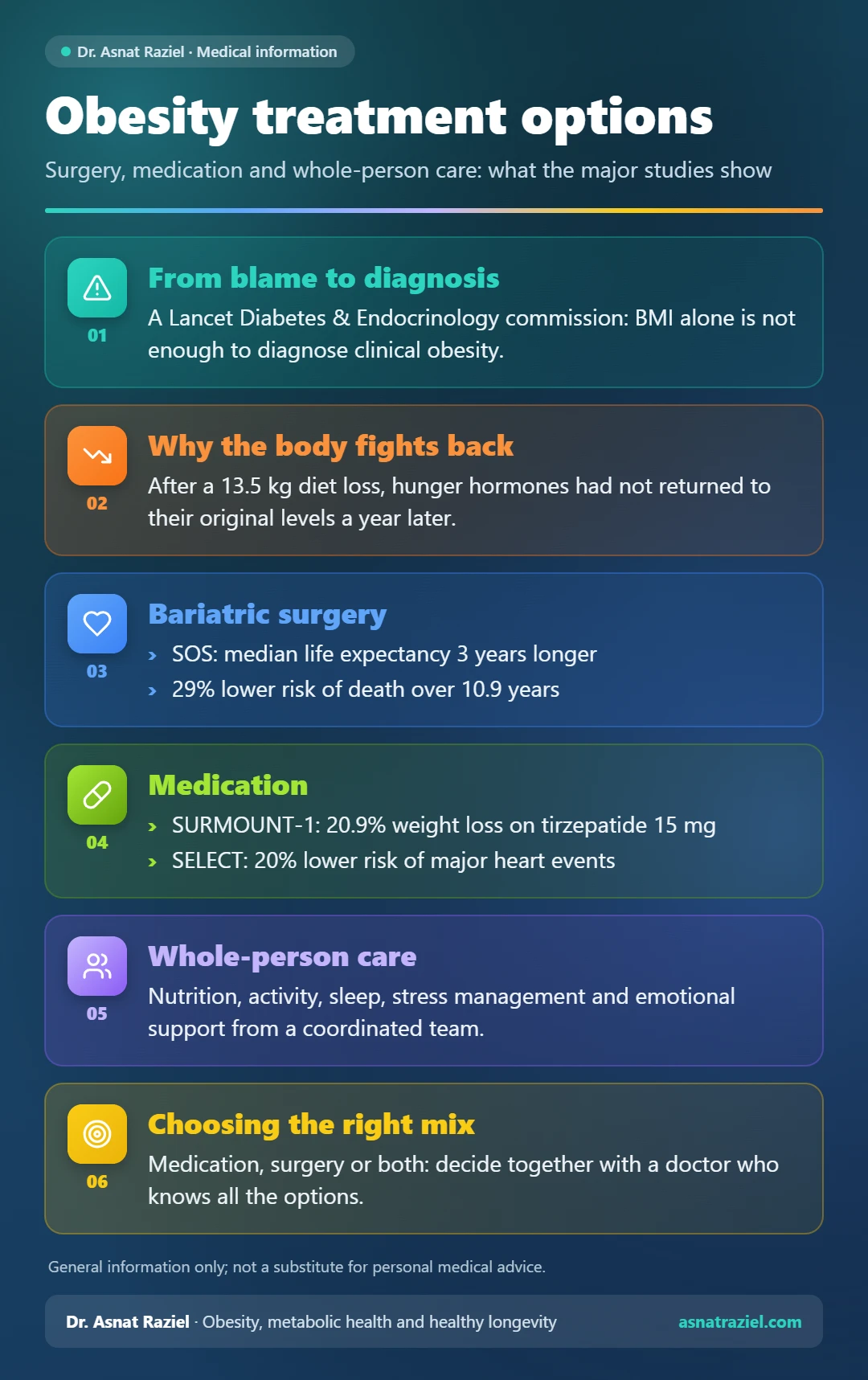
Obesity treatment options: how to choose the right mix
There is no single answer that fits everyone. Still, the studies allow us to sketch a few guiding principles:
- In severe obesity, bariatric surgery is one of the most effective tools, and it also improves diabetes, blood pressure and fatty liver.
- Drugs such as tirzepatide and semaglutide allow significant weight loss, and in the SELECT trial, a 20% reduction in cardiovascular risk.
- For some patients, combining medication and surgery will give the best result.
- Every treatment needs behavioral support, nutrition, physical activity and emotional support.
So the right question is not “diet or surgery,” but which combination suits you, your body and your current stage of life. It is best to make this decision together with a doctor who knows all the options.
The stigma that still harms care
Despite the progress, stigma around obesity still exists, sometimes even within the health system. A joint international consensus statement in Nature Medicine determined that weight stigma causes physical and psychological harm. In addition, people who experience it often receive inadequate care.
Women feel this especially strongly. Social expectations of the female body are very high. As a result, women with obesity may face criticism, shame or a lack of attention. Sometimes doctors immediately attribute symptoms to weight instead of investigating them in depth.
Stigma is not just a social issue. It drives patients away and delays diagnosis. For that reason, changing the conversation is an essential part of all obesity treatment options. I have also written about this in my article on how weight stigma affects health.
Obesity and women’s health across the lifespan
Obesity affects women in many ways: fertility, pregnancy, gestational diabetes, high blood pressure, heart disease and quality of life. Despite this, many seek treatment only after years of personal struggle, weighed down by guilt.
Modern women’s medicine must include obesity treatment options. Not only as weight loss, but as part of a woman’s overall health throughout her life.
Obesity treatment options that combine body, mind and environment
The person at the center
The holistic approach puts the person at the center, not just the weight. Every patient arrives with a life story, a medical background, a family reality and an emotional world. That is why we need to understand the sources of difficulty, the habits, the environment and the goals. The goal is not only weight loss, but health, quality of life and maintaining the change over time.
Multidisciplinary support
Effective treatment almost always requires a team: doctors, dietitians, psychologists, fitness trainers and sometimes sleep specialists. When the team works in coordination, it creates a framework that covers every aspect of the disease: body, mind and behavior.
The core components include balanced nutrition, physical activity, quality sleep and stress management. Alongside these, emotional support and a supportive environment play an important role. The World Health Organization also recommends combining medication with behavioral support, healthy eating and physical activity.
When all the components come together, we can build obesity treatment that lasts.
My personal path as a doctor and as a person
For years, surgery was a very male field. The path into it demanded persistence, discipline and faith, and it became my professional home. Over time, however, I realized that medicine is far broader than surgery. My encounters with patients taught me a deep lesson: every person is a whole world, with a story, with pain and with hope.
Over the years I have met thousands of patients, and each encounter has taught me humility and the importance of truly listening. Today I see myself not only as a surgeon, but as part of a journey of life change. Sometimes the change is physical, sometimes emotional and sometimes a change in perspective.
Looking ahead: the future of obesity treatment options
The future of obesity treatment lies in precise, personal and humane medicine. This is medicine that distinguishes between risk and active disease, as the new definition of clinical obesity proposes. In addition, it combines deep listening, advanced scientific knowledge and a wide range of tools. Above all, it allows people not only to lose weight, but to live full, healthy and meaningful lives.
Oprah Winfrey and Serena Williams talk about this in the following video:
Bottom line
Obesity is a chronic disease, not a weakness of character. Today’s obesity treatment options include medication, surgery when needed, nutrition, physical activity and emotional support. So if you are living with obesity, the first step is a conversation with a doctor who knows all the options.
The information in this article is general and does not replace personal medical advice.
References
Definition and diagnostic criteria of clinical obesity
WHO issues global guideline on the use of GLP-1 medicines in treating obesity
Long-term persistence of hormonal adaptations to weight loss
Life Expectancy after Bariatric Surgery in the Swedish Obese Subjects Study
Effects of bariatric surgery on mortality in Swedish obese subjects
Tirzepatide Once Weekly for the Treatment of Obesity
Semaglutide and Cardiovascular Outcomes in Obesity without Diabetes
Joint international consensus statement for ending stigma of obesity
Novo Nordisk funded the SELECT trial.




