By Dr. Asnat Raziel, bariatric surgeon specializing in obesity treatment, metabolic health and healthy longevity; Director of the Multidisciplinary Center for Obesity Treatment, Assia Medical, Assuta Ramat HaChayal, Tel Aviv
Childhood obesity research from Leipzig, Germany, is changing how we think about early risk. Prof. Antje Körner’s group has followed tens of thousands of children, and its findings were a highlight of the latest European Congress on Obesity. In this article, I go through those studies one by one: what they found and what they mean for parents. For a broader look at the health effects of obesity in children, see my article on the consequences of childhood obesity, and for practical steps with young children, my guide to obesity in preschoolers.
Childhood obesity research: a passing phase or a disease?
For years, people saw obesity in early childhood as a “passing phase,” something a child would grow out of. Today, childhood obesity research paints a completely different picture. Many studies show that obesity in childhood is not a cosmetic or temporary problem. It is a biological disease that can affect health throughout life.
At the European Congress on Obesity, ECO 2026, a prominent session focused on obesity in children and adolescents. Among the speakers was Prof. Antje Körner of Leipzig University. Körner received the 2024 Prize for Excellence of the European Association for the Study of Obesity and the Novo Nordisk Foundation for her research in this field. She presented worrying data, but also hope. We may be able to identify at-risk children at a very young age, intervene in time and even prevent diabetes later in life.
The Leipzig cohort: obesity starts earlier than we thought
One of the most striking findings is that the path to obesity sometimes begins as early as preschool. In a study by the Leipzig group published in NEJM, researchers followed 51,505 children from birth to adolescence. Almost 90% of the children who had obesity at age 3 also had overweight or obesity as adolescents.
Moreover, among adolescents with obesity, the fastest weight gain happened between ages 2 and 6. In other words, obesity does not suddenly appear in adolescence. Instead, it develops gradually, sometimes over many years. That is why obesity in early childhood is a window of opportunity, not a reason to wait.
What childhood obesity research shows about metabolism
The researchers emphasized that significant metabolic changes appear even in very young children. Among children with obesity in the Leipzig cohort, high insulin levels (hyperinsulinemia) appeared at a young age, sometimes even in preschool. In addition, glucose tolerance tests showed abnormal patterns of insulin response. According to the data presented, these patterns point to a high risk of diabetes later on.
The message was clear: metabolic damage begins long before overt diabetes appears.
Children’s fat tissue is not harmless
In the past, experts thought that fat tissue in children was less harmful metabolically. However, a study that examined 171 fat tissue samples from children and adolescents showed otherwise. In children with obesity, fat cells were large and numerous already in early childhood. From age 6 onward, inflammatory cells also infiltrated the tissue.
In addition, children with large fat cells had more insulin resistance, independent of other factors. In other words, even at a young age, fat tissue becomes active tissue that releases inflammatory substances and affects the whole body.
COVID-19 made obesity worse in young children and teens
An analysis of almost 1.5 million medical visits in Germany between 2002 and 2023 looked at trends in severe obesity. The peak came in 2021, in all age groups. By 2023, young children had returned to pre-pandemic levels. In contrast, older children, especially girls aged 8 to 16, stayed at a higher weight. The weight gain was especially marked in children who already had severe obesity.
The reasons are many: less physical activity, long hours of screen time, stress, loneliness, disrupted sleep and changes in eating habits. We can expect the effects of this period to stay with us for years. You can read about how screens affect teenagers in my article on screen time in teens.
Childhood obesity research: are there genetic factors too?
The lecture also included a fascinating story about a rare genetic form of obesity. The researchers identified a change in the ASIP gene that causes abnormal production of the protein in many cells of the body. In a girl with severe obesity, the change caused obesity from a very young age, accelerated growth and high insulin levels. She also reported constant hunger.
When the researchers re-examined 1,745 children from the Leipzig cohort, they found four more patients with the same mutation. The clinical picture matched a well-known mouse model in which the protein is produced throughout the body. This childhood obesity research shows that obesity is not just a matter of willpower or habits. Sometimes it is a truly biological and genetic disease.
Obesity in early childhood: why not wait?
One of the most intriguing topics at the congress was timely treatment for high-risk children and adolescents. The researchers presented a plan for a future study that will test whether early intervention prevents diabetes in children at high metabolic risk. Instead of waiting for diabetes, high blood pressure or fatty liver, the goal is to identify at-risk children and step in before complications develop.
This direction is in line with the 2023 guidelines of the American Academy of Pediatrics. The guidelines state that there is no place for “watchful waiting” in childhood obesity. Instead, they recommend intensive behavioral and family-based treatment right from diagnosis. In addition, they allow doctors to consider drug treatment from age 12. In Israel, the issue also came up around weight loss injections for teens in the national health basket, and data on how well the treatment works appear in my article on the STEP TEENS trial.
The big challenge: the move from childhood to adulthood
Another problem highlighted was the gap between pediatric and adult medicine. A follow-up of 209 young people from the Leipzig cohort showed that in 93.3% of them, excess weight from childhood persisted into adulthood. In addition, 94.3% lost contact with a dedicated obesity clinic in the transition to adulthood. Lack of knowledge was the most common reason.
Moreover, 83.7% of the young people had at least one complication, and 87% did not know about some of their complications before the follow-up. That is why experts are calling for organized, coordinated transition pathways between pediatric and adult medicine.
Childhood obesity research from Leipzig: five key findings
To sum up the studies above, here are the five numbers I would want every parent to know:
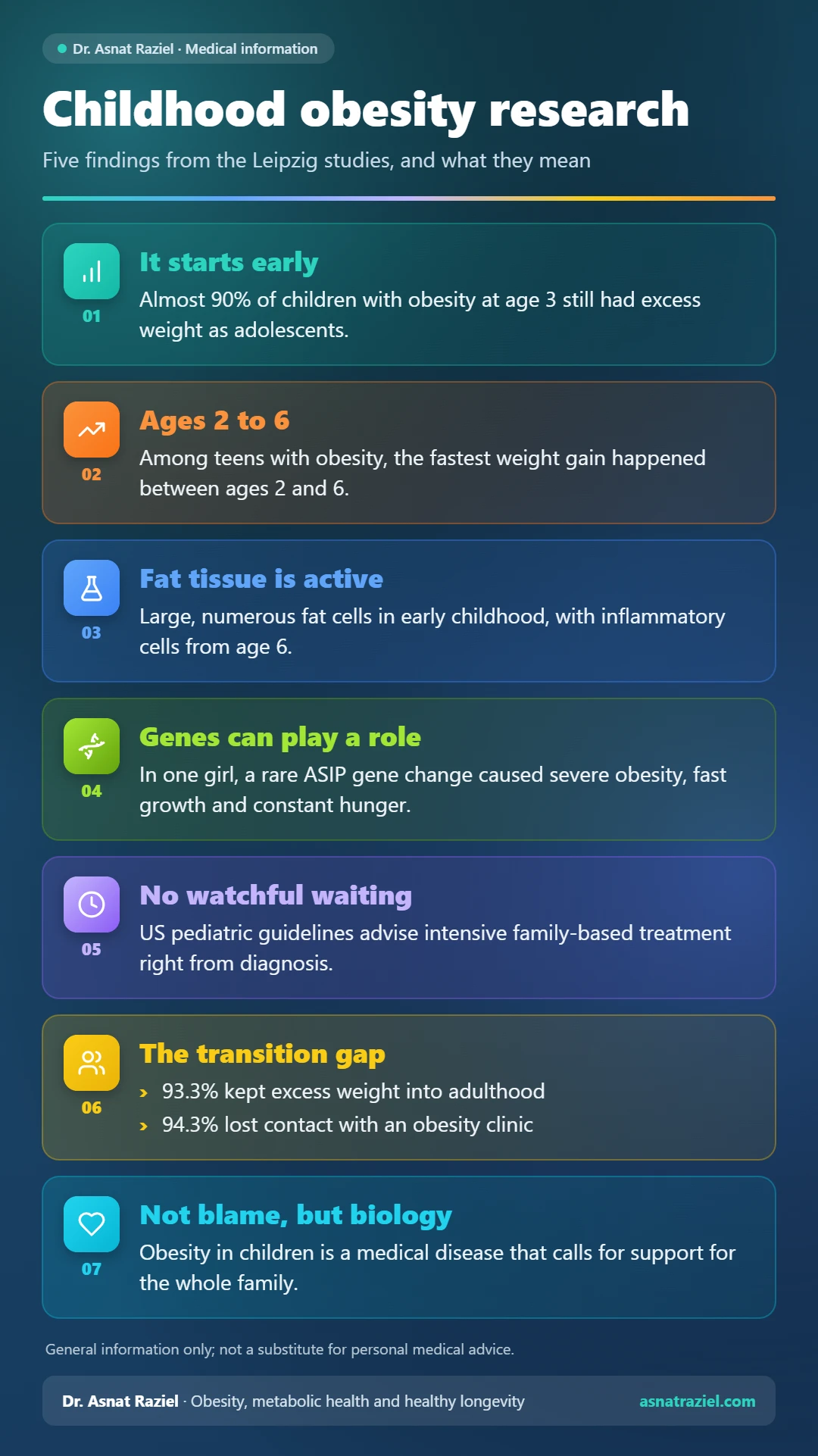
- Almost 90% of children with obesity at age 3 still had excess weight as adolescents.
- Among teens with obesity, the fastest weight gain happened between ages 2 and 6.
- In children with obesity, fat cells were large and numerous in early childhood, with inflammatory cells from age 6.
- A rare change in the ASIP gene was found in a girl with severe obesity and in four more of 1,745 children re-examined.
- In 93.3% of young people, excess weight persisted into adulthood, and 94.3% lost contact with an obesity clinic.
Together, these findings point in one direction: the earlier we identify a child at risk, the better the chance to change the course.
Not blame, but a biological disease
One of the most important human messages of the session was the need to reduce stigma. When a child has obesity, society tends to blame the parents or the child. But childhood obesity research shows a much broader picture: genetics, biology, environment, sleep, stress, ultra-processed food, physical activity and brain mechanisms all affect the risk. You can read about the price of judgment in my article on weight stigma and health.
The new approach sees obesity in children as a medical disease. It requires timely diagnosis, professional guidance, emotional support and multidisciplinary treatment that involves the whole family.
Bottom line: obesity in early childhood deserves attention
The message of the childhood obesity research presented at ECO 2026 is clear: we cannot start treating obesity only at age 40. Obesity in early childhood is a first warning sign that should be taken seriously, gently and without blame. Ultimately, the sooner we identify children at risk and build a support system around them, the more we can change the health trajectory of an entire generation.
The information in this article is general and does not replace personal medical advice.
References
Acceleration of BMI in Early Childhood and Risk of Sustained Obesity
From Childhood to Adolescence: Long-Term Trends in Severe Obesity in German Youth (2002-2023)




