By Dr. Asnat Raziel, bariatric surgeon specializing in obesity treatment, metabolic health and healthy longevity; Director of the Multidisciplinary Center for Obesity Treatment, Assia Medical, Assuta Ramat HaChayal, Tel Aviv
Survodutide vs semaglutide: where a new kind of drug fits in
Survodutide vs semaglutide is a question my patients are starting to ask, and it deserves a careful answer. This experimental once-weekly injection for obesity works through a dual mechanism. In this article, I will focus on how it differs from the drugs we already use, what the trials actually compared and what we still cannot know.
In October 2026, researchers published the results of a large phase 3 trial in people with type 2 diabetes and obesity. Compared with placebo, they showed meaningful weight loss and better blood sugar control. I describe that trial in detail in a separate article on survodutide results in type 2 diabetes; here, the focus is on the comparison with current treatments.
In recent years, drugs such as Ozempic, Wegovy and Mounjaro have transformed obesity medicine. Today we understand that obesity is a chronic metabolic disease, not just a weight problem. However, people with diabetes usually respond less strongly to weight-loss drugs. That is why every new drug tested specifically in this population matters so much.
Not just GLP-1: how survodutide works differently
Survodutide is not just another GLP-1 drug. It activates two receptors: the GLP-1 receptor and the glucagon receptor. GLP-1 is a satiety hormone that the gut releases after a meal. It reduces hunger and slows stomach emptying. Glucagon, by contrast, is a hormone released by the pancreas. It acts on the liver, on fat breakdown and on how much energy the body burns.
This combination is intriguing because it may do more than suppress appetite. Researchers hope it will also increase the use of fat stores, especially in the liver. Other new-generation drugs work in a similar way. For example, retatrutide activates three receptors.
Survodutide vs semaglutide in the early studies
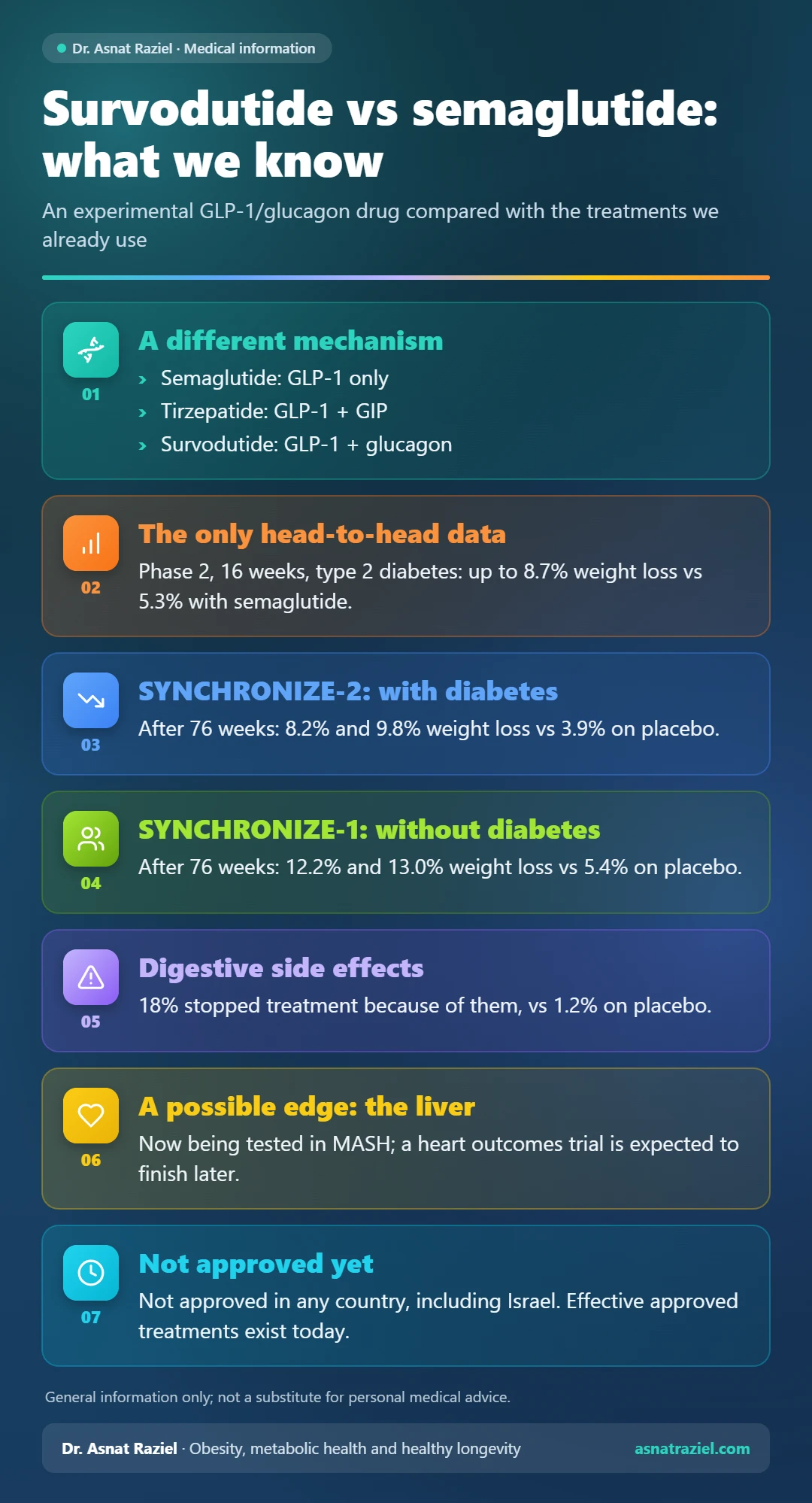
A phase 2 study in people with type 2 diabetes included 413 patients. After only 16 weeks, weight fell by up to 8.7% at the high dose. For comparison, the semaglutide group in that study lost 5.3%. In addition, HbA1c (average blood sugar over the past three months) fell by up to 1.71%.
At the same time, a 46-week phase 2 study in people with obesity but without diabetes found that the 4.8 mg dose lowered weight by 14.9%, compared with 2.8% on placebo. These data led to the large phase 3 research program called SYNCHRONIZE.
The SYNCHRONIZE-2 trial in people with diabetes
NEJM published the results of the SYNCHRONIZE-2 trial on October 1, 2026, and the researchers presented them at the European Association for the Study of Diabetes (EASD) meeting. The trial enrolled 752 adults with type 2 diabetes and a BMI of 27 or higher. Each participant received, at random, survodutide 3.6 mg, 6.0 mg or placebo once a week. Their average age was 55.7 years, and their average BMI was 36.5.
Many participants also had other conditions. For example, they had high blood pressure, high blood lipids, sleep apnea and heart disease. In other words, this was a population at high cardiometabolic risk. At the start, average HbA1c was 7.4%, meaning diabetes that was not fully controlled.
Results: weight and blood sugar
After 76 weeks, weight fell by 8.2% on the 3.6 mg dose and by 9.8% on the 6.0 mg dose. In the placebo group, it fell by 3.9%. This analysis includes all participants, even those who stopped treatment. Overall, 57.6%, 64.5% and 35.1% of participants, respectively, lost at least 5% of their weight.
According to the developer’s report, among those who stayed on treatment, weight loss reached up to 13.1%, compared with 3.1% on placebo. Moreover, HbA1c fell by 0.9 percentage points on the lower dose and by 0.8 points on the higher dose. On placebo, it fell by only 0.2 points. These numbers matter because obesity and type 2 diabetes feed each other.
What about people without diabetes?
In June 2026, researchers also published the SYNCHRONIZE-1 trial in people with obesity but without diabetes. It included 725 adults. After 76 weeks, weight fell by 12.2% and 13.0% on the two doses, compared with 5.4% on placebo. Among those who stayed on treatment, weight loss reached up to 16.6%. So a familiar picture emerges: in people with diabetes, weight loss is more modest by comparison.
Survodutide side effects compared with current drugs
The most common side effects involved the digestive system: nausea, vomiting, diarrhea and constipation. Most were mild to moderate and eased over time. In SYNCHRONIZE-2, 72.8% and 77.7% of patients on the two doses reported such effects, compared with 38.6% on placebo.
Still, I want to say this openly. According to the report, 18% of patients on survodutide stopped treatment because of digestive side effects, compared with 1.2% on placebo. That is a high rate compared with some existing drugs. Therefore, the pace of dose increases and close follow-up will probably be critical.
Survodutide vs semaglutide and tirzepatide: what we can compare today
When patients ask me how survodutide stacks up, I start with the mechanism. Semaglutide acts on GLP-1 alone, tirzepatide combines GLP-1 and GIP, and survodutide combines GLP-1 with glucagon. Next, I look at the data. The only direct comparison so far comes from the 16-week phase 2 study in diabetes, where survodutide led to up to 8.7% weight loss versus 5.3% with semaglutide. In contrast, the large phase 3 trials compared survodutide with placebo only.
In people with diabetes, the phase 3 numbers are lower than those seen with tirzepatide. Furthermore, the 18% dropout rate due to digestive effects is higher than with some existing drugs. Its possible edge may lie in the liver instead.
Will survodutide outperform semaglutide and the current generation?
Right now, it is impossible to say. In these trials, researchers compared the drug with placebo, not with semaglutide or tirzepatide. In addition, in people with diabetes, the numbers are lower than those seen with tirzepatide. Survodutide’s possible advantage may actually lie in the liver. The drug is now also being tested in advanced inflammatory fatty liver disease (MASH), and a cardiovascular outcomes trial is expected to finish later on. I cover this in more depth in a separate article on survodutide and fatty liver.
We are already seeing a shift from single-mechanism drugs to combined mechanisms. Tirzepatide combines GLP-1 and GIP, while survodutide combines GLP-1 and glucagon. A similar drug called mazdutide has already been approved in China for obesity and diabetes. In the future, we will probably see more triple combinations as well.
Beyond weight: overall health
One of the trial’s most important messages is that obesity treatment is not only about the number on the scale. Participants had a range of metabolic, cardiovascular and inflammatory conditions. In the trial, waist circumference and fasting blood sugar also fell. If the drug later proves to improve the liver, blood pressure and heart risk as well, its impact will be much broader.
This is exactly the modern view of obesity medicine. Treatment aims to improve health, quality of life and daily function, and to lower the future risk of disease. You can read about the liver connection in my guide to diagnosing and treating fatty liver.
The bottom line
For now, the survodutide vs semaglutide question has no final answer. Survodutide has not yet been approved for use in any country, including Israel. It is expected to reach regulators only after further studies are completed. Meanwhile, effective approved treatments for people with diabetes and obesity are available today. The most important message remains the same: obesity is not a personal failure. It is a chronic disease that requires advanced, long-term and personalized medical care.
What this means for patients today
First, there is no reason to wait for a future drug. People living with diabetes and obesity can benefit from approved treatments right now. Second, it is important to remember that response to medication varies from person to person. That is why we choose treatment based on each patient’s goals, other conditions and tolerance. In addition, every medication works best alongside a tailored diet, physical activity and good sleep. Finally, once survodutide reaches the approval stage, we will know how to fit it into this broader picture.
The information in this article is general and does not replace personal medical advice.
References
Survodutide Once Weekly in Adults with Obesity and Type 2 Diabetes
Survodutide Once Weekly for the Treatment of Adults with Obesity
Dual Agonist Survodutide Delivers Up to 13.1% Weight Loss in T2D
Boehringer Ingelheim, the company developing the drug, funded the studies.




