By Dr. Asnat Raziel, bariatric surgeon specializing in obesity treatment, metabolic health and healthy longevity; Director of the Multidisciplinary Center for Obesity Treatment, Assia Medical, Assuta Ramat HaChayal, Tel Aviv
Foundayo approval: a new era in obesity treatment
This article focuses on the Foundayo approval: what regulators approved, which data it rests on, and what is still being monitored afterward. For practical dosing and day-to-day tips, see my separate hands-on guide to treatment with Foundayo.
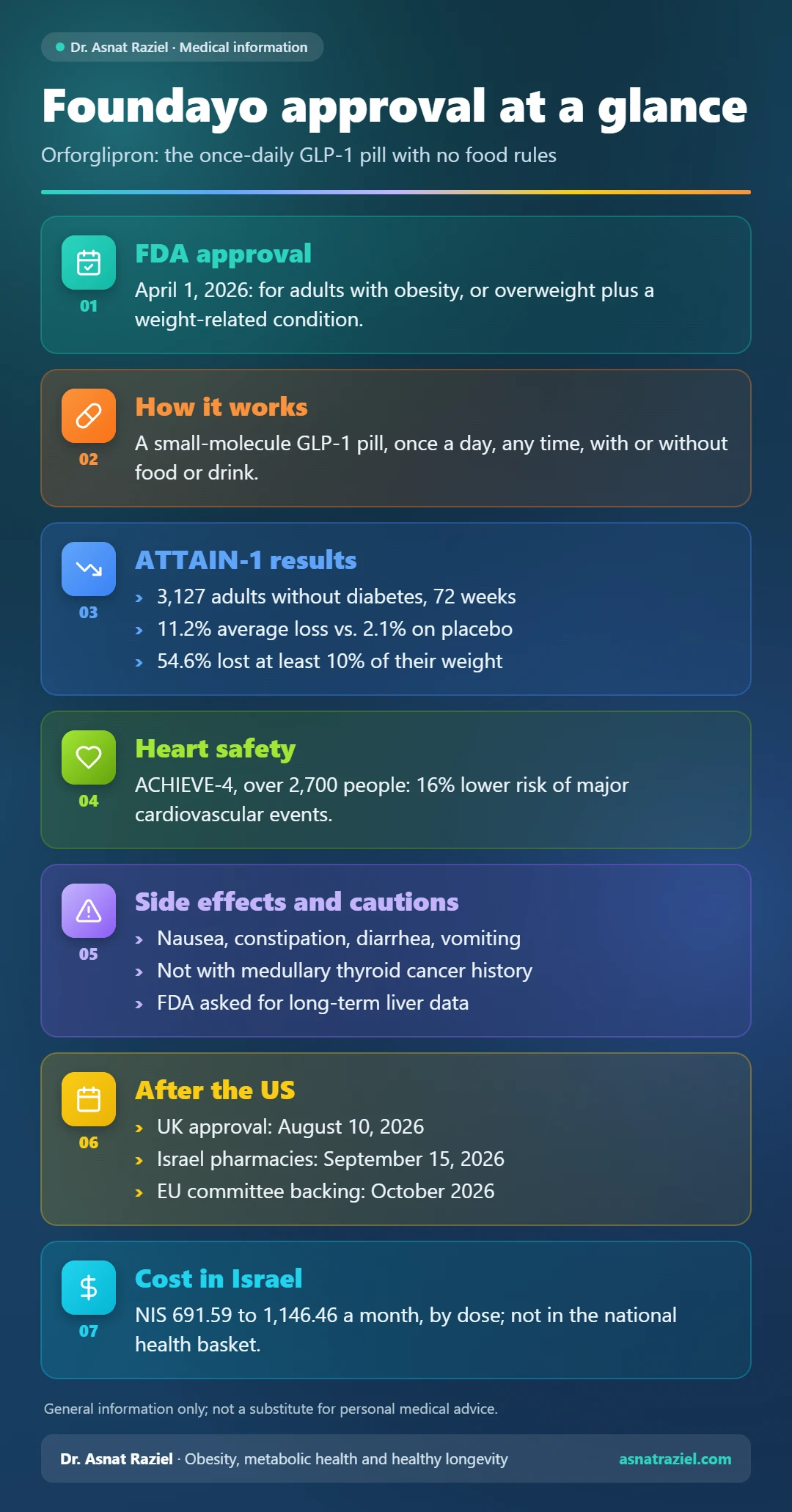
Foundayo is a new daily weight-loss pill, and it marks a new stage in obesity treatment. After the revolution of GLP-1 injections such as Wegovy, Ozempic and Mounjaro, here is an oral treatment with no injections, no fasting and no mealtime restrictions. On April 1, 2026, the US Food and Drug Administration approved the drug from Eli Lilly. Its active ingredient is orforglipron. The approval covers adults with obesity, or with overweight and a weight-related condition.
This is one of the most significant developments in weight-loss drugs in recent years. Unlike earlier GLP-1 pills, orforglipron can be taken at any time of day, with or without food, and with no limits on drinking. That simplicity may help many patients stay on treatment over the long term.
What is orforglipron and how does it work?
Orforglipron activates the GLP-1 receptor, much like semaglutide and tirzepatide. However, it is not a protein but a small molecule that can be swallowed as an ordinary pill. So there is no need for an injection, and no need for a special carrier to help absorption.
The drug mimics the natural hormone GLP-1. The gut releases this hormone after a meal. It slows stomach emptying, reduces hunger, increases fullness and acts on the hunger centers in the brain. In addition, it improves blood sugar control. The treatment fits today’s understanding of obesity as a chronic disease with biological, hormonal and neural mechanisms. It is not the result of a lack of willpower.
The data behind the Foundayo approval: how much weight did people lose?
The ATTAIN-1 trial enrolled 3,127 adults with obesity who did not have diabetes. The trial lasted 72 weeks. On the highest dose, patients lost an average of 11.2% of their body weight, compared with 2.1% on placebo. Among those who stuck with treatment, the loss reached 12.4%, compared with 0.9% on placebo. In addition, 54.6% of patients on the highest dose lost at least 10% of their weight.
That is a very meaningful result for a pill. Still, it is lower than the weight loss seen with the strongest injections. You will find a comparison with semaglutide pills in my article on Foundayo vs. oral semaglutide.
Beyond weight: heart, blood sugar and metabolic markers
In ATTAIN-1, waist circumference, systolic blood pressure, triglycerides and non-HDL cholesterol also improved. In other words, the benefit is not only about weight. The ACHIEVE-4 trial compared the drug with insulin glargine in people with type 2 diabetes at cardiovascular risk. According to the report, the trial included more than 2,700 participants and met its cardiac safety goal. The orforglipron group showed a 16% lower risk of major cardiovascular events.
These data reinforce the view that obesity treatment is about broad health. It includes lowering the risk of diabetes, heart disease, fatty liver and sleep apnea. You can read more in my article on Foundayo and the prevention of diabetes and heart disease.
The big advantage of Foundayo
One of the challenges of any long-term treatment is sticking with it. Many patients struggle with instructions to take a drug on an empty stomach or at fixed times. With other GLP-1 pills, you have to wait before eating or drinking, which disrupts the daily routine.
That is why Foundayo’s main advantage is simplicity. One pill a day, regardless of meals, suits people with busy mornings too. It is also especially suitable for people who are wary of injections. In addition, pills are simpler to manufacture than injection pens, which may improve access to treatment in many countries.
Will pills replace injections?
Despite the excitement, the advanced injections, especially tirzepatide, still show much larger weight losses. On the other hand, not every patient needs the same treatment intensity. Moreover, not everyone is ready for injections or interested in them.
The future will most likely be personalized. Some patients will prefer a weekly injection, others a daily pill, and some will combine the two over the years. As treatment options grow, we can match treatment to preferences, underlying conditions and lifestyle.
Foundayo side effects
As with other GLP-1 drugs, the common side effects are nausea, constipation, diarrhea, vomiting and abdominal pain. In most cases they are mild to moderate and fade gradually as the body adjusts. In ATTAIN-1, 5.3% to 10.3% of patients on the drug stopped treatment because of side effects, compared with 2.7% on placebo.
As with other drugs in this family, it must not be taken by anyone with a personal or family history of medullary thyroid cancer. There are also rare risks, such as pancreatitis and gallbladder problems.
After the Foundayo approval: liver safety and what the FDA asked for
Shortly after the drug’s launch, a single case of liver failure was reported to the FDA’s adverse event database. The company’s safety team reviewed the case and concluded there was no reasonable link to the drug. It is important to remember that a report like this does not prove cause and effect. Even so, the FDA asked the company to collect long-term data on liver injury, cardiac events and thyroid cancer. I cover this in more detail in my article on Foundayo and liver safety.
As with any advanced drug treatment, personal tailoring and structured medical follow-up matter. Treatment also works best combined with good nutrition, physical activity, quality sleep and stress reduction.
Foundayo approval around the world and in Israel
After the United States, the UK medicines regulator approved the drug on August 10, 2026, for obesity and type 2 diabetes. In October 2026, the European Medicines Agency’s scientific committee recommended approving it for both indications. The European Commission makes the final decision, and as of early November 2026 it was still pending.
In Israel, Foundayo reached pharmacies on September 15, 2026. The monthly price ranges from NIS 691.59 on the lowest dose to NIS 1,146.46 on the highest. The drug is not included in Israel’s national health basket. You will find more details in my article on Foundayo in Israel.
The Foundayo approval timeline at a glance
Here are the key milestones in one place, as they appear above:
- April 1, 2026: the FDA approves Foundayo for adults with obesity, or overweight with a weight-related condition.
- After launch: the FDA asks Lilly for long-term data on the liver, the heart and thyroid cancer.
- August 10, 2026: the UK approves it for obesity and type 2 diabetes.
- September 15, 2026: Foundayo reaches pharmacies in Israel, outside the health basket.
- October 2026: the EMA’s scientific committee recommends approval, with a final EU decision still pending.
The future of obesity treatment is already here
The Foundayo approval marks another step in the obesity medicine revolution. A shift to simple, accessible and convenient treatments could greatly expand the number of people who receive effective care. More treatments are expected in the coming years, including advanced pills and drug combinations. In the end, the goal is not only weight loss. The goal is better health, quality of life and life expectancy.
The information in this article is general and does not replace personal medical advice.
Sources
Orforglipron, an Oral Small-Molecule GLP-1 Receptor Agonist for Obesity Treatment
Eli Lilly Releases Updated Safety Data for Foundayo Following FDA’s Request
Foundayo’s liver failure blip weighs down Lilly shares but analysts unconcerned
UK first in Europe to authorise orforglipron for weight management and type 2 diabetes
EMA Panel Backs Lilly’s Foundayo for Obesity and Type 2 Diabetes in Europe
No more injections? New weight-loss pill to launch in Israel next week
The ATTAIN-1 and ACHIEVE-4 trials were funded by Eli Lilly, the drug’s manufacturer.