By Dr. Asnat Raziel, bariatric surgeon specializing in obesity treatment, metabolic health and healthy longevity; Director of the Multidisciplinary Center for Obesity Treatment, Assia Medical, Assuta Ramat HaChayal, Tel Aviv
Retatrutide mechanism of action: why does it matter?
The retatrutide mechanism of action sets a new bar in obesity treatment. Just a few years ago, we thought successful obesity treatment depended mainly on reducing hunger. Then came drugs that act on a single hormone. Later, drugs that act on two hormones appeared. Now science is taking another step forward.
Retatrutide is the first drug that activates three key hormone receptors at the same time. This combination does more than reduce hunger. It also changes the way the body uses energy and fat. The first phase 3 results were published in 2026, and they are especially impressive. However, the drug has not been approved yet. For a broader overview, see my article on retatrutide for weight loss.
Three hormones, three targets, one drug
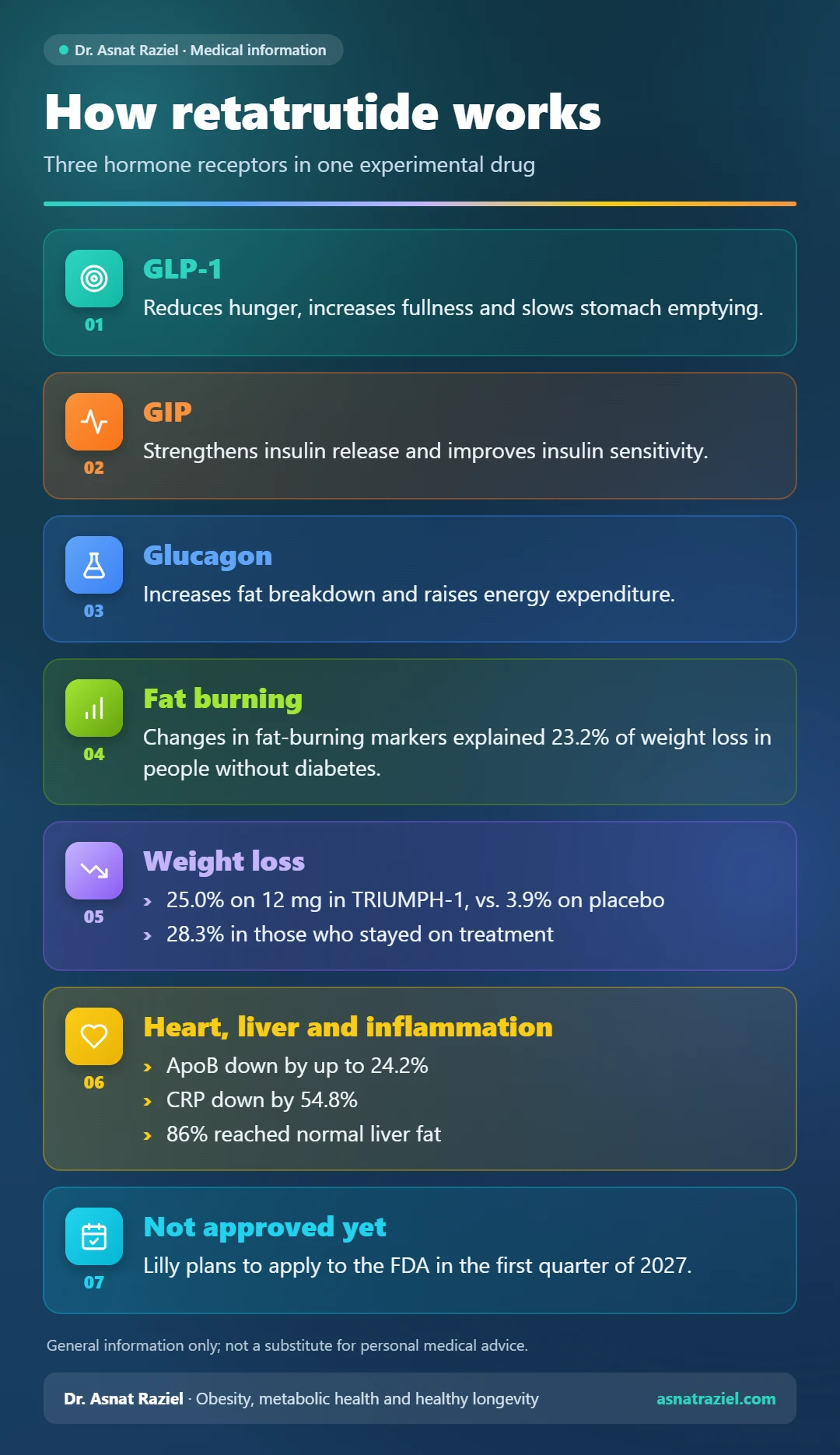
What makes retatrutide unique is that it activates three receptors: GLP-1, GIP and glucagon. Until now, we have been used to thinking of GLP-1 as the “star” of weight-loss drugs. This hormone reduces hunger, increases fullness and slows stomach emptying. Drugs such as Ozempic and Wegovy are based on this mechanism. For a full explanation of the satiety hormones, see my article on the physiology of satiety in the brain and gut.
The next step added activation of the GIP receptor, as in Mounjaro. This addition boosted weight loss and improved metabolism. Retatrutide adds a third layer: activation of the glucagon receptor. Here, the goal is not only to eat less. It is also to increase the body’s energy expenditure.
Not just eating less: the retatrutide mechanism of action and fat
One of the biggest challenges in any weight loss is the body’s response. When we lose weight, the body tries to protect itself. Metabolism slows down, and energy expenditure drops. In addition, the body “works hard” to regain the lost weight.
This is where glucagon receptor activation comes in. In earlier studies, it encouraged fat breakdown and raised energy expenditure. Now there are human data as well. A metabolic analysis of the phase 2 trials identified changes in markers of fatty acid burning. According to the analysis, these changes explained 23.2% of the weight loss in participants without diabetes. In other words, the retatrutide mechanism of action also includes a change in how the body uses fat, not just eating less.
Retatrutide mechanism of action: the role of each hormone
GLP-1
This hormone reduces hunger, increases fullness and slows stomach emptying. In addition, it improves insulin release after meals.
GIP
This hormone strengthens insulin release according to blood sugar levels and improves insulin sensitivity. Researchers suspect that it also enhances the effect of GLP-1 and eases some of the nausea.
Glucagon
For years, we knew glucagon mainly as a hormone that raises blood sugar. Today, we know it has another role. At a controlled dose, and alongside GLP-1 and GIP, it increases fat breakdown and contributes to higher energy expenditure. In fact, the balance among the three hormones makes it possible to enjoy the benefits of each one. At the same time, it limits the possible drawbacks.
The results: the retatrutide mechanism of action in practice
In a phase 2 trial published in the NEJM in 2023, participants on 12 mg lost an average of 24.2% of their body weight after 48 weeks. Since then, phase 3 results have been published. The TRIUMPH-1 trial, published in September 2026, included 2,339 adults with obesity and without diabetes. After 80 weeks, average weight loss on 12 mg was 25.0%, compared with 3.9% on placebo.
According to Lilly’s announcement, weight loss reached 28.3% among those who stayed on treatment. Numbers like these are already approaching the results of some bariatric operations. The trial also showed relief from knee pain and improvement in sleep apnea. In TRIUMPH-2, in people with type 2 diabetes, weight loss was considerably lower: 20.8% on 12 mg. For a closer look at the trial data and the safety picture, see my article on what the trials revealed about safety.
Beyond weight: heart, liver and inflammation
Beyond weight itself, the researchers saw improvements in blood pressure, blood fats, blood sugar control and waist circumference. An analysis of cardiovascular risk markers showed a drop of up to 24.2% in ApoB, the protein that carries “bad” cholesterol. In addition, levels of CRP, a marker of inflammation in the blood, fell by 54.8% in participants without diabetes.
The liver also responded dramatically. In a fatty liver substudy, 86% of participants on 12 mg reached normal liver fat levels after 24 weeks. I wrote about this in more detail in my article on retatrutide and fatty liver.
Is this a longevity drug?
This may be the most fascinating question of all. Retatrutide is being developed as a treatment for obesity and diabetes, but its effects may reach far beyond weight. Excess fat, especially visceral fat around the organs, drives chronic inflammation and insulin resistance. It also contributes to fatty liver, heart disease and biological aging.
Therefore, when we reduce this fat and improve metabolism, we may also be affecting aging itself. However, this is still a hypothesis. No study has tested the effect of retatrutide on lifespan. In the TRIUMPH-3 trial, according to Lilly’s announcement, there was no significant difference in heart events compared with placebo.
Are there downsides?
Like the other drugs in this family, retatrutide causes nausea, vomiting, diarrhea and constipation. These symptoms appear mainly at the start of treatment and when the dose is increased. In TRIUMPH-1, for example, 42.4% of patients on 12 mg reported nausea, compared with 14.8% on placebo. Raising the dose gradually usually makes the drug easier to tolerate.
In addition, a distinctive side effect called dysesthesia emerged: an abnormal or unpleasant sensation in the skin. It occurred in 12.5% of people on the high dose, compared with 0.9% on placebo. Most cases were mild to moderate. Even so, 11.3% of patients on 12 mg stopped treatment because of side effects. It is also important to preserve muscle mass during rapid weight loss.
When will the drug arrive?
As of October 2026, retatrutide is not approved anywhere in the world. Lilly plans to submit an application to the FDA in the first quarter of 2027. For this reason, products sold online under the name retatrutide should not be used. These products are unregulated, and they may put your health at risk.
The bottom line on the retatrutide mechanism of action
The world of obesity medicine is changing fast. In the past, we settled for reducing hunger. Today, we can act at the same time on fullness, energy expenditure, fat use, liver health and blood sugar control. The retatrutide mechanism of action marks the shift from treating weight to treating metabolic health as a whole. For a comparison with existing drugs, see my article on retatrutide vs. Ozempic.
Ultimately, the question may no longer be which drug takes off the most kilograms. Instead, we will want to know which drug puts metabolism back on a healthy track, and which one adds not only years to life, but also good life to those years.
The information in this article is general and does not replace personal medical advice.
Sources
Triple-Hormone-Receptor Agonist Retatrutide for Obesity – A Phase 2 Trial
Retatrutide, a Triple Hormone Receptor Agonist, for Treatment of Obesity
Lilly’s triple agonist, retatrutide, delivered powerful weight loss in pivotal Phase 3 obesity trial
The studies were funded by Eli Lilly, the drug’s manufacturer.




