By Dr. Asnat Raziel, bariatric surgeon specializing in obesity treatment, metabolic health and healthy longevity; Director of the Multidisciplinary Center for Obesity Treatment, Assia Medical, Assuta Ramat HaChayal, Tel Aviv
Maximum dose: is stronger always better?
The maximum dose of an obesity drug is not necessarily right for every patient. For years, we got used to thinking that stronger means better. If a drug works, a higher dose should bring greater weight loss. With the new generation of metabolic drugs, however, a much more precise approach is emerging.
At the European Congress on Obesity, ECO 2026, this idea came up again and again. Not every patient needs the highest dose, and it is not always the goal. Today, many experts talk about tailoring treatment to the individual. The decision rests on the body’s response, side effects, age, body composition and medical goals. In other words, obesity medicine is moving from a uniform approach to personalized medicine.
Every body responds differently
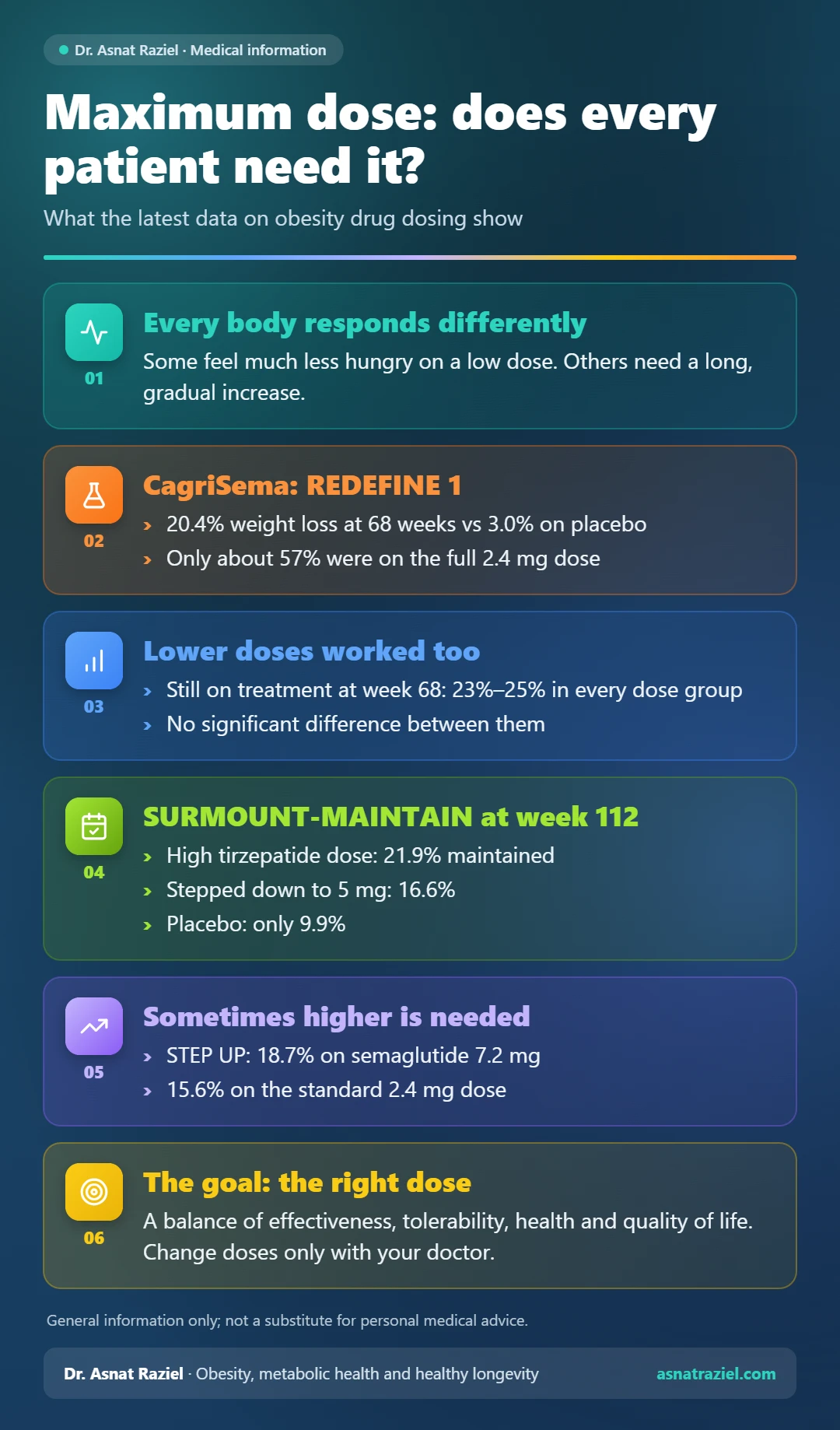
The main reason for this shift is simple: the response to these drugs varies greatly from person to person. Some patients feel a sharp drop in hunger even at a low dose. Others need a long, gradual increase to reach the same effect. Side effects vary as well. Some people cope well with a high dose, while others suffer from nausea, fatigue, constipation or weakness from the very first stages. That is why many doctors now understand that no single path fits everyone. You can read about ways to ease these symptoms in my guide to preventing side effects of obesity drugs.
The CagriSema finding: the maximum dose is not always necessary
One of the most notable analyses at the congress focused on CagriSema, a combination of semaglutide and cagrilintide. It is one of the most intriguing treatments in the field today. The data came from the REDEFINE 1 trial, which included 3,417 participants and appeared in NEJM. After 68 weeks, average weight loss with CagriSema reached 20.4%, compared with 3.0% with placebo, a dummy treatment.
The trial allowed flexible dose escalation. As a result, only about 57% of patients on CagriSema were on the full 2.4 mg dose by the end of the trial. The rest stayed on lower doses. Even so, according to the analysis presented at the congress, weight loss was similar across all dose groups: between 23% and 25%, with no significant difference between them. These figures refer to patients still on treatment at week 68. That is why they are higher than the overall average of 20.4%. You can find more about this drug in my article on CagriSema and obesity treatment.
Who stayed on a lower dose?
Patients who stayed on a lower dose tended to be older, mostly women, and to have a lower starting BMI. BMI, or body mass index, is the ratio of weight to height. This finding reinforces an important insight. We don’t always need to push the body to its limit to get a good result.
Moreover, some of the dose reductions came after clear success. About a third of patients had already lost at least 10% of their weight when their dose was first lowered, and a quarter had lost at least 20%. In addition, 24% of them had no side effects at all before the reduction. In other words, for some people the body simply responded well to a lower dose.
Weight loss is not the only measure
For years, we measured success almost entirely in kilograms. Today the view is much broader. Doctors also look at blood sugar control, blood pressure, sleep and joint pain. In addition, they check energy, quality of life, persistence with treatment and preservation of muscle mass. I expanded on this in my article on how we measure success in obesity treatment.
A patient who loses weight steadily, feels well and stays on treatment over time gains a great deal. This is true even when they are not taking the maximum dose.
Sometimes a slower increase is better
Another topic raised at the congress was the pace of dose escalation. Going up too quickly can worsen side effects and lead people to stop treatment. In contrast, a slow, gradual increase allows the body to adapt. In the real world, the goal is not just fast weight loss. What matters is a treatment you can stick with over time, which is why persistence with treatment is a key part of success.
Maximum dose, maintenance dose or something in between?
The CagriSema data raise an interesting possibility. Perhaps in the future, some patients will move to a personal maintenance dose after the initial weight loss. Such an approach could reduce side effects, improve persistence and perhaps even lower the cost of treatment.
Still, it is important to be precise. The SURMOUNT-MAINTAIN trial, published in The Lancet in May 2026, tested this idea with tirzepatide. Participants first spent 60 weeks on the highest dose they tolerated. The researchers then divided them into three groups. At week 112, those who continued on the high dose maintained a weight loss of 21.9%. People who stepped down to 5 mg maintained 16.6%, and those on placebo only 9.9%. In other words, a lower dose is far better than stopping, but some patients regain weight on it.
And sometimes a higher dose is needed
On the other hand, some patients don’t reach their goal on the standard dose. That is where higher doses come in. In the STEP UP trial, semaglutide 7.2 mg led to 18.7% weight loss, compared with 15.6% on 2.4 mg. These figures include every participant. Among those who stayed on treatment, the numbers were 20.7% and 17.5%. This dose was approved in the United States on March 19, 2026, as I described in my article on Wegovy 7.2 mg. So the decision is not between low and high. Rather, it is about what suits the patient in front of me.
Beyond the maximum dose: precision medicine
The new approach fits a broader trend in modern medicine: a shift from uniform treatment to personalized care. In the future, dosing decisions may rely on age, muscle mass, blood tests, genetics, sleep quality and hunger patterns. They may also draw on data from smartwatches and health apps. The aim is to understand which treatment suits which person, at what dose and at what pace. For further reading, see my article on adjusting the dose to a treatment target.
The bottom line: the right dose, not the maximum dose
One of the key messages of ECO 2026 was simple. Obesity is a chronic, complex disease, so its treatment must be personal too. Not every patient needs the same dose, and not every success shows up as a number on the scale. Ultimately, the maximum dose for everyone is not the goal. Instead, the goal is a precise balance between effectiveness, tolerability, health and quality of life. Change your dose only in consultation with your treating doctor.
The information in this article is general and does not replace personal medical advice.
References
Coadministered Cagrilintide and Semaglutide in Adults with Overweight or Obesity
Characterisation of CagriSema dose reductions in the REDEFINE 1 trial
FDA Approves Higher Dose Semaglutide (Wegovy HD) Injection 7.2 mg for Obesity
Novo Nordisk and Eli Lilly, the companies that make these drugs, funded the studies.