By Dr. Asnat Raziel, bariatric surgeon specializing in obesity treatment, metabolic health and healthy longevity; Director of the Multidisciplinary Center for Obesity Treatment, Assia Medical, Assuta Ramat HaChayal, Tel Aviv
Ashwagandha and longevity: thousands of years before “healthspan”
Ashwagandha and longevity are meeting again in modern research. Long before anyone spoke of healthspan, chronic inflammation or stress management, Ayurvedic medicine was already using ashwagandha (Withania somnifera). In fact, it belonged to the Rasayana group, treatments meant to preserve vitality, resilience and function throughout life. Healthspan, by the way, is the number of years we live in good health and with good function.
Today, ashwagandha is best known as a supplement for easing stress and improving sleep. In the age of longevity medicine, however, an intriguing question arises: does the herb affect the systems that shape how we age? I mean stress, sleep, inflammation, muscle, fitness and cognitive function. A comprehensive 2025 review in Biogerontology examined the plant through exactly this lens.
Let me say it right at the start: no study shows that ashwagandha extends human life. Still, longevity is not only about how many years we live. It is also about how many of those years we spend with a sharp brain, strong muscles, good sleep and good function.
Rasayana: an ancient version of healthy longevity
In Ayurveda, ashwagandha is not just a remedy for one particular symptom. Instead, it is a Rasayana, a term that describes strengthening, renewal and preserving vitality. There is a surprising similarity here to modern longevity medicine. Rather than waiting for disease, the goal is to preserve reserves and resilience throughout life. Of course, tradition is not scientific proof. But it does explain why aging researchers are taking a fresh look at the plant.
Chronic stress is also an aging issue
Stress regulation is one of the areas where the evidence for ashwagandha is especially strong. After all, chronic stress is not just a feeling. Prolonged activation of the HPA axis, the stress axis linking the brain and the adrenal glands, raises cortisol. That state is linked to poor sleep, metabolic changes, cognitive impairment and changes in immunity. I have written at length about the link between stress and obesity.
Clinical studies have found that certain ashwagandha extracts reduce perceived stress, and sometimes cortisol levels as well. In addition, a 2026 meta-analysis of 22 randomized trials in about 1,391 adults found significant improvements in measures of stress, anxiety and depression. It also found a link between the dose and the size of the effect on stress. From a longevity perspective, this may be the most interesting reason to study the herb. The point is not to use it as a sedative, but as a possible tool for coping with ongoing strain.
Sleep: one of the most powerful longevity medicines
Good sleep is a foundation of healthy aging. During sleep, the body runs processes that support memory, hormonal balance, immunity, metabolism and recovery. You can read more about this in my article on sleep and brain health.
Small clinical studies have found that ashwagandha may improve sleep quality, sleep efficiency, sleep duration and the time it takes to fall asleep. The effect is especially noticeable in people with insomnia. So part of its possible contribution to healthspan does not come from some mysterious anti-aging mechanism. Rather, it comes from something far more basic: less stress and better sleep.
Ashwagandha and longevity: the muscle connection
As we age, we gradually lose muscle mass, strength and function. Sarcopenia, or age-related muscle loss, raises the risk of falls, fractures, loss of independence and even death. Likewise, grip strength is an important marker of longevity.
Several clinical studies have found that combining ashwagandha with resistance training is linked to increases in strength and muscle mass. Other studies have found signals of improved cardiorespiratory fitness and VO₂max, the body’s maximum oxygen uptake. Therefore, the interesting question is whether the herb supports the ability to train, recover and preserve muscle. That said, ashwagandha is no substitute for strength training, adequate protein or aerobic exercise. At most, it is an add-on to a system that is already built correctly.
What about the brain?
Here, too, the data are intriguing. Small human studies have found possible improvements in memory, attention and processing speed, including in people with mild cognitive decline. In preclinical models, researchers have also identified mechanisms that protect nerve cells. However, it is important to separate levels of evidence. A better score on a cognitive test in a small study does not prove that ashwagandha prevents Alzheimer’s disease or dementia. This is a promising area for research, not a clinical recommendation. I have written about what is actually proven in my article on reducing dementia risk.
Inflammaging: does ashwagandha affect age-related inflammation?
The link between ashwagandha and longevity also runs through inflammation. Inflammaging is a key concept in longevity science: chronic, low-grade inflammation that intensifies with age. Withanolides, the group of active compounds in ashwagandha, show activity against inflammation and oxidative stress in laboratory studies. The Biogerontology review also describes a drop in inflammatory markers such as CRP, an inflammatory protein in the blood.
Here, we need to be especially careful. A mechanism seen in a cell or a mouse does not prove that aging slows down in humans. Science offers a biological explanation for why the herb may be geroprotective, meaning protective against aging. Even so, it does not yet prove that ashwagandha “slows the biological clock.”
What about telomeres?
This may be the most intriguing area, and also the one where it is easiest to exaggerate. Preclinical studies suggest an effect on the activity of telomerase, the enzyme that protects the ends of chromosomes. Telomeres are one of the most studied markers of cellular aging. However, there is a long way from there to the claim that ashwagandha “lengthens telomeres and therefore extends life.” As of today, there is no clinical basis for saying that it slows biological age in humans.
The regulatory debate: root or leaf?
The root and the leaf do not share the same composition. The NIH fact sheet says so explicitly, and adds that most supplements contain root extract. In the Ayurvedic tradition, people mainly use the root. Similarly, most modern clinical studies have tested root extracts.
One of the controversial issues is withaferin A, a compound found in different concentrations in different parts of the plant. Concern about it is among the reasons for the debate over the leaves. For example, in April 2026 India’s food authority restricted the use of ashwagandha leaves in food products and allowed only the root. Denmark had already banned ashwagandha in food supplements back in 2023.
On the other hand, a position paper from an extract maker that combines root and leaves argues that we should judge an extract by its composition, dose and proven safety in humans. There is logic in evaluating the specific product rather than just the name of the plant. But when there is a choice, the root has the edge: it is closer to traditional use, and it has a broad clinical evidence base.
Ashwagandha and longevity: can you take it for years?
This is where an interesting gap opens between ancient and modern medicine. The Rasayana concept is not an “eight-week course.” It grew out of the idea of nurturing health throughout life. Modern medicine, however, demands safety data. According to the NIH and the NCCIH, most people tolerate ashwagandha well in short-term use, up to about three months. Yet there is not enough information about its safety with continuous use over many months or years.
This is not proof that long-term use is dangerous. Rather, it is an admission that researchers have not yet done the necessary studies. In addition, there are rare reports of liver injury, a possible effect on the thyroid gland, and interactions with medications, including drugs for diabetes and thyroid conditions. The NCCIH advises avoiding it during pregnancy and breastfeeding. That is why longevity medicine, of all fields, must not fall into a paradox. It makes no sense to take a supplement for years to improve your health when there are still no safety data for years of use.
Bottom line: ashwagandha and longevity
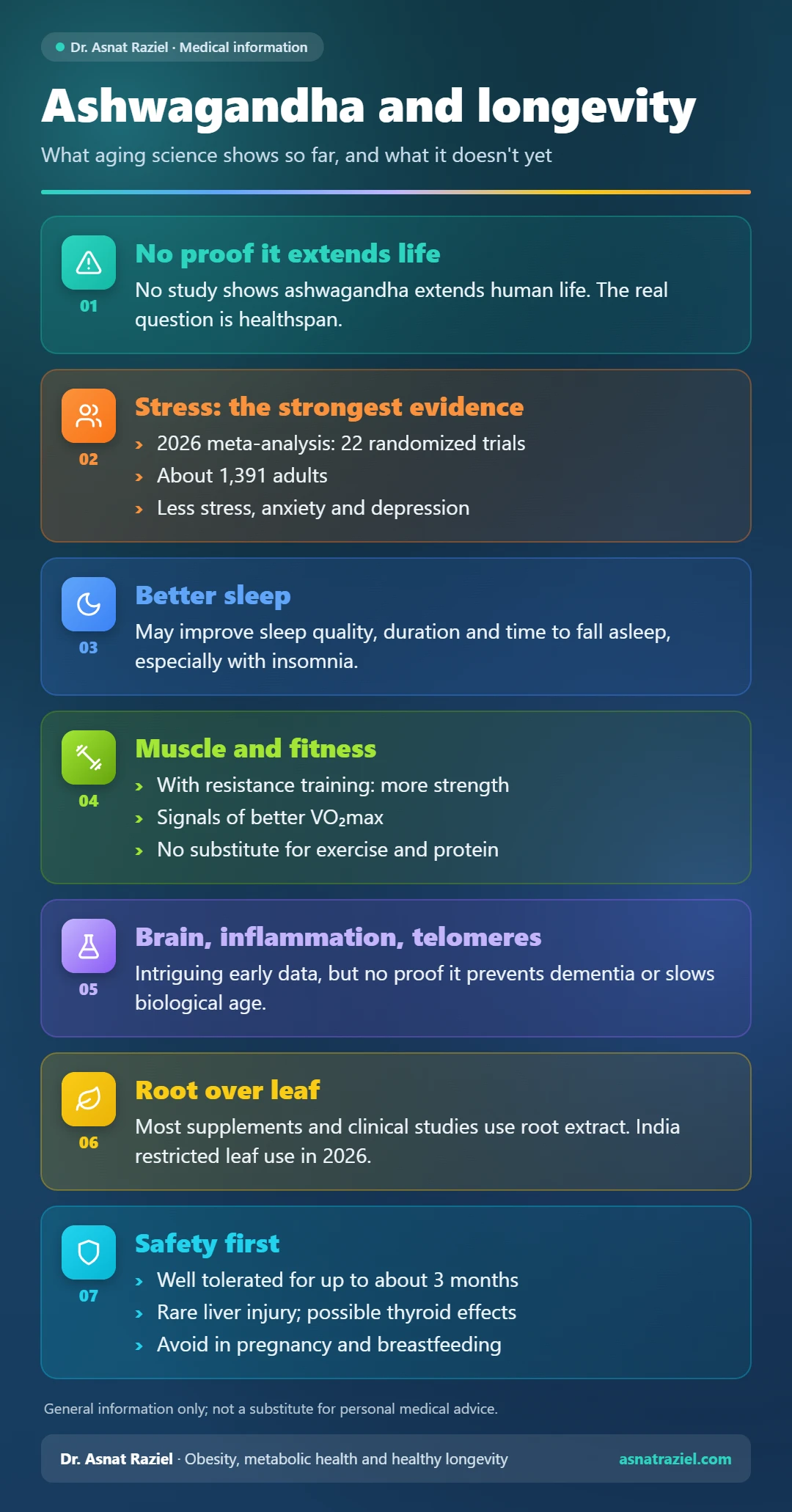
It is still too early to call ashwagandha a “life-extending supplement.” Still, we can say something interesting: it sits at the crossroads of several factors that matter for healthspan. These include stress, sleep, muscle, fitness, cognition and inflammation. For some of these, human clinical studies already exist. For others, we are still at the stage of mechanisms and preclinical research.
So the connection between ashwagandha and longevity makes more sense if we see the herb as a candidate for supporting systems we want to preserve as we age, and not as a substance that extends life. This brings us back, in a sober way, to the idea of Rasayana: the goal is not only to add years to life, but to preserve vitality within those years. Before taking a supplement like this, it is a good idea to consult a doctor, especially if you take regular medications.
The information in this article is general and does not replace personal medical advice.
References
Ashwagandha: Is it helpful for stress, anxiety, or sleep?
Beyond Root and Leaf: Whitepaper on Ashwagandha
Ashwagandha: Usefulness and Safety
India bans ashwagandha leaf use in any form, industry reacts
Note: an ashwagandha extract manufacturer published the root-and-leaf position paper.




