By Dr. Asnat Raziel, bariatric surgeon specializing in obesity treatment, metabolic health and healthy longevity; Director of the Multidisciplinary Center for Obesity Treatment, Assia Medical, Assuta Ramat HaChayal, Tel Aviv
What are epigenetic clocks and why do they matter?
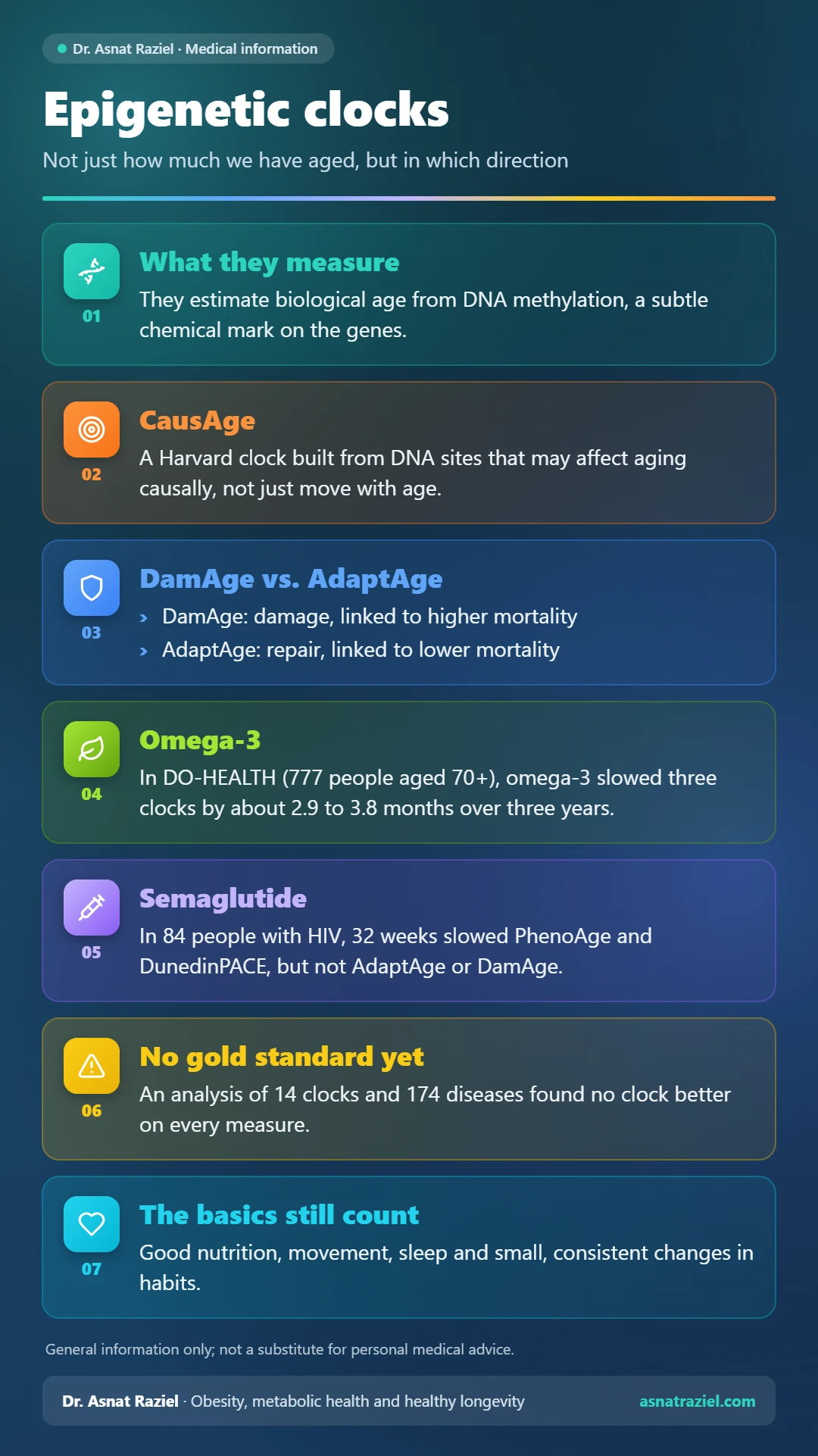
Epigenetic clocks are tests that estimate biological age from DNA methylation patterns. Methylation is a subtle chemical mark on the genes. It affects how genes are expressed, but it does not change the DNA sequence itself. Until now, these clocks gave us a single number: how old the body “looks.” However, the new generation tries to answer a much smarter question. Does a change in the body reflect damage, or is it actually protection?
CausAge: a clock that looks for causes, not just correlations
This innovation is at the heart of a paper by Harvard researchers in Nature Aging from January 2024. The researchers used broad genetic data and a method called Mendelian randomization. This statistical method uses natural genetic differences between people to test for cause and effect. With it, the researchers identified CpG sites, the spots in DNA where methylation is measured, that may affect aging causally. In other words, they were not just sites that “move together” with age.
From this framework, the researchers built the CausAge clock. From it, they derived two complementary clocks: DamAge and AdaptAge. According to the researchers, existing clocks include almost none of these causal sites. So the new approach adds information we did not have before. The press release about the study describes them as a new way to measure age.
DamAge and AdaptAge: two sides of the same process
The DamAge clock captures the harmful side of aging: signals of damage, disease and death. In an analysis of 4,651 participants from the Framingham and Normative Aging studies, faster DamAge was strongly linked to mortality. In contrast, AdaptAge captures the body’s adaptive side. These are the mechanisms the body uses to repair, protect and preserve function. Indeed, faster AdaptAge was actually linked to a lower risk of death.
Put simply, the old clocks asked, “How old does the body look?” The new clocks ask, “Is this change damage, or a protective response?” That is a very important distinction. After all, aging is not just a slow breakdown of systems. It also includes repair, compensation and adaptation. Therefore, a measurement that mixes everything together may miss the real story.
Omega-3 and epigenetic clocks: what the studies found
One of the most intriguing examples is omega-3. In the CausAge paper, six weeks of omega-3 supplements in people with overweight raised AdaptAge and lowered DamAge. That is, damage signals went down and adaptation signals went up. However, this is a short-term biological finding. It is not proof that omega-3 “rejuvenates” the body in a clinical sense.
In addition, the DO-HEALTH study, published in Nature Aging in February 2025, strengthened this interest. The study included 777 participants aged 70 and over. For three years, they received vitamin D at 2,000 units a day, omega-3 at 1 gram a day, a home exercise program, or a combination of these. Omega-3 alone slowed three clocks: PhenoAge, GrimAge2 and DunedinPACE. The effect was small, roughly 2.9 to 3.8 months over three years. Moreover, the PhenoAge clock showed an additive benefit in people who received all three treatments together.
Not every intervention moves the clock the right way
On the other hand, not every intervention affects the epigenome for the better. In a review by Adiv Johnson and David Sinclair in Frontiers in Genetics from May 2026, the researchers gathered 41 human studies. The review noted that decitabine, an epigenetic drug for blood cancers, sharply lowered AdaptAge and raised DamAge in patients with acute myeloid leukemia. This must be said clearly: it is not a reason to avoid life-saving treatment. In cancer care, controlling the disease comes first. Sinclair also explains the idea of reversing aging in a filmed conversation.
Another finding is of special interest to the obesity field. A randomized trial of semaglutide included 84 people with HIV and abdominal fat buildup. After 32 weeks, the drug slowed several clocks, including PhenoAge and DunedinPACE. However, according to the review, AdaptAge and DamAge did not change significantly. In other words, each clock sees a different part of the picture. You can read about the link between these drugs and biological age in my article on semaglutide and aging.
What epigenetic clocks mean for medicine
The broader meaning is that epigenetics is moving from a descriptive tool to an interpretive one. Instead of a single number, researchers are breaking biological age into its parts. Which part reflects harm? Which part reflects repair? And what changes in response to diet, medication, exercise or disease?
That is why DamAge and AdaptAge are attracting so much interest. They offer a new language for evaluating interventions in metabolic health and longevity. For example, they could help assess the drugs being tested today against aging. In addition, they may clarify the role of factors such as the microbiome and biological age.
Caution: epigenetic clocks are not yet a gold standard
This is the point to pause. Even the researchers stress that there is no single “gold standard” for biological age today. An editorial in the journal eBioMedicine from February 2026 reviewed an analysis of 14 clocks and 174 diseases. According to the editorial, no clock proved better on every measure. In addition, the DO-HEALTH researchers noted that it is still unclear whether changes in the clocks will lead to longer lives, less frailty or disease prevention.
So methylation clocks do not replace a medical assessment. Nor do they replace classic measures: physical function, muscle mass, cardiorespiratory fitness, inflammation, sleep and mental health. For a practical path to healthy older age, see my guide on healthspan and longevity.
The bottom line on epigenetic clocks
The message for the public is not to chase one test or one supplement. The medicine of the future will measure health in depth. It will not settle for weight, BMI (body mass index), cholesterol and blood sugar. Instead, it will check whether we are accumulating damage, whether we are repairing, and whether the intervention we chose is changing our path.
Ultimately, epigenetic clocks such as DamAge and AdaptAge represent a shift in thinking. They move us from aging as fate to aging as a process we can measure, and perhaps also steer. In the meantime, the foundation stays the same: good nutrition, movement, sleep and small, consistent changes in habits.
The information in this article is general and does not replace personal medical advice.
References
Causality-enriched epigenetic age uncouples damage and adaptation
Semaglutide slows epigenetic aging in a randomized trial of HIV-associated lipohypertrophy
Epigenetic clocks: advancing biological age measures towards meaningful clinical use




