By Dr. Asnat Raziel, bariatric surgeon specializing in obesity treatment, metabolic health and healthy longevity; Director of the Multidisciplinary Center for Obesity Treatment, Assia Medical, Assuta Ramat HaChayal, Tel Aviv
Proper breathing: air goes into the lungs, not the belly
Proper breathing starts with a simple insight: air goes into the lungs, not into the belly. Betsy Polatin has been teaching breathing and movement for more than 45 years. For 25 years she was a lecturer in theater and music at Boston University, and she leads trauma workshops alongside Dr. Peter Levine and Dr. Gabor Maté. In her view, the common instruction to breathe into your belly misleads many people.
Polatin spoke with a psychologist who specializes in anxiety at the Nervous System Reboot 2026 summit. Here are the highlights of their conversation, along with what physiology tells us.
The moment she realized the body shapes our emotions
In 1968, as a young dancer, Polatin took part in a choreography class. Each time, the teacher placed one participant in the center of a circle. That person opened their arms to each of the others in turn. Some felt welcomed, and some burst into tears. For her, it was a defining moment. She realized that our posture and movement affect our emotions, our breathing and our nervous system.
What happens in the body during proper breathing
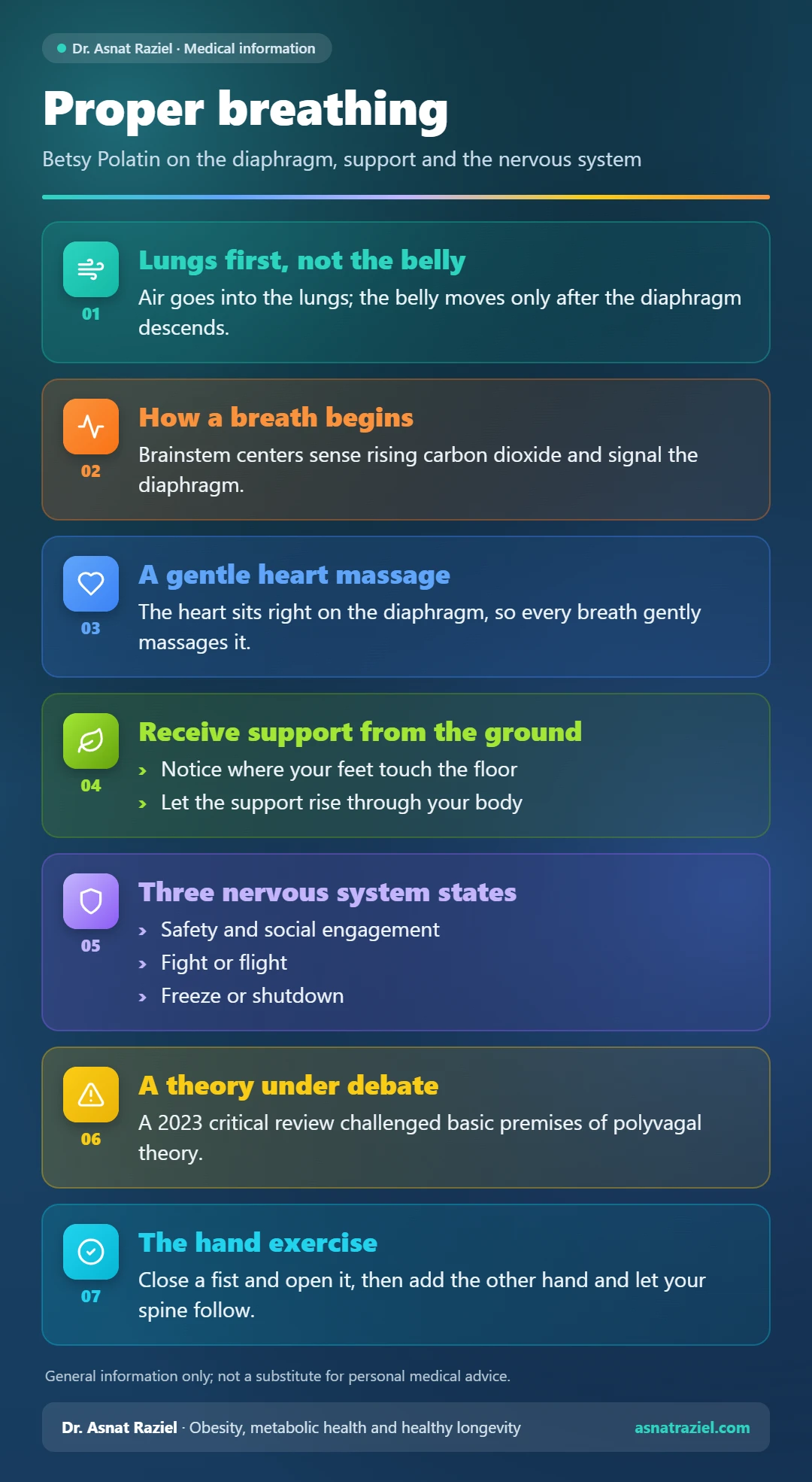
Polatin describes the mechanism this way. Breathing centers in the brainstem sense a rise in carbon dioxide and send a signal to the diaphragm. The diaphragm is a dome-shaped muscle at the base of the rib cage. When it descends, it makes room, and the lungs fill with air. As a result, the belly is pushed slightly forward. When you exhale, the belly moves back in, the diaphragm rises, and the air flows out. The control of breathing by the brainstem centers is well described in the StatPearls chapter on the physiology of respiratory drive.
The belly moves, but we don’t push air into it
According to Polatin, the belly does move when we breathe, but the timing matters. First the lungs fill and the diaphragm descends, and only then does the belly expand. If you try to push air into your belly, you may skip filling your lungs. On the other hand, she doesn’t recommend high chest breathing with raised shoulders either. In her view, proper breathing is a gentle, effortless filling of the lungs.
In addition, the heart sits right on top of the diaphragm. So, she says, every breath is also a kind of gentle massage for the heart.
Receiving support from the ground
Polatin doesn’t like the word grounding, because she finds that people tend to sink when they hear it. Instead, she prefers to talk about receiving support. The force rising up from the ground supports us, and all we need to do is allow it. Here is how to practice:
Your feet: notice your feet, especially where they touch the floor.
The support: remind yourself that the ground is supporting you from below.
Your joints: gently ask whether your ankles, knees and hips are free enough to receive that support.
Your body: feel the support rising through the chair, your lower back, rib cage, shoulders, neck and head.
Looking around: take in the room. What does the room look like when you feel supported?
She compares it to a children’s magic drawing board: you lift the plastic sheet, and the writing disappears. That is how you reset the nervous system.
The three states of the nervous system
Polatin explains Stephen Porges’s polyvagal theory. According to this theory, the nervous system has three main states: social engagement and safety, fight or flight, and freeze or shutdown. All of us move between them many times a day.
She says you can recognize these states in the body. In fight or flight, you feel tension in your shoulders or legs. In freeze, the belly tightens. When you are in good company, you feel relaxed. However, it’s important to know that polyvagal theory is controversial. A 2023 critical review challenged some of its basic premises. Even so, many people find its language useful in therapy.
There is also an important insight here for relationships. If someone near us is quiet and withdrawn, it isn’t necessarily about us. They may simply be in a shutdown state. I have also written about this in my article on the window of tolerance.
The hand exercise: contracting and expanding
According to Polatin, life is made of contraction and expansion. Here is the exercise she guided:
First: close one hand into a fist, then open it. Look at your hand.
Next: notice what you feel when the hand closes, and what you feel when it opens.
Then: feel how your whole body responds to the movement, and which emotions come up.
Finally: add the other hand, and let your spine move with the rhythm. Everyone at their own pace.
She says that one of the things lost in trauma is our inner rhythm. This exercise helps bring it back.
Fascia: the web that connects everything
The subject Polatin is most focused on today is fascia, the connective tissue that wraps every muscle, bone and organ. She says anatomists once treated it as waste tissue. Today we understand that it is very important. Its most striking feature is elasticity. Turn your body to one side as far as you can, then let go. Your body springs back to the center, like a rubber band.
According to her, the breath shows this elasticity too. At the end of the exhale, the next inhale comes on its own. That’s why she doesn’t count breaths. Instead, she simply listens to each person’s own rhythm.
Watch the full conversation: Betsy Polatin on proper breathing
The conversation runs about 50 minutes. It was recorded at the Heart Mind Institute’s Nervous System Reboot 2026 summit.
Proper breathing, weight and health
Calm breathing is one of the simplest tools for lowering stress. Stress, in turn, affects sleep, appetite and weight. I wrote about this in my article on stress and obesity, and about yoga and metabolic health. For more practical tools, see my guide to stress relief techniques.
The bottom line
Proper breathing takes no effort. According to Betsy Polatin, the lungs fill, the diaphragm descends and the belly moves on its own. In addition, you can draw on the support of the ground and on the rhythm of contraction and expansion. Some of the ideas in the conversation rest on well-known physiology, and some on her long experience. Either way, a few minutes of listening to your breath is a good start.
The information in this article is general and does not replace personal medical advice.
Sources and further reading
Fundamental challenges and likely refutations of the five basic premises of the polyvagal theory




