By Dr. Asnat Raziel, bariatric surgeon specializing in obesity treatment, metabolic health and healthy longevity; Director of the Multidisciplinary Center for Obesity Treatment, Assia Medical, Assuta Ramat HaChayal, Tel Aviv
Epigenetics and stress: your genes are a cookbook, not a verdict
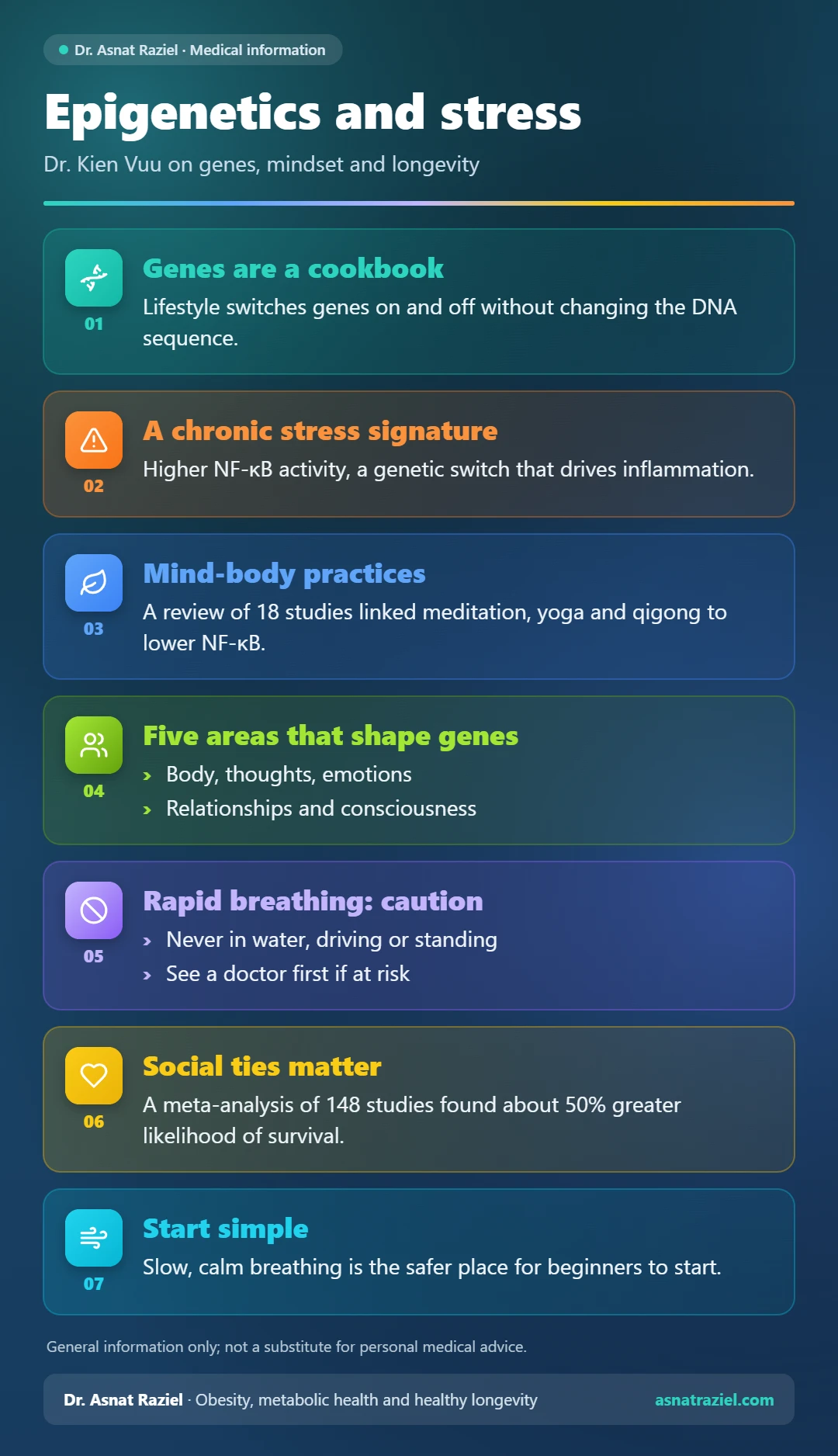
Epigenetics and stress are linked far more closely than many people think. This field studies how our environment and lifestyle switch genes on and off without changing the DNA sequence itself. Dr. Kien Vuu, an interventional radiologist and a lecturer at UCLA, calls DNA a cookbook. In his view, the meal that comes out of it depends on the cook: on our sleep, nutrition, movement, thoughts and emotions.
Vuu spoke with psychologist Dr. Ronald Siegel of Harvard Medical School at the Nervous System Reboot 2026 summit. Here are the highlights of their conversation, along with what the research says.
The white coat that hid an illness
About 15 years ago, at the height of his career, Vuu was sick. He says he was overweight and had diabetes and high blood pressure, and he was taking several medications. He knew that if he kept going this way, he would eventually end up on his own operating table. So he began to change his diet, his physical activity and his sleep. That way, he says, he managed to bring his diabetes and blood pressure back under control.
Yet he finds the root of the problem in his childhood. Vuu fled Vietnam as a baby, on a crowded refugee boat with about 2,000 people. According to him, he was the only baby who survived. He then grew up in Los Angeles’s Chinatown, where he was bullied. As a result, he formed a deep belief that he was not good enough. That belief, he says, drove him into a nonstop race, with little sleep and hospital food.
How stress reaches our genes
According to Vuu, when we live in constant fight-or-flight mode, we send our body the message that a tiger is chasing us. In response, the body turns on inflammatory genes and turns down immune genes. This combination, he says, sets the stage for chronic disease.
Research does describe a pattern like this. A systematic review of 18 studies describes a molecular signature of chronic stress: increased activity of NF-κB, a genetic switch that drives inflammation. In addition, the review found that meditation, yoga, qigong and breathing practices are linked to lower NF-κB activity. However, the researchers note that the studies were small and that more research is needed.
The five areas that shape gene expression
Vuu lists five areas that shape the energetic environment of our cells:
The body: sleep, nutrition and movement.
Thoughts: whether we think from fear or from a sense of safety.
Emotions: what we feel throughout the day.
Relationships: who we spend our time with.
Consciousness: whether we live in a world of “me” alone, or feel part of something larger.
This point matters a great deal to my patients. According to Vuu, even healthy eating that comes from stress and anger doesn’t serve us well. In other words, it’s not only what we do, but also the state of mind we do it in.
Epigenetics and stress in a world of achievement
Siegel raises an interesting tension. Many people come to Vuu in order to win and to live forever. Yet that very drive is part of the problem. Vuu explains that you have to meet people where they are. He cites a saying often attributed to the Dalai Lama: people sacrifice their health to make money, and then sacrifice their money to restore their health. So, he says, the desire to be better is a good starting point. From there, people can move on to deeper change.
In organizations, he brings in qigong, tai chi and even laughter yoga. He says some workplaces open every Monday morning this way. Shared laughter shifts the nervous system into a different state, one in which it is easier to think differently.
Dr. Vuu’s breathing exercise, and when not to do it
During the conversation, Vuu guided an intense breathing exercise in three rounds. It is based on rapid breaths through the mouth, followed by breath holds. Here is how it goes:
Three-part breath: inhale into the belly, inhale into the chest, exhale. About 10 to 15 times, finishing at double speed.
Hold with a squeeze: a deep inhale, then hold and squeeze every muscle in the body for about 15 seconds.
Hold after the exhale: exhale, and hold for as long as it feels comfortable. Then return to normal breathing through the nose.
Intention: in each round, focus on a different feeling: safety, love and connection.
It’s important to know that rapid breathing lowers the level of carbon dioxide in the blood. As a result, it can cause dizziness, tingling and even loss of consciousness. In a controlled study from Stanford University, researchers tested a similar version: accelerated breathing with breath holds. However, it was breathing with a long, slow exhale that worked best for improving mood.
So never practice this exercise in water, while driving or while standing. In addition, if you have heart disease, uncontrolled high blood pressure, epilepsy or panic attacks, or if you are pregnant, consult a doctor first. For beginners, I recommend slow, calm breathing, as in my article on stress relief techniques. Another gentle option is EFT tapping, which I describe in a separate article.
Safety, love and connection
According to Vuu, three things feed the brain’s default mode network, the network of the self and of worry: feeling unsafe, unloved and disconnected. That’s why, in each round of the exercise, he invites us to feel exactly the opposite. He also admits that his old self sneaks back in almost every day. The difference today, he says, is that he recognizes it and chooses differently.
Watch the full conversation: Dr. Kien Vuu on epigenetics and stress
The conversation runs about 50 minutes. It was recorded at the Heart Mind Institute’s Nervous System Reboot 2026 summit.
What epigenetics and stress teach us about healthy longevity
I see this connection in my clinic every day. Chronic stress disrupts sleep, increases appetite and makes it harder to change habits. I wrote about this in my article on stress and obesity, and also about biological age and how to influence it.
In addition, the social side that Vuu emphasizes is well supported by a meta-analysis of 148 studies. It found about a 50% greater likelihood of survival in people with strong social relationships. That’s why treatment at our center also includes the mind, with psychologists, yoga and stress-reduction techniques.
The bottom line
Epigenetics and stress remind us that our genes are not a verdict. According to Dr. Kien Vuu, the way we sleep, eat, move, think and connect changes the messages our cells receive. Some of what he says rests on research, and some on his personal experience. Either way, it’s worth starting with safe, simple steps.
The information in this article is general and does not replace personal medical advice.
Sources and further reading
Brief structured respiration practices enhance mood and reduce physiological arousal
Social Relationships and Mortality Risk: A Meta-analytic Review




