By Dr. Asnat Raziel, bariatric surgeon specializing in obesity treatment, metabolic health and healthy longevity; Director of the Multidisciplinary Center for Obesity Treatment, Assia Medical, Assuta Ramat HaChayal, Tel Aviv
Gender medicine and International Women’s Day
Gender medicine is medicine that recognizes the biological differences between women and men and tailors diagnosis and treatment to them. International Women’s Day is a symbolic moment, but it is also a chance to ask deeper questions. Not only about women in leadership or the pay gap, but also about the way medicine sees, studies and treats the female body.
For decades, medicine relied mainly on studies in men. The results were then applied to women almost by default. Only in recent years has the understanding taken hold that the female body is not a “scaled-down version” of the male body. Rather, it is a unique biological system, with hormonal and physiological patterns of its own.
Why this gap matters in the clinic
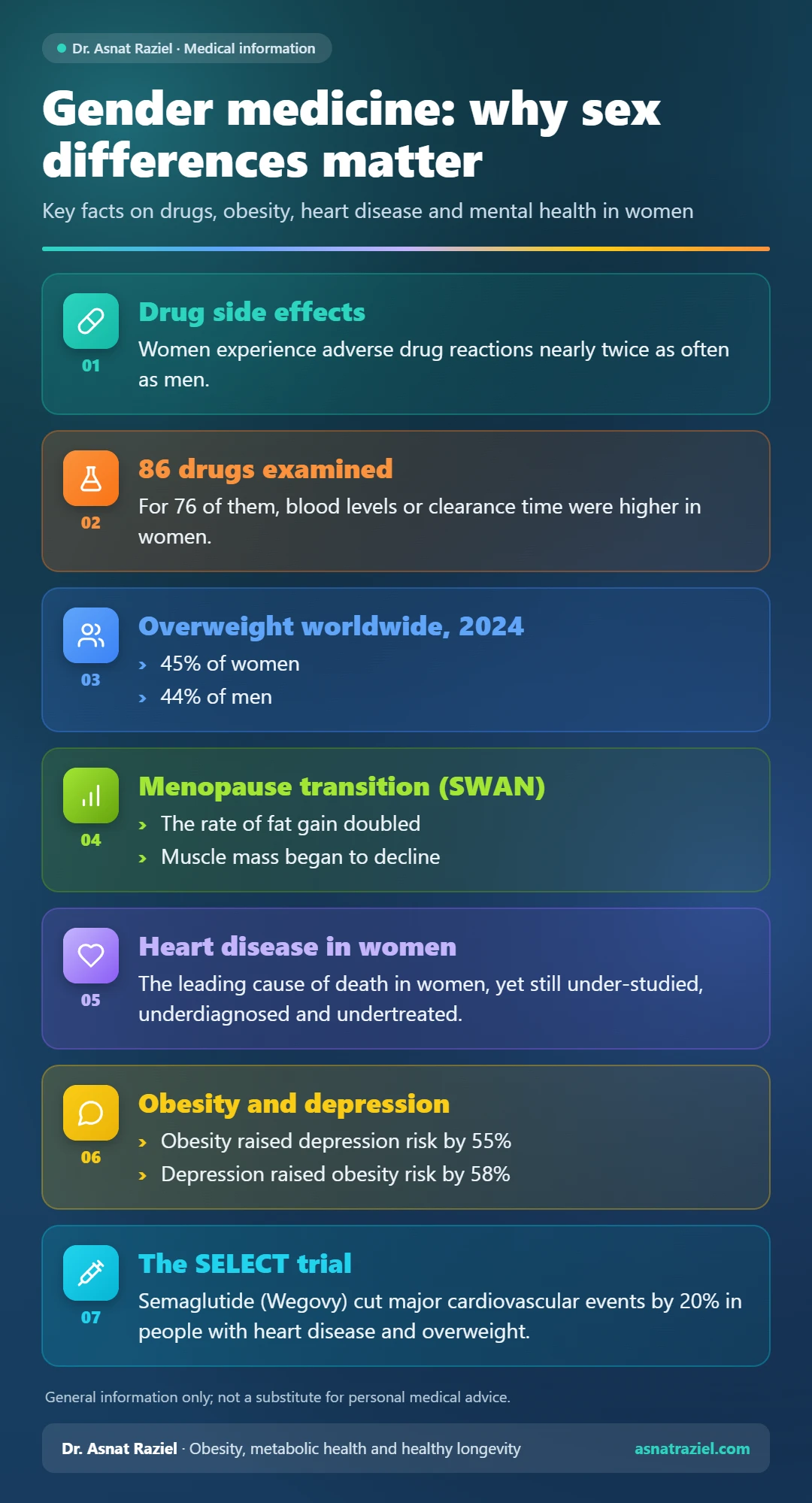
This has real consequences in everyday care. A review in the journal Biology of Sex Differences found that women experience adverse drug reactions nearly twice as often as men. The researchers examined 86 drugs. For 76 of them, blood levels of the drug or the time it took to clear from the body were higher in women. Therefore, they recommend evidence-based dose adjustments for women.
However, gender medicine is not only about dosing. It also asks how symptoms look in women, how diseases progress in them and which treatment suits each stage of life. When no one asks these questions, women reach a diagnosis late. In many cases, they also receive treatment that does not suit them.
Obesity as a test case for gender medicine
Obesity illustrates the gap well. According to the World Health Organization, in 2024, 45% of women and 44% of men worldwide had overweight. Beyond the numbers, the experience of living with obesity is also different for women.
Obesity is not the result of a lack of willpower. It is a chronic, multisystem disease in which the brain’s hunger, satiety and energy mechanisms are disrupted. Hormones such as leptin, ghrelin and GLP-1 work within a system that genetics, sleep, stress and the environment also influence. In women, the picture is even more complex because of hormonal changes throughout life. I wrote about this at length in my article on obesity in women across the lifespan.
Hormones, pregnancy and menopause
Puberty, pregnancies, childbirth, fertility treatments and menopause all bring sharp changes in estrogen and progesterone levels. In the SWAN study, which followed women through the menopause transition, the rate of fat gain doubled at the start of the transition. At the same time, muscle mass began to decline, even without a faster rise in total body weight. In other words, it is not only the number on the scale that matters, but also body composition and where fat is stored. A complete guide appears in my article on weight gain in menopause.
In addition, emotional strain, lack of sleep and chronic stress are common among women who carry a heavy load of responsibility at home and at work. These affect cortisol levels and metabolism. They are real physiological mechanisms, not a personal weakness.
Heart disease: late diagnosis and misplaced blame
Heart disease is the leading cause of death in women. Yet for many years, it was seen as a “man’s problem.” The Lancet Commission on women and cardiovascular disease concluded in 2021 that heart disease in women is still under-studied, underdiagnosed and undertreated. In addition, a statement from the American Heart Association describes sex differences in the symptoms, mechanisms and outcomes of heart attacks. You can read more in my article on heart disease in women.
Similarly, women with obesity often leave the clinic feeling guilty. Instead of an explanation of the hormonal and metabolic mechanisms, they get general advice: eat less and move more. This creates a feeling of struggle, not only against the disease but also against the system.
The link to mental health
The medical literature points to a two-way link between obesity and depression. A meta-analysis of 15 longitudinal studies showed that obesity increased the risk of depression by 55%. Conversely, depression increased the risk of obesity by 58%. Stigma, negative body image and discrimination deepen shame and guilt. I wrote about this in my article on weight stigma and health.
Emotional distress can lead to emotional eating, and weight gain makes the distress worse. It is a cycle that is hard to break without comprehensive, compassionate and tailored care.
Gender medicine and breakthroughs in obesity treatment
Advances in research have changed the conversation. New treatments are based on an understanding of satiety hormones and brain mechanisms. They allow significant weight loss and improvements in metabolic markers. For example, in the SELECT trial, semaglutide (Wegovy) reduced major cardiovascular events by 20% in people with heart disease and overweight.
Large clinical trials have also shown improvements in blood sugar control, blood pressure, blood lipids and chronic inflammation. For some women, weight loss also improves ovulation and cycle regularity, for example in polycystic ovary syndrome. These are not cosmetic changes, but a profound improvement in health.
Listen, believe, tailor
Real care for women is not limited to a drug or an operation. It requires a look at the whole story: lifestyle, emotional load, sleep, hormonal status, coexisting conditions and personal history. Medicine that respects women knows how to listen. It believes their symptoms and does not rush to judge.
In addition, it offers a tailored, multidisciplinary solution, with up-to-date knowledge, emotional support and long-term follow-up. New technological tools are joining in as well, as I described in my article on the femtech revolution.
The bottom line on gender medicine
On International Women’s Day, it is worth remembering a simple truth: a woman’s body should not have to fight to get care. It should not have to justify itself or prove that it meets strict criteria. Gender medicine is not a side note in research. It is a precondition for precise and fair medicine. In the end, women’s health is at the heart of equality. As healthcare moves toward evidence-based, personalized medicine, we can narrow historical gaps and give women professional, respectful care from the very start.
The information in this article is general and does not replace personal medical advice.
References
Sex differences in pharmacokinetics predict adverse drug reactions in women
Changes in body composition and weight during the menopause transition
The Lancet women and cardiovascular disease Commission: reducing the global burden by 2030
Acute Myocardial Infarction in Women: A Scientific Statement From the American Heart Association
Overweight, obesity, and depression: a systematic review and meta-analysis of longitudinal studies
Semaglutide and Cardiovascular Outcomes in Obesity without Diabetes