By Dr. Asnat Raziel, bariatric surgeon specializing in obesity treatment, metabolic health and healthy longevity; Director of the Multidisciplinary Center for Obesity Treatment, Assia Medical, Assuta Ramat HaChayal, Tel Aviv
Pilates for weight loss: the short answer
Does Pilates for weight loss really work? It is one of the most common questions I hear in my clinic. The honest answer: Pilates can help, but on its own it is a modest tool for losing weight. In studies, people with excess weight lost an average of about 2.4 kg with it. Its real value, however, lies in strengthening your muscles, improving your posture and keeping you active for years.
In this article, I’ll explain how much energy Pilates actually burns, what the studies found and how to fit it properly into a weight loss plan.
What Pilates is and what it does for your body
Pilates is a training method developed by Joseph Pilates in the early 20th century. It is based on controlled movements, breathing and work on the core muscles (the muscles of the abdomen, back and pelvis). If you’d like the background, there is a good overview of what Pilates is and the history of the method.
There are two main types. The first is mat Pilates, which uses only your body weight. The second is equipment-based Pilates, such as the Reformer, which adds resistance with springs. In both cases, the work is slow and precise. That is why Pilates is also suitable for people with excess weight, people with back pain or anyone returning to activity after a long break.
Pilates for weight loss: the calorie math
To lose weight, you need a calorie deficit, meaning you spend more energy than you eat. This is where Pilates is limited. A systematic review of the energy cost of Pilates found light to moderate intensity. On average, a Pilates session burns about 3.8 calories per minute. However, the researchers considered the most reliable estimate to be lower, at about 2.9 calories per minute.
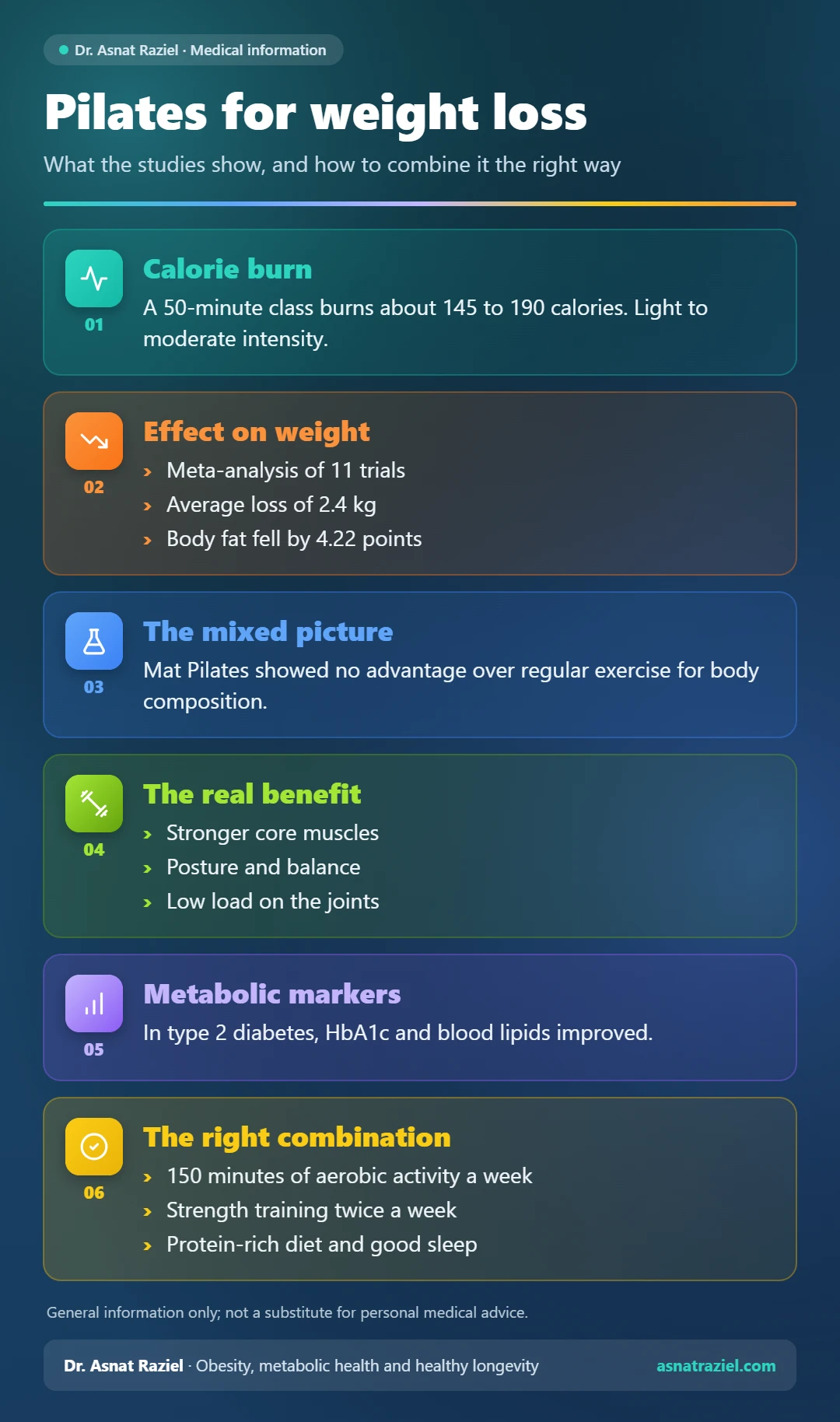
By a simple calculation, a 50-minute class burns about 145 to 190 calories. That is an amount you can easily eat back with one small snack. In addition, a small ACE study of 15 young women found that in a beginner class, heart rate reached only 54% of maximum. In the advanced class, it reached 62%, a load similar to brisk walking. You’ll find a full comparison of different workouts in my article on calories burned during exercise.
What the research says about Pilates for weight loss
First, the positive data. A meta-analysis of 11 controlled trials included 393 adults with overweight or obesity. Compared with control groups, Pilates led to an average weight loss of 2.4 kg. In addition, body mass index (BMI) fell by 1.17 units, and body fat percentage fell by 4.22 percentage points. The effect was most pronounced in people with obesity and in longer programs.
However, the same meta-analysis found no significant change in waist circumference or lean body mass. The researchers themselves noted that the trials were small and that larger studies are needed.
On the other hand, a review of mat Pilates reached a more cautious conclusion. Based on 10 studies, mat Pilates was no better than conventional exercise or a control group at improving body composition. In other words, the studies are not clear-cut. Pilates helps a little, but it is not a special method for weight loss.
Pilates, muscle and metabolism
So why do I still recommend it to some of my patients? Because weight is not the whole story. Strong muscles support your joints, your balance and your everyday activity. While you lose weight, and especially on medication, it is important to preserve muscle mass. I wrote about this in detail in my article on strength training to preserve muscle mass.
What’s more, Pilates may also improve metabolic markers. An analysis of 52 studies on mind-body exercise in type 2 diabetes found that Pilates improved HbA1c (average blood sugar) and blood lipid levels. Similarly, yoga also contributes to metabolic health, as I explained in my article on yoga and metabolic health.
Why am I exercising and not losing weight?
This is a very common complaint. After a workout, many people feel very hungry and eat back what they burned. In addition, the body compensates by slightly reducing activity for the rest of the day. As a result, exercise alone usually leads to only a small weight loss. I explained this further in my article on exercising but not losing weight.
Likewise, obesity is a chronic disease with hormonal and genetic components. For some people, lifestyle change is not enough. In such cases, it is worth learning about the options for medication treatment for obesity.
How to fit Pilates into a weight loss plan
The international recommendations are clear. Adults need at least 150 minutes of moderate-intensity aerobic activity a week, plus strength training two days a week. Pilates can cover the strength and flexibility part. Even so, it is worth adding brisk walking, cycling or swimming.
- Two Pilates classes a week, preferably on a Reformer with gradually increasing resistance.
- A brisk 30-minute walk on most days of the week.
- A diet rich in protein and vegetables, to preserve muscle and help you feel full.
- Sleep and brain health are part of the plan, because lack of sleep increases hunger.
Finally, choose what you will stick with. New methods, such as infrared training, are interesting, but consistency matters more than any technique.
The bottom line
Pilates is an excellent workout for strength, posture and flexibility. As a tool for weight loss, its effect is modest, about 2.4 kg on average in studies. Therefore, it works best as part of a plan that includes nutrition, aerobic activity and sleep. If your weight loss stalls despite your efforts, it is worth consulting a doctor who specializes in obesity, such as Dr. Asnat Raziel.
The information in this article is general and does not replace personal medical advice.
Questions and answers
Will Pilates help me lose weight without changing my diet?
Usually only a little. A 50-minute class burns about 145 to 190 calories. A small change to your menu affects your calorie balance just as much. Changing your diet is the foundation of weight loss.
Is Pilates as effective for weight loss as brisk walking?
Not necessarily. In an advanced class, the load on the heart is similar to brisk walking. The main difference is that Pilates strengthens muscles, while walking improves aerobic fitness. Combining the two is the best choice.
How many times a week should I do Pilates?
Two or three times a week is a good starting point. That way, it meets the strength training recommendation and still leaves time for aerobic activity.
Is Pilates suitable for people with obesity?
Yes, in most cases. The movements are slow and the load on the joints is low. Still, tell your instructor about any pain or limitations, and if you have heart disease, consult a doctor first.
Sources
Pilates for Overweight or Obesity: A Meta-Analysis
Effects of the Mat Pilates Method on Body Composition: Systematic Review With Meta-Analysis
ACE Study Evaluates Benefits of Pilates




