By Dr. Asnat Raziel, bariatric surgeon specializing in obesity treatment, metabolic health and healthy longevity; Director of the Multidisciplinary Center for Obesity Treatment, Assia Medical, Assuta Ramat HaChayal, Tel Aviv
Calories burned during exercise: how many, really?
Calories burned during exercise are one of the most confusing topics for people trying to lose weight. Your smartwatch shows one number, the machine at the gym shows another, and the scale doesn’t always budge. In this article, I’ll explain how much energy different workouts require, why the numbers vary from person to person, and how to use this information wisely.
How energy expenditure is measured
The standard measure is the MET, short for metabolic equivalent of task. One MET is the rate of energy use while sitting quietly, roughly 1 calorie per kilogram of body weight per hour. Activities of 3 to 6 METs are moderate in intensity, while activities of 6 METs or more are vigorous.
This gives us a simple formula: the MET value times body weight in kilograms times the number of hours. For example, a person weighing 70 kg who exercises for one hour at 6 METs burns about 420 calories. MET values for different activities are collected in the updated Compendium of Physical Activities, which includes 1,114 activities. For 912 of them, the values were actually measured in the lab.
Calories burned during exercise by type of activity
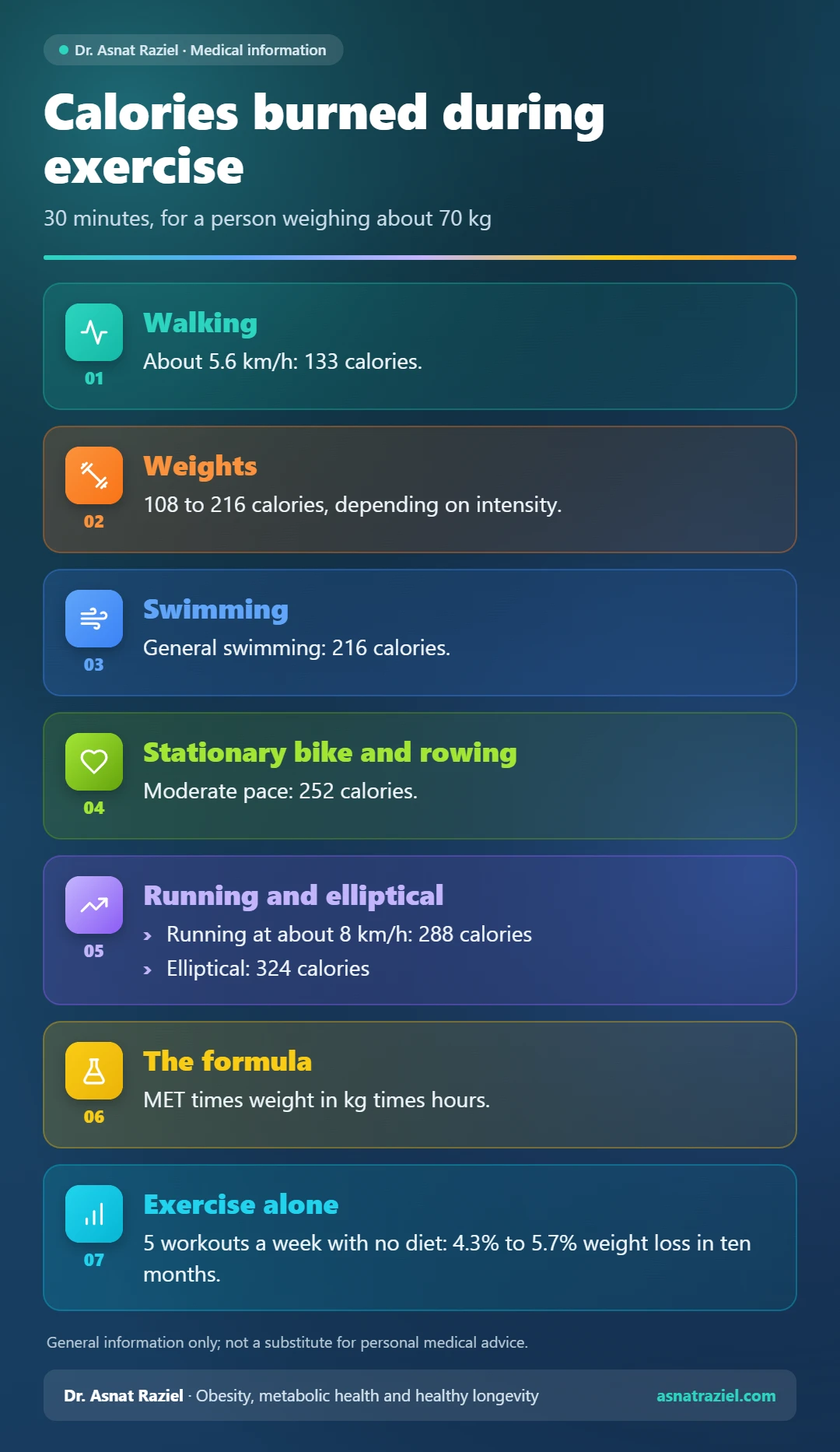
A table from Harvard Medical School shows energy expenditure for 30 minutes of activity. The figures below refer to a person weighing about 70 kg (155 pounds).
- Weight lifting, general intensity: 108 calories.
- Walking at about 5.6 km/h: 133 calories.
- Yoga (hatha): 144 calories.
- Vigorous weight lifting: 216 calories.
- Swimming, general: 216 calories.
- Stationary bike or rowing machine at a moderate pace: 252 calories.
- Running at about 8 km/h: 288 calories.
- Elliptical trainer: 324 calories.
By contrast, the same table shows that half an hour of sleep uses only 22 calories. In other words, every bit of movement adds up. Let’s try a simple example. A person weighing 70 kg who walks for half an hour five times a week uses about 665 calories a week from walking alone. If they also add two vigorous weight-lifting sessions, they reach about 1,100 calories a week. That total builds a habit, improves fitness and supports weight loss over time.
Why calories burned during exercise differ for everyone
Body weight
A heavier body needs much more energy to move. In the Harvard table, a 30-minute run at about 8 km/h takes 240 calories for a person weighing about 57 kg. For a person weighing about 84 kg, however, the same run takes 336 calories.
Intensity, fitness and body composition
Intensity changes the picture significantly, sometimes far more than the length of the workout. In addition, people differ in muscle mass, age and fitness. Beyond that, the basic MET value is based on a single healthy 70 kg man. According to calorimetry measurements, it overestimates the true resting rate by about 20% to 30% on average. Therefore, every table and formula gives only an estimate.
A simple way to gauge your intensity is the talk test. At moderate intensity, you can talk but find it hard to sing. At high intensity, on the other hand, it is hard to say a full sentence without pausing for breath. That way, you can adjust your workout even without a watch or any equipment.
Watches and machines
Smartwatches and fitness machines calculate expenditure from your heart rate, your movement and the data you entered. The number is useful for tracking a trend, but not as a precise measurement. So it is better to compare one of your workouts with another, rather than use it to decide how much you are allowed to eat.
Does exercise alone lead to weight loss?
The answer is yes, but less than people hope. In a controlled study, the Midwest Exercise Trial 2, young adults with excess weight exercised under supervision five times a week for ten months, with no diet. One group burned 400 calories per session and lost an average of 3.9 kg (4.3%). The group that burned 600 calories lost 5.2 kg (5.7%), while the control group gained 0.5 kg.
In other words, it takes a large amount of exercise to lose a few kilograms. Moreover, hunger often rises after a workout, and the body compensates by being less active for the rest of the day. This is one of the reasons people ask why they can’t lose weight even though they exercise. That is why combining exercise with the right nutrition is key, as I explained in my article on combining diet and exercise for weight loss.
How to choose a workout: not just by calories burned during exercise
The best workout is the one you will stick with. Strength training uses relatively little energy during the session itself, but it preserves muscle as your weight goes down. Aerobic exercise, meanwhile, improves your heart and your endurance. I compare the two in detail in my article on aerobic vs. strength training.
- At least 150 minutes a week of moderate activity, according to the World Health Organization.
- Strength training two or three times a week, to preserve muscle.
- Daily movement: stairs, walking and getting up from your chair.
- Activity you enjoy, such as dancing, swimming or Pilates.
Daily steps also matter over time, especially for keeping weight off after losing it, as I wrote about walking for weight maintenance. And for a broader look at training your body for the decades ahead, read my guide to complete fitness for longevity.
The bottom line
Calories burned during exercise depend on the type of activity, its intensity and your body weight. Running, the elliptical and rowing take relatively a lot of energy, while walking and yoga take less, but they all contribute. The numbers on your watch are an estimate, not permission to eat more. Ultimately, what brings results is the combination of regular exercise, strength training and nutrition tailored to you.
The information in this article is general and does not replace personal medical advice.
Questions and answers
Which type of exercise burns the most calories?
In the Harvard table, workouts such as running, the elliptical and vigorous rowing top the list. However, the difference depends on intensity and body weight.
Is my smartwatch accurate?
It is good for tracking trends, but its estimate can be off. For that reason, you shouldn’t use it to decide how much to eat.
How many calories are burned during strength exercise?
According to Harvard, 108 to 216 calories in 30 minutes for a person weighing about 70 kg, depending on intensity. Its main advantage, though, is that it preserves muscle.
Can I lose weight from exercise alone?
Yes, but the loss is modest. In a controlled study, exercising five times a week took off 4.3% to 5.7% of body weight over ten months.
Sources
Calories burned in 30 minutes for people of three different weights – Harvard Health
2024 Adult Compendium of Physical Activities: A third update of the energy costs of human activities




