By Dr. Asnat Raziel, bariatric surgeon specializing in obesity treatment, metabolic health and healthy longevity; Director of the Multidisciplinary Center for Obesity Treatment, Assia Medical, Assuta Ramat HaChayal, Tel Aviv
Why do women live longer than men?
Women live longer than men almost everywhere in the world, and science is still looking for the explanation. For decades, scientists thought that pregnancy and childbirth take a toll on the body and shorten life. However, a new hypothesis, published in August 2026 in the journal Cell, turns this picture upside down. According to it, the female reproductive system does not clash with longevity. On the contrary, it may actually be what drives it. This insight could change aging research, in women and in men alike.
Biology is only part of the story. A Ynetnews report on why women outlive men also points to psychosocial factors: women have wider support networks, while men smoke more, drink more alcohol and go to the doctor less often.
Reproduction and longevity: not opposing forces
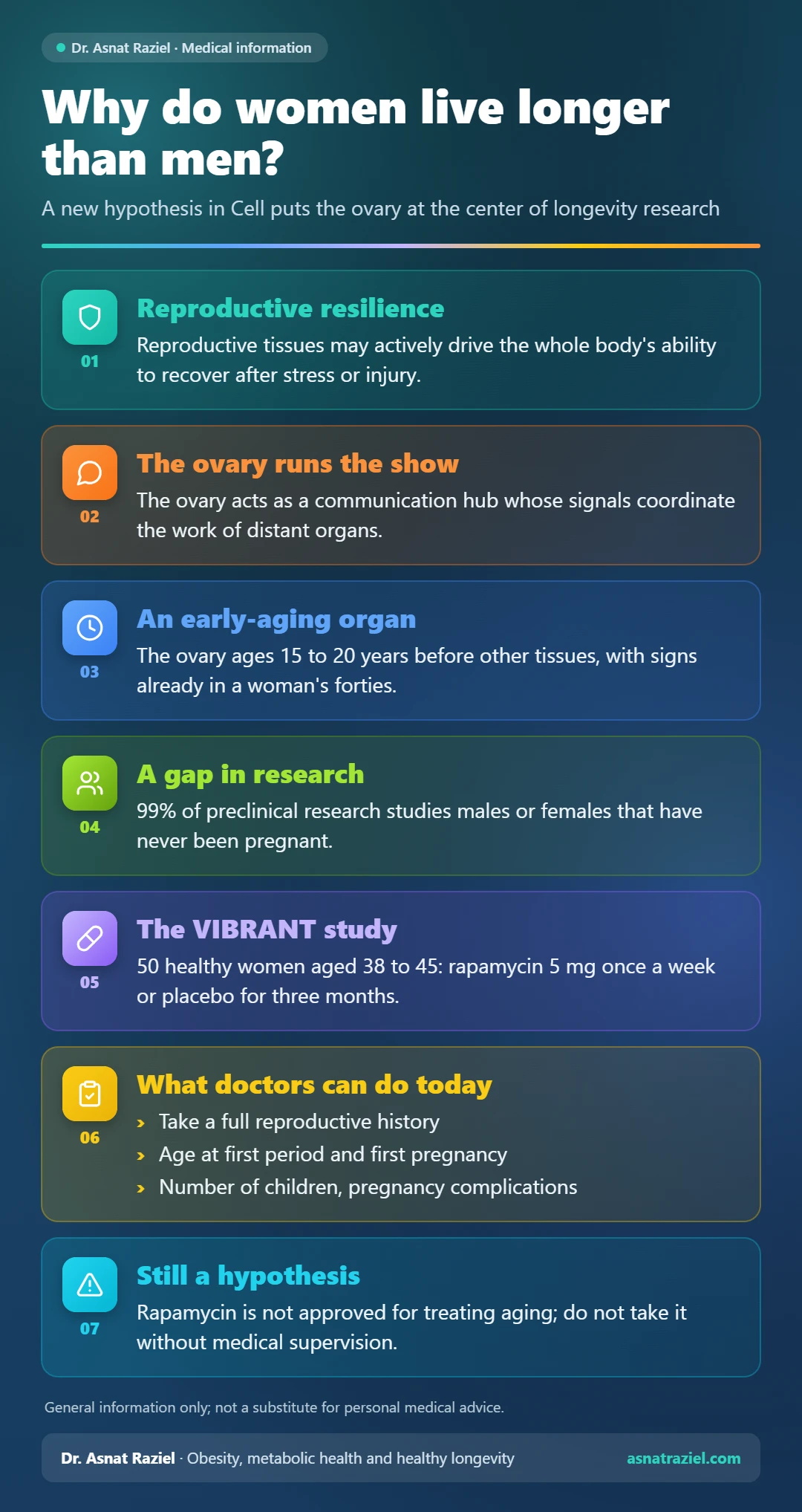
Its name is the Reproductive Resilience Hypothesis. According to this hypothesis, reproductive tissues do not just use up the body’s resources. They also actively drive the resilience of the whole body, meaning its ability to recover after stress or injury.
Researchers from the Buck Institute for Research on Aging in California led the paper in Cell. Prof. Pankaj Kapahi heads the team. In his words, the hypothesis starts from a simple evolutionary question. Why do females usually live longer than males, despite the enormous burden of pregnancy, childbirth and breastfeeding? According to the Buck Institute announcement, the researchers propose viewing the loss of reproductive resilience as a hallmark of aging unique to women.
Evolution’s answer
The old view held that reproduction speeds up aging. The logic was simple: the body diverts resources to reproduction at the expense of maintenance and repair. But this view does not fit species whose survival depends on repeated reproduction and long-term care of offspring.
The new logic is the reverse. Health and resilience allow a female to reproduce again, raise offspring and support them. Therefore, longevity itself improves reproductive success. In such a case, natural selection may favor mechanisms that link reproduction to body maintenance. Kapahi also points to an interesting fact. According to him, pregnancy at a young age goes hand in hand with faster aging and a higher risk of several diseases. In contrast, women who gave birth later in life tend to live longer.
The ovary as a communication hub
In an interview with Medscape, Kapahi described how every tissue in the body communicates with the ovary, and he even argued that the ovary runs the show. In the paper itself, the researchers describe the ovary as a communication hub. Its signals coordinate the work of distant organs. When the ovary declines, weak spots that it had protected until then may come to light.
Moreover, the ovary is one of the first organs in the body to age. That is the explanation of Prof. Yousin Suh of Columbia University, who did not take part in writing the paper. According to an article from Columbia University Irving Medical Center, the ovary ages 15 to 20 years before other tissues. Already in a woman’s forties, it shows molecular signs that also appear in the aging brain, heart and kidney. You can read about the link between menopause and metabolic health in my article on obesity during menopause.
Women live longer than men, and men will benefit too
The researchers stress that the hypothesis is not only about estrogen. In addition, they do not claim that the ovary is the only cause of aging. Genetics, age and lifestyle also play a role. Still, they are asking science to change its habits. According to them, 99% of preclinical research studies males or females that have never been pregnant.
The message reaches beyond women’s health. If we understand why women live longer than men, we may discover mechanisms that benefit everyone. “If we wish to understand why organisms age, nature points us toward studying women,” Kapahi said in the Buck Institute announcement. I wrote about the effect of excess weight on women’s health across the lifespan in my article on obesity and women’s health.
From the lab to the clinic: rapamycin and VIBRANT
In mouse experiments, restoring ovarian function, for example by transplanting young ovaries, improved metabolic and cognitive measures. In addition, studies in mice found that rapamycin preserved ovarian function and extended the fertile period. Rapamycin is a drug that suppresses the immune system, and doctors give it to prevent rejection of a kidney transplant.
Now it is the turn of humans. The VIBRANT study at Columbia University is testing whether a low dose of rapamycin slows ovarian aging. Dr. Zev Williams leads the study together with Suh. The study includes 50 healthy women aged 38 to 45. They take 5 mg once a week or a placebo for three months. As of October 2026, the full results have not yet been published in a scientific journal. “By delaying ovarian aging, we could live longer and healthier lives,” says Suh.
What can you do today?
There is no need to wait for new drugs. According to Suh, doctors can already take a full reproductive history. For example: age at first period, age at first pregnancy, number of children and pregnancy complications. Until now, medicine has hardly collected this information in a systematic way. Adding it to the medical record could sharpen each woman’s risk assessment. Likewise, the Buck Institute researchers recommend documenting reproductive history in every human study.
Kapahi also has a social message. In his view, delaying pregnancy is a choice many women make for professional and financial reasons. Perhaps it also carries long-term health benefits. Of course, this is a hypothesis and not a medical recommendation. In the meantime, simple tools such as sleep, movement and good nutrition already affect biological age right now.
The bottom line: women live longer than men, and the ovary is at the center
Longevity research is changing direction. In the past, researchers saw the ovary as an organ with a time-limited role. Today, it is emerging as a control center for aging as a whole. If clinical studies confirm the hypothesis, the path to slowing aging may actually run through female biology. Ultimately, the question of why women live longer than men may open the door to healthy aging for all of us.
It is important to remember that this is a scientific hypothesis, and the research is in its early days. No regulator has approved rapamycin for treating aging, and no one should take it without medical supervision.
The information in this article is general and does not replace personal medical advice.
References
Why women need to be prioritized in longevity research
How Female Biology Could Solve the Mystery of Longevity
Studying Ovaries to Understand How We All Age
Pilot Study Evaluates Weekly Pill to Slow Ovarian Aging, Delay Menopause
The NIH, the Larry L. Hillblom Foundation and the Hevolution Foundation were among the funders of the study in Cell.