By Dr. Asnat Raziel, bariatric surgeon specializing in obesity treatment, metabolic health and healthy longevity; Director of the Multidisciplinary Center for Obesity Treatment, Assia Medical, Assuta Ramat HaChayal, Tel Aviv
Reducing constant hunger: why it matters so much
Reducing constant hunger is one of the first things my patients ask me for. Many of them describe hunger that comes back an hour after a meal, even when they have eaten enough. It is important to know that this is not a weakness or a lack of willpower. Behind the hunger is a biological system of hormones, nerves and the brain. So once you understand it, you can also influence it.
In this article, I explain what causes persistent hunger, what the research says and what actually helps. In addition, I describe when it is worth seeking a medical evaluation.
What happens in the body when we are hungry all the time
The body manages eating with two types of signals. Hunger signals encourage us to eat, while satiety signals tell us to stop. The hunger and satiety system includes stretch receptors in the stomach, the vagus nerve and centers in the hypothalamus, a small area at the base of the brain.
The best-known hunger hormone is ghrelin, which is released mainly by the stomach. In contrast, leptin comes from fat tissue and signals long-term fullness. The gut sends signals, too: CCK acts right after a meal, while GLP-1 and PYY act over a longer period. A professional review of the neurohormonal mechanisms of appetite describes this system in detail. It is also worth reading my article on satiety hormones and the brain.
What’s more, hunger is not only physical. Many people experience food noise in the brain, meaning nonstop thoughts about food. In this state, the brain amplifies the drive to eat even when the body does not need energy.
Why hunger gets stronger after a diet
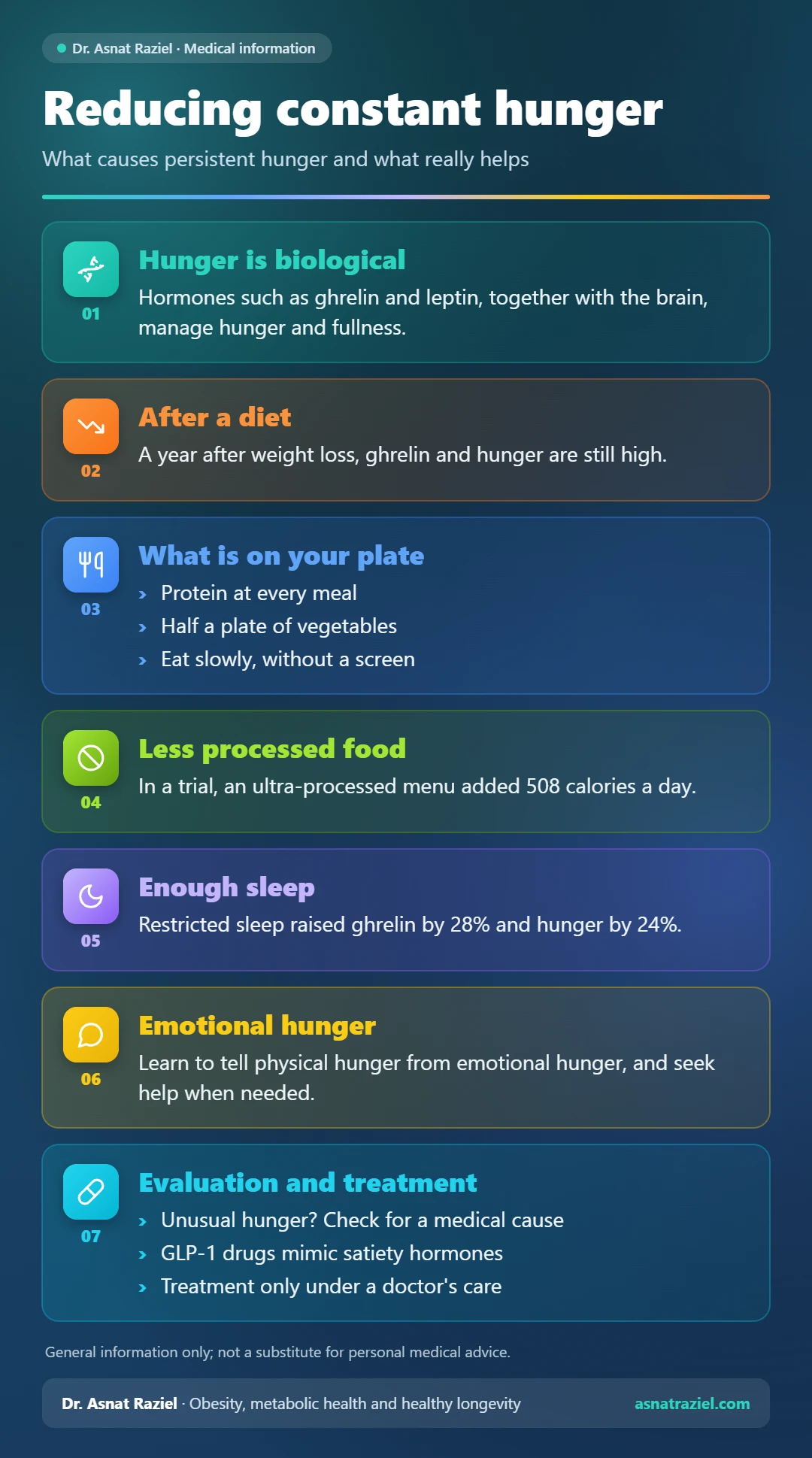
Many patients tell me that their hunger became especially strong precisely after they lost weight. Research has an explanation for this. A study published in the NEJM followed 50 people with excess weight who lost an average of 13.5 kg on a low-calorie diet. A year later, ghrelin levels were still high, while levels of leptin, PYY and CCK remained low. The hunger the participants reported also stayed high.
In other words, the body defends its previous weight. This is why a short diet alone does not solve persistent hunger. Therefore, treatment needs to be long-term and to combine several tools. I explain this mechanism in my article on treating the root cause of obesity.
Reducing constant hunger starts on your plate
The makeup of a meal has a big effect on how long you stay full. First, protein at every meal triggers the release of satiety hormones in the gut, including CCK. You can read more in my guide to protein intake for weight loss.
Second, vegetables, legumes and whole grains add volume and fiber. They slow stomach emptying and extend the feeling that you have eaten enough. I have also written at length about the role of dietary fiber in balancing blood sugar.
In addition, it is worth cutting back on ultra-processed food. A controlled trial at the U.S. National Institutes of Health included 20 adults who could eat as much as they wanted. On the ultra-processed menu, they ate an average of 508 more calories a day than on the unprocessed menu, and gained 0.9 kg in two weeks. By contrast, on the unprocessed menu they lost 0.9 kg.
- Protein at every meal, such as eggs, yogurt, chicken, fish or tofu.
- Half a plate of vegetables at main meals.
- Eating slowly, without a screen, to give satiety signals time to arrive.
- Drinking water throughout the day, because thirst sometimes disguises itself as hunger.
Reducing constant hunger through sleep and stress management
Short sleep increases hunger. A small trial of 12 young men compared two nights of restricted sleep with two nights of extended sleep. After restricted sleep, leptin fell by 18%, ghrelin rose by 28% and hunger rose by 24%. You will find more on the link between sleep deprivation, appetite and obesity in a separate article.
Stress and emotions also trigger the urge to eat. In such cases, food serves as a way to calm down, not as a response to a physical need. That is why it is worth learning to recognize the difference between physical hunger and emotional hunger. When emotional eating happens again and again, talking with a professional can help. For example, a psychologist or psychotherapist can help, and my practical guide to emotional eating offers useful first steps.
When hunger is a sign of a medical problem
Sometimes unusual hunger is caused by a medical condition. Examples include uncontrolled diabetes, an overactive thyroid gland or treatment with certain medications, such as steroids. So if the hunger appeared suddenly, or comes with weight loss, increased thirst or extreme fatigue, it is important to see a doctor.
Another common situation is constant hunger after stopping treatment with weight-loss injections. In this situation, the natural signals return, sometimes with great intensity. However, planning ahead and close follow-up make this period much easier.
Medication to reduce constant hunger
When lifestyle changes are not enough, effective medical solutions are available today. According to the U.S. NIDDK, obesity medications are intended for adults with a BMI of 30 or higher, or 27 or higher with a weight-related medical problem, such as high blood pressure or type 2 diabetes.
Medications in the GLP-1 class, such as semaglutide and tirzepatide, mimic the body’s natural satiety hormones. They also act on the brain and reduce food noise, as I explained in my article on food noise and how to treat it. You will find more information about the different options on the medication treatment page of this site. Ultimately, the decision about treatment is made together with a doctor, based on each person’s health.
The bottom line
Constant hunger is a real biological phenomenon, not a personal failure. You can reduce it with a combination of a diet rich in protein and fiber, less processed food, good sleep and emotional support when needed. When that is not enough, medication under a doctor’s supervision can help a great deal. If hunger has been with you for a long time, it is a good idea to get a proper evaluation.
The information in this article is general and does not replace personal medical advice.
Questions and answers
Can constant hunger be reduced without medication?
Yes, for many people. Meals with protein and fiber, less ultra-processed food and enough sleep reduce hunger significantly. However, when hunger is linked to long-standing obesity, medication is sometimes needed as well.
Why am I hungry even after eating?
Satiety signals reach the brain only after some time. In addition, a meal low in protein and fiber, short sleep or stress weaken the feeling of fullness. If this happens often, it is also worth checking for a medical cause.
Will the hunger come back after stopping weight-loss injections?
Often, yes, because the medication no longer mimics the satiety hormones. That is why it is important to plan the discontinuation with your doctor and to strengthen eating, sleep and activity habits in advance.
Sources
Long-term persistence of hormonal adaptations to weight loss
Physiology, Obesity Neurohormonal Appetite And Satiety Control




